🐟 Betta Fish Genetics Calculator
Predict offspring colors, patterns, and tail types using Mendelian genetics for betta splendens breeding
| Gene Locus | Alleles | Dominance | Effect |
|---|---|---|---|
| Red Layer (Er) | Er (extended red), nr (non-red) | Er dominant | Controls red/yellow pigment expression |
| Blue/Iridescent (Bl) | Bl (steel blue), bl (non-blue) | Incomplete dominance | Bl/Bl = steel, Bl/bl = royal, bl/bl = turquoise |
| Melano Black (m) | M (wild), m (melano) | m recessive | m/m = dense black; females infertile |
| Black Lace (BlL) | BlL / + | Incomplete dominance | Dark body without melano infertility |
| Cambodian (c) | C (wild), c (cambodian) | c recessive | c/c = flesh body, colored fins only |
| Marble (Mb) | Mb (marble), + (wild) | Mb dominant (transposon) | Irregular color patches, changes over time |
| Opaque (Op) | Op (opaque), + (wild) | Op incomplete dominant | White dense iridescent overlay layer |
| Metallic/Dragon (Cu) | Cu (metallic), + (wild) | Cu incomplete dominant | Thick iridescent layer over entire body |
| Non-Red Wash (Nr) | Nr (wash), + (wild) | Nr modifies yellow | Controls yellow/orange pigment intensity |
| Double Tail (dt) | Dt (single), dt (double) | dt recessive | dt/dt = split caudal fin, wider dorsal |
| Base Layer | Red Layer | Blue Layer | Resulting Phenotype |
|---|---|---|---|
| Dark (wild type) | Extended Red (Er) | None (bl/bl absent) | Solid Red |
| Dark (wild type) | Non-red (nr/nr) | Steel (Bl/Bl) | Steel Blue |
| Dark (wild type) | Non-red (nr/nr) | Royal (Bl/bl) | Royal Blue |
| Dark (wild type) | Non-red (nr/nr) | Turquoise (bl/bl spread) | Turquoise / Green |
| Dark (wild type) | Extended Red (Er) | Steel (Bl/Bl) | Purple (red + steel overlay) |
| Dark (wild type) | Extended Red (Er) | Turquoise (bl/bl) | Mustard Gas (green body, colored fins) |
| Cambodian (cc) | Extended Red (Er) | None | Cambodian (flesh body, red fins) |
| Melano (mm) | Non-red (nr/nr) | None | Black Melano (dense black) |
| Any + Marble (Mb) | Variable | Variable | Koi / Marble (irregular blotches) |
| Any + Opaque (Op) | Non-red (nr/nr) | Steel or Royal | White Opaque |
| Tail Type | Genetics | Dominance | Notes |
|---|---|---|---|
| Veiltail (VT) | VT allele | Dominant over most types | Most common pet store tail; masks HM genes |
| Halfmoon (HM) | Polygenic + modifiers | Recessive to VT | Requires selective breeding for 180° spread |
| Crowntail (CT) | CT allele (separate locus) | Incompletely dominant | CT × HM often produces combtail intermediates |
| Plakat (PK) | Short-fin allele | Dominant over long-fin | Wild-type fin length; PK × HM = medium fins F1 |
| Double Tail (DT) | dt/dt (homozygous) | Recessive | Split caudal, wide dorsal; Dt/dt = single with wide dorsal |
| Delta / Super Delta | Polygenic spread modifiers | Intermediate | Partial HM spread; stepping stone to HM line |
| Rosetail (RT) | Extreme HM + branching | Polygenic | Excessive ray branching; can cause fin issues |
| Cross | F1 Offspring | F2 Expected | Key Notes |
|---|---|---|---|
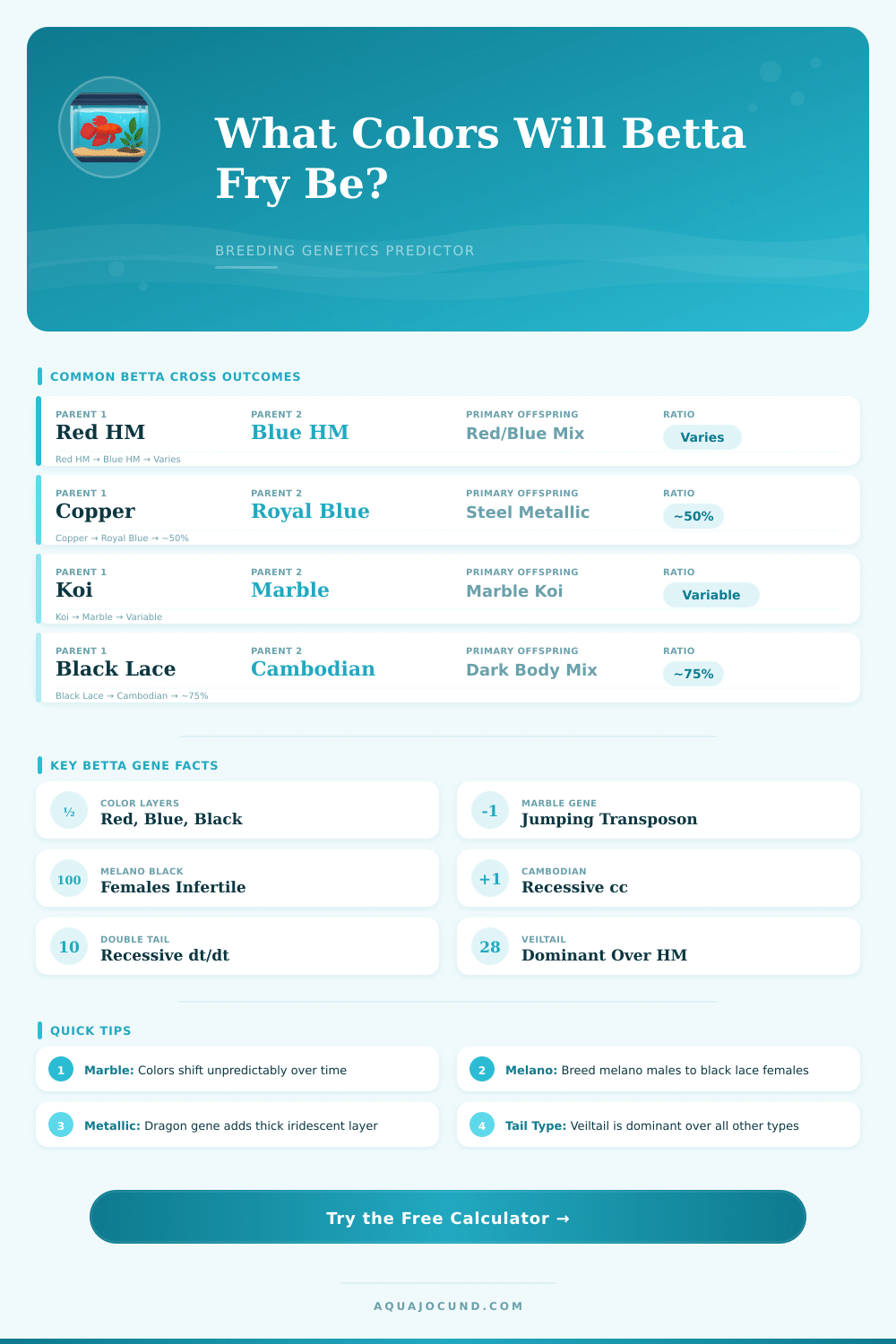
| Red × Blue (Royal) | Multi-color (red wash + blue iri) | Red, Royal Blue, Purple mixes | Red and blue on separate layers |
| Steel Blue × Royal Blue | 100% Royal Blue | 25% Steel, 50% Royal, 25% Turq | Classic incomplete dominance ratio |
| Melano × Black Lace | Dark-bodied carriers | ~25% melano males viable | Standard method for breeding melano |
| Cambodian × Wild Type | 100% dark body (Cc carriers) | 25% Cambodian, 75% dark body | Cambodian fully recessive |
| Marble × Solid | ~50% marble, ~50% solid | Variable marble expression | Marble is dominant but unpredictable |
| HM × VT | VT-like (long droopy fins) | ~75% VT type, ~25% HM type | VT masks HM; avoid VT in HM lines |
| DT × Single Tail | 100% single tail (Dt/dt carriers) | 25% DT, 75% single tail | DT carriers have wider dorsal fin |
| Copper × Royal Blue | Metallic blue / steel types | Metallic, blue, iridescent mix | Cu interacts with blue layer |
The Genetics of Betta Fish maybe seem complex when one starts to research it for the first time, but when one divides it in parts, it becomes quite a lot clear. Each betta gets a mix of genes from both parents, and exactly those genes decide everything… From the color and form of the fins to the patterns and marks on the body.
Keeping simple the idea of how dominant and recessive traits act, one truly grasps the essence of why Betta Fish ultimately look so differently from each other.
How Betta Fish Genes Decide Color, Fins and Health
When dealing with dominant traits, Betta Fish can have red, opal, turquoise, steel blue, royal, butterfly, marble, veiltail and crowntail patterns. I only mention the common ones. To show such a trait, one copy of the dominant gene is enough, and it shows.
But with recessive traits the case is entirely different. Betta Fish show a recessive trait only if they carry two copies of that gene. For instance, long fins are dominant, while short are recessive.
The double tail works rather uniquely; itself is the recessive in that pair.
When Betta Fish inherit two copies of the gene for double tail, the result is a fish with double tail. But here the interesting parts: a male with only one copy of that gene can have broader dorsal fins then usually. Such a feature sometimes points to secret genes in the fish.
Also the veiltail gene is dominant, so crossing of a veiltail with other fin types commonly gives veiltail children.
The Genetics of colors fall quickly into confusion. The black layer involves at least three common color genes: cambodian, blond and melano, all act as recessives. The blue and red colors bind to separate genes.
One gene forces more blue in the body, while it blocks red undertone; another controls the strength of the red shade. Worth noting is that Betta Fish do not get born in their deepest color. They start more pale and slowly deepen, as their color genes work over time.
The koi pattern comes from something called transposons, basically, genetic material that jumps around in the DNA. Such movement can damage important systems, like the immune system, which commonly makes koi Betta Fish weak against diseases. Metallic Betta Fish have their own problems, especially diamond eye, where scales cover the eyes and tumors appear more commonly.
Types with heavy fins, like dumbo, halfmoon, crowntail and rosetail, commonly struggle with swimming, because the extra weight of the fins drags them down.
Wild type Betta Fish tend to be the healthiest. Betta splendens originally came from central Thailand and regions around the lower Mekong. Before, folks bred them for fighting, similar to rooster fights, not for beauty.
Centuries of selection for bigger fins and more vivid colors changed the strains deeply. The common problem? Most breeders do not bring in fresh lines, so inbreeding happens constantly.
That weakens the overall health of the fish, just like with any species. Short-finned plakat Betta Fish commonly show stronger build, maybe because of absence of thatextra fin mass. About health, the Genetics of responsible breeding matter more than any tail form that the fish will have.