PPS-Pro Dosing Calculator
Estimate daily macro and micro doses for PPS-Pro, then check weekly nutrient targets, bottle life, and TDS headroom. The calculator blends tank volume, plant mass, CO2, fish load, and maintenance style.
Pick a preset to load a common planted aquarium layout. Each preset sets the tank shape, volume, fertilizer profile, plant density, CO2 style, fish load, water change, bottle size, and TDS targets.
Formula note: PPS-Pro targets are lean by design. This page uses the profile base dose, then nudges it for plant mass, CO2, fish load, and maintenance so the estimate stays practical.
PPS-Pro Output
Daily doses are calculated from actual water volume, then adjusted for profile, planting, CO2, fish load, and maintenance settings.
| Profile | Macros mL/10g | Micros mL/10g | Weekly ppm |
|---|---|---|---|
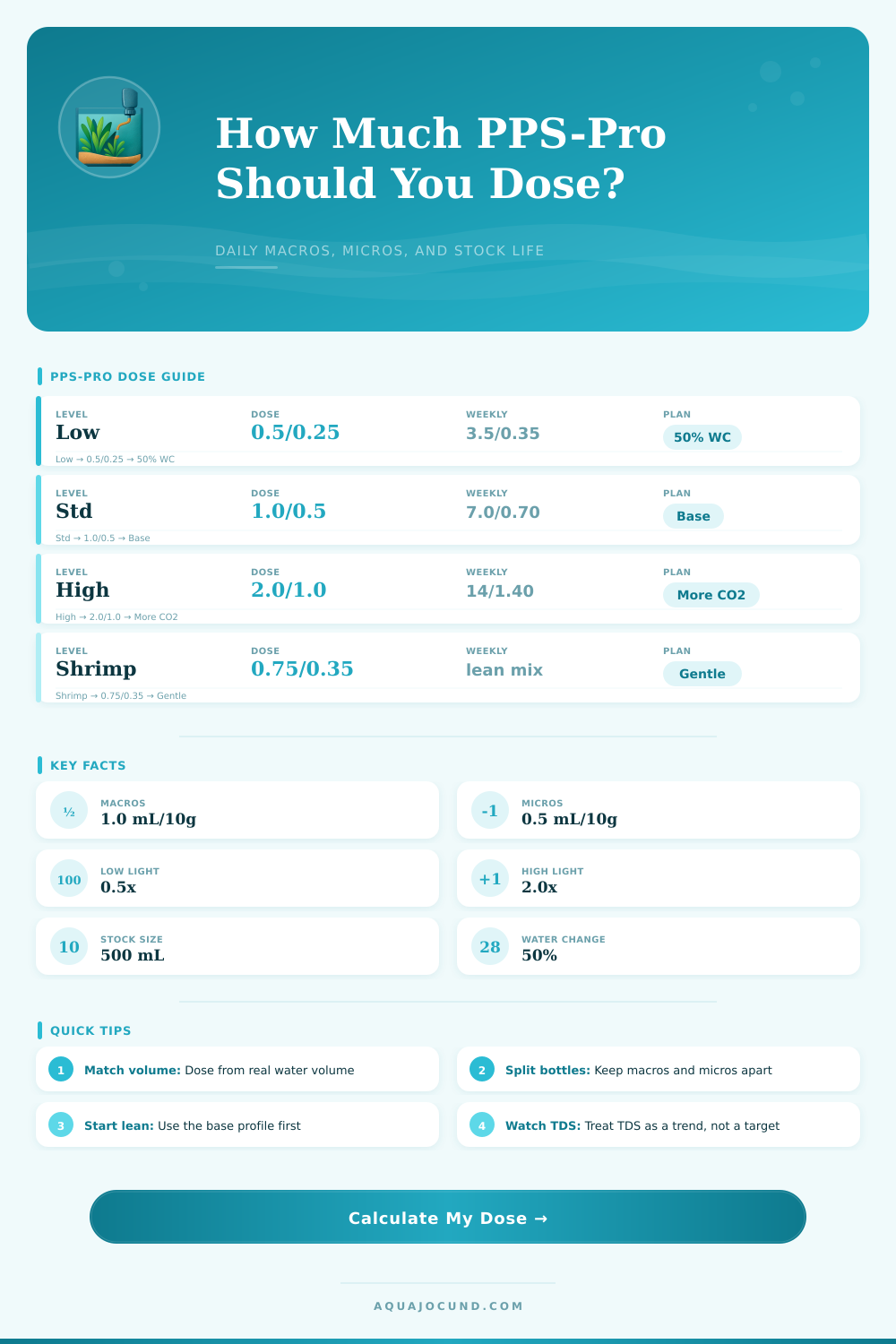
| Low-light PPS-Pro | 0.5 | 0.25 | 3.5 N, 0.35 TE |
| Standard PPS-Pro | 1.0 | 0.5 | 7.0 N, 0.35 TE |
| High-light PPS-Pro | 2.0 | 1.0 | 14 N, 0.70 TE |
| Custom blend | user factor | user factor | scaled target |
| Stock item | Standard recipe | Alt recipe | Role |
|---|---|---|---|
| Macros bottle | 33 KNO3, 29 K2SO4, 3 KH2PO4, 20 MgSO4 | 31, 28, 2.7, 19 | Main NPK mix |
| Micros bottle | 29 g trace mix | 14.5 g trace mix | Iron and traces |
| Fill water | To 500 mL | To 500 mL | Dissolve fully |
| Dose point | 1 mL/10 gal | 0.5 mL/10 gal | Daily target |
| Tank | Actual volume | Macro/day | Micro/day |
|---|---|---|---|
| 5 gal nano | 5 gal | 0.5 mL | 0.25 mL |
| 10 gal betta | 10 gal | 1.0 mL | 0.5 mL |
| 20 long | 20 gal | 2.0 mL | 1.0 mL |
| 40 breeder | 40 gal | 4.0 mL | 2.0 mL |
| 75 gal | 75 gal | 7.5 mL | 3.75 mL |
| 125 gal | 125 gal | 12.5 mL | 6.25 mL |
| Condition | What it means | What to do | Why it matters |
|---|---|---|---|
| Below target | Room for nutrients | Keep schedule | Stable dosing zone |
| Near target | Normal PPS-Pro range | Maintain profile | Least guesswork |
| Above target | Minerals stacking up | Trim dose or change water | Helps avoid buildup |
| Cloudy start | Mixing issue likely | Separate bottles | Precipitation risk |
PPS-Pro
- Lean daily dosing
- Best for planted tanks
- Minimal testing needs
EI
- Higher nutrient surplus
- Uses regular resets
- Best for fast growth
Lean daily
- Lower nutrient demand
- Good for low-tech tanks
- Simple to maintain
All-in-one
- Easy one-bottle routine
- Less precise control
- Convenient for beginners
The PPS-Pro method is an type of aquarium fertilization that use dosing to provide nutrients to the plants in the tank. The PPS-Pro method uses small dose each day rather than large doses provided once a week. This method provides stability to the planted tank by providing nutrients to meet the demand of the plant.
Large weekly doses of fertilizers floods the tank with nitrogen and potassium. However, the PPS-Pro method add nutrients to maintain a lean profile of seven parts per million of nitrogen over the course of the week. Using a lean profile prevent algae from growing on the plants while allowing the plants to grow good without drastic fluctuations in nutrient supply.
PPS-Pro Method for Aquarium Plants
The gentle dosing required by the PPS-Pro method is beneficial to the fish and invertebrates in the tank as it does not stress them from excess nutrients. To use the PPS-Pro method effectively, a person must calculate the water volume of the tank. A tanks listed size often do not provide the correct measurement of the water volume due to the volume that the substrate and decorations in the tank take up.
To calculate the water volume, one should fill the tank to 90% of its marked tank capacity and take into account the volume that the decoration in the tank take up. One can calculate how much nutrient dosing is required by determining the density of the plants in the tank. The fewer the plants, the less nutrient dosing that the tank will requires.
The amount of carbon dioxide that is used in the tank will dictate the nutrient dosing requirements. If carbon dioxide are not used, there will be less nutrient dosing for the plants as they require more nutrients when exposed to carbon dioxide. Additionally, the number of fish in the tank will also impact the nutrient dosing requirement of the aquarium.
Tanks with a heavy load of fish require less dosing as the fish produce waste that act as fertilizer for the tanks plants. Water changes also have an impact on nutrient dosing. Tanks that undergo water changes more often will require less nutrient dosing than tanks with less frequent water changes.
The Total Dissolved Solids (TDS) of the tanks water is another measurement that can have an impact on nutrient dosing. When first establishing the tank with the PPS-Pro method, a TDS of 180 parts per million should be established using tap or reverse osmosis water. However, the TDS should be kept at 260 parts per million or less to ensure that the high level of dissolved solids in the water does not stress the livestock in the tank.
Additionally, the length of time that a bottle of PPS-Pro will last in the tank will depend upon the size of the tank. A 500-milliliter bottle of PPS-Pro will last many months in a nano tank but will only last a few weeks in a large tank. Additionally, an individual can add a five percent safety margin to the dosing measurement to allow for any error in the measurement of the dose.
The PPS-Pro method uses different dosing profiles based off the type of tank and the species that lives within the aquarium. The standard profile requires one milliliter of macros per ten gallons of water in the tank and half of this amount of micro nutrient. A low-light profile requires half the dose of the standard dosage, and a shrimp-safe profile requires an even lower dose than the low-light profile.
A high-light profile requires the dosing amount to be doubled as opposed to the standard dosage. Additionally, an individual can create custom nutrient blends in case they have specific needs for there aquarium, such as copper-free nutrients. Each profile aim to achieve a certain amount of each nutrient in the tank each week, with nitrogen as the primary nutrient and the trace elements including in the dosage.
There are some mistakes that people will make when attempting to implement the PPS-Pro method. One mistake is adding both the macro and micro nutrients to the same bottle. This can cause the iron to crash out of the water.
The macro and micro nutrients should be kept in separate bottles. Additionally, these nutrients should be dosed daily. If too many nutrients are initially added to the tank, the new plants will be burned out.
Rather, lean profiles should be used when first establishing a planted tank. If the plants in the tank begin to melt, this may mean that there is a nutrient imbalance in the water, specifically in the levels of potassium. Plants often communicate their needs for nutrients through their growth pattern.
These growth patterns are more indicative of nutrient needs than the test kit that are added to the water. Other than the plants in the tank, the fish and shrimp can also impact how the PPS-Pro method is utilized in the tank. For example, a single betta fish in a ten gallon tank will require sparse dosing.
However, a forty gallon tank with many fish will require a medium load of nutrients. The fish will produce waste that acts as fertilizer. Additionally, shrimp tanks will require the gentlest dosing possible for the shrimp gills will be stressed out by high levels of trace elements.
The daily dosing required by the PPS-Pro method can become a ritual within the tank care routine. The PPS-Pro method focus on providing nutrients to the plants in the tank in a way that provides stability to the tank and allows for the even development of the plant.