🌿 Estimative Index Dosing Calculator
Size KNO3, KH2PO4, and K2SO4 doses for planted tanks with EI, EI Light, Lean EI, and custom targets
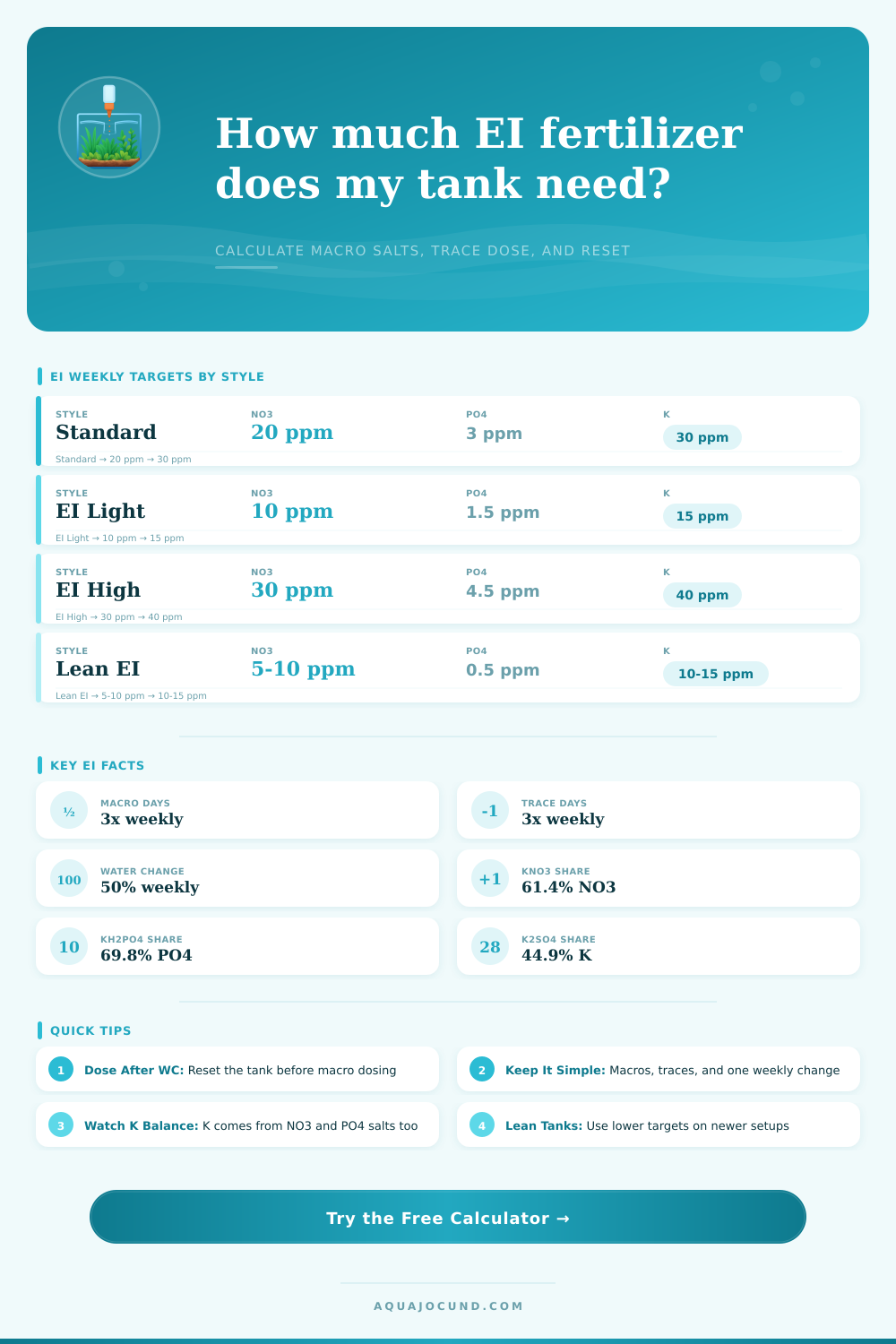
| Style | NO3 | PO4 | K |
|---|---|---|---|
| Standard EI | 20 ppm | 3 ppm | 30 ppm |
| EI Light | 10 ppm | 1.5 ppm | 15 ppm |
| High Light EI | 30 ppm | 4.5 ppm | 40 ppm |
| Lean EI | 5-10 ppm | 0.5 ppm | 10-15 ppm |
| Tank | Size | Macro Dose | Trace Dose |
|---|---|---|---|
| 5 Gal Nano | 18 x 9 x 10 | 0.9 g KNO3 | 0.2 tsp |
| 10 Gal Betta | 20 x 10 x 12 | 1.8 g KNO3 | 0.3 tsp |
| 20 Long | 30 x 12 x 12 | 3.7 g KNO3 | 0.5 tsp |
| 29 Gallon | 30 x 12 x 18 | 5.4 g KNO3 | 0.7 tsp |
| 40 Breeder | 36 x 18 x 16 | 7.4 g KNO3 | 0.9 tsp |
| 55 Gallon | 48 x 13 x 21 | 10.3 g KNO3 | 1.2 tsp |
| 75 Gallon | 48 x 18 x 21 | 14.2 g KNO3 | 1.5 tsp |
| 125 Gallon | 72 x 18 x 21 | 23.8 g KNO3 | 2.4 tsp |
| Salt | Formula | Main Nutrients | Mass Share |
|---|---|---|---|
| KNO3 | Potassium nitrate | NO3 + K | 61.4% NO3 |
| KH2PO4 | Mono potassium phosphate | PO4 + K | 69.8% PO4 |
| K2SO4 | Potassium sulfate | K + S | 44.9% K |
| Trace Mix | CSM+B or liquid | Micros + Fe | Source based |
| Day | Action | Macros | Notes |
|---|---|---|---|
| Monday | Macro dose | KNO3 + KH2PO4 + K2SO4 | After lights on |
| Tuesday | Trace dose | Trace mix only | Midday works well |
| Wednesday | Macro dose | KNO3 + KH2PO4 + K2SO4 | Keep routine steady |
| Thursday | Trace dose | Trace mix only | Watch plant tips |
| Friday | Macro dose | KNO3 + KH2PO4 + K2SO4 | Last macro day |
| Saturday | Optional trace | Trace mix or rest | Use if tank is hungry |
| Sunday | Water change | 50% reset | Restart EI cycle |
Estimative Index dosing are a method for fertilizing aquarium plants. Estimative Index dosing is a method that provides an abundance of nutrient to the aquarium plants to ensure that the plants is not limited by the availability of nutrients. Rather than being a method that relies on pinpoint precision in relation to the nutrient requirements of the aquarium’s plants, Estimative Index dosing is actualy a method that provides more nutrients then the aquarium plants require, and then removes the excess nutrients through regular water change.
Estimative Index dosing is used to provide the plants with three macronutrients (nitrogen, phosphorus, and potassium) that they require in order to perform normal growth processes, and regular water changes are used to ensure that the aquarium water does not become too highly in those nutrients. Aquarium plants requires specific nutrients in order to perform the processes necessary to grow. The nutrients that aquarium plants require include nitrogen, which the plants use to produce leaf; phosphorus, which the plants use to perform energy transfer within the plant; and potassium, which the plants use to maintain their health.
Using the Estimative Index for Aquarium Plants
These nutrients typically naturally enters the water from the rainfall and the soil in the aquarium in inconsistent amounts. For these reasons, Estimative Index dosing is utilized to provide the aquarium plants with abundant amounts of these nutrients. Aquarium keepers typically dose the macronutrients three times a week, dose the trace elements on alternate day, and perform a large water change every Sunday night.
Additionally, daily water testing is not necessary for Estimative Index dosing, as the weekly water change will remove any excess nutrients from the water. The volume of the aquarium must be considered in the calculation of the amount of nutrients that should be dosed into the aquarium using Estimative Index dosing. The volume of the aquarium is the most important factor in determining how much of each nutrient should be dosed into the tank.
To calculate the volume of the aquarium, the keeper must take into account the shape of the aquarium. For instance, a rectangular aquarium can be easily calculated to determine the total volume of the tank, but a bow front aquarium will have a curved front section of the aquarium that increases the volume of the aquarium by ten to fifteen percent. Furthermore, assuming that the water will occupy only ninety percent of the total tank volume can account for the volume of the aquarium that is occupied by the substrate, the aquarium equipment, and the rock.
Finally, once the keeper has calculated the volume of the aquarium, the volume can be used to calculate how much of each nutrient should be dosed into the aquarium. There are several different styles of Estimative Index dosing that can be utilized, each based off the amount of light that falls upon the aquarium and the amount of carbon dioxide that is present in the water within the aquarium. The standard style of Estimative Index dosing provides twenty parts per million of nitrate, three parts per million of phosphorus, and thirty parts per million of potassium into the aquarium each week.
This dosing schedule is best used for aquariums that receive a moderate amount of light and that have steady level of carbon dioxide in the water. For aquariums that receive low levels of light, the light style of Estimative Index dosing can be used. In contrast, high dosing levels is used in aquariums with high levels of light (such as those with high-intensity LED lights).
Finally, a lean style of Estimative Index dosing is used in new aquariums or in aquariums that contain shrimp, since the lean style to Estimative Index dosing maintains the nutrient levels in the aquarium to avoid the growth of algae. Potassium is contained within several types of fertilizers. For this reason, the aquarium keeper must take care to not overdose the aquarium in relation to the amount of potassium that is provided to the water.
For instance, potassium is found in potassium nitrate, monopotassium phosphate, and potassium sulfate. Because the three fertilizers contain potassium, it is easy for the potassium levels in the aquarium to increase rapid if the aquarium is dosed with these three types of fertilizers. In addition to dosing the aquarium with potassium and the other macronutrients, the aquarium water should also be dosed with trace elements, such as iron and other micronutrients that the aquarium plants require to grow.
While dry blends of trace elements can be used in large aquariums, liquid trace elements are used in small aquarium. Water changes are performed each week for Estimative Index dosing. The reason for the performance of water changes is to rinse out the aquarium of any excess nutrients that may otherwise accumulate within the water.
If the water changes are not performed each week, the nutrient levels will become too high in the aquarium, which can lead to the growth of algae. During a standard dose of Estimative Index dosing, fifty percent of the water in the aquarium should be changed. However, if the lean style of Estimative Index dosing is being used, only thirty percent of the tank water should be changed each week.
The frequency and the amount of water change that is performed each week may depend upon the light levels in the aquarium, the levels of carbon dioxide in the water, and the density of the plants growing within the aquarium. It is likely that an individual will make some mistake when first using Estimative Index dosing. For instance, an individual may start with dosing levels that are too high for the number of plants within the aquarium.
For instance, using high dosing levels in an aquarium that receives high levels of light but contains little plant mass will result in the growth of algae before the aquarium plants are able to consume all of the nutrients that are dosed into the water. Additionally, individuals may often forget to dose the water with trace elements. The trace elements are required for the aquarium plants to grow, but if they are not dosed into the water along with the macronutrients, the leaves of the aquarium plants will become pale.
Macronutrients should be dosed after the lights are turned on in the aquarium, but trace elements should be dosed during the middle of the day. For Estimative Index dosing to be effective, there are several things that should be monitored within the aquarium. For instance, one way of monitoring the effectiveness of Estimative Index dosing is to inspect the tips of the leaves of the aquarium plants.
If the tips of the leaves are growing, it is an indication that there are sufficient nutrients in the water; if the tips of the leaves are yellow, there may not be enough nutrient. Additionally, if the leaves of the aquarium plants are pearly (excreting oxygen in the form of bubbles), the nutrient and carbon dioxide levels are sufficient. However, if the tips of the plants is experiencing stunted growth, more macronutrients should be dosed into the water.
Other factors to consider when using Estimative Index dosing include the chemistry of the water that is used to fill the aquarium. For instance, areas with hard water contain high levels of calcium and magnesium ions; soft water contains low levels of these elements. Soft water may require more potassium to fulfill the nutrient requirements of the aquarium plants.
Finally, some animals, such as shrimp, should be considered in the decision to use Estimative Index dosing; shrimp require very stable levels of water chemistry, and should not experience large changes in the chemistry of their water.