💧 Gallons to Liters Converter
Switch between US, imperial, and dry gallon standards with precise batch math, rounding control, and quick presets for common jobs.
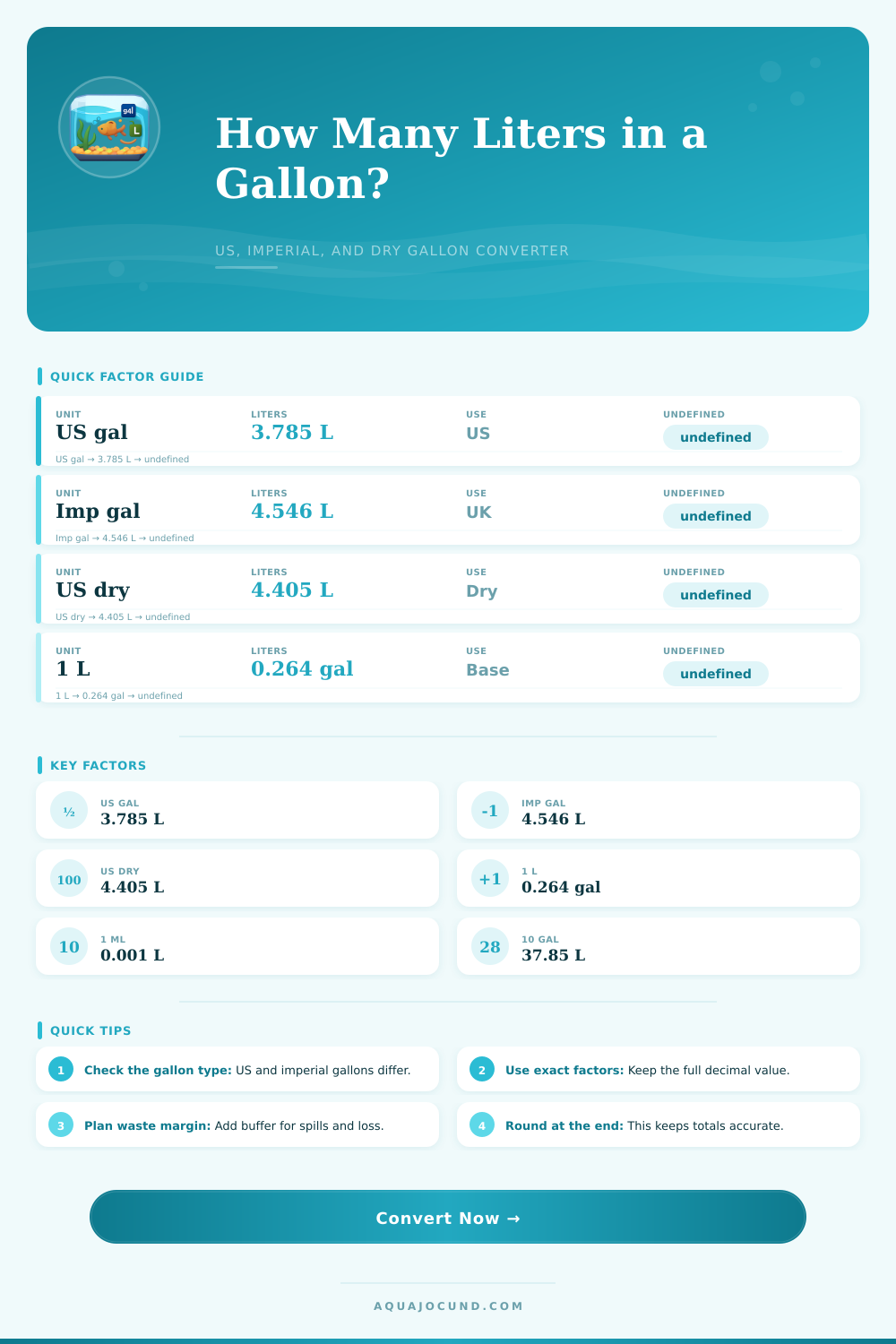
| Standard | Exact Liters | Reverse | Typical Use |
|---|---|---|---|
| US liquid gallon | 3.785411784 | 0.264172 US gal | Water, fuel |
| Imperial gallon | 4.54609 | 0.219969 Imp gal | UK labels |
| US dry gallon | 4.404883771 | 0.227022 dry gal | Dry measure |
| Liter | 1 | 1 L | Metric base |
| Milliliter | 0.001 | 1000 mL | Small doses |
| Container | Liters | Gallons | Good For |
|---|---|---|---|
| 1 L bottle | 1 | 0.26 | Samples |
| 5 L jug | 5 | 1.32 | Small jobs |
| 10 L pail | 10 | 2.64 | Mixing |
| 20 L carboy | 20 | 5.28 | Batches |
| 55 L drum | 55 | 14.53 | Drums |
| 100 L tank | 100 | 26.42 | Storage |
| 200 L barrel | 200 | 52.83 | Bulk |
| 1000 L tote | 1000 | 264.17 | Large lots |
| Gallons | Liters | mL | Fast Hint |
|---|---|---|---|
| 0.5 | 1.89 | 1,893 | Half gallon |
| 1 | 3.79 | 3,785 | Milk jug |
| 2 | 7.57 | 7,571 | Small batch |
| 5 | 18.93 | 18,927 | Bucket size |
| 10 | 37.85 | 37,854 | Can size |
| 20 | 75.71 | 75,708 | Water run |
| 55 | 208.2 | 208,098 | Drum |
| 100 | 378.54 | 378,541 | Bulk tank |
| Decimals | Best For | What You See | Risk |
|---|---|---|---|
| 0 | Estimates | Whole liters | Lowest detail |
| 1 | Fast checks | Tenths | Small drift |
| 2 | Labels | Hundredths | Balanced |
| 3 | Shop math | Thousandths | Very accurate |
| 4 | Formula work | Fine detail | Best for exactness |
- US liquid gallon: Most North American drink, water, and fuel labels use this standard.
- Imperial gallon: Common in the UK and some older Commonwealth references.
- US dry gallon: Only for dry goods and commodity math, not liquid filling.
- Label clue: If the source says gallons without context, verify the region first.
- Batch count: Multiply the source amount before you apply the target conversion.
- Waste allowance: Add a small buffer for spills, transfer loss, and residue.
- Fill efficiency: Use less than 100 percent when a container cannot be filled fully.
- Round last: Keep the full decimal factor until the final display step.
In order to perform the conversion from gallons to liters, a person must be precisely in there calculations. The units of gallons and liters is different from one another, and should the wrong factor be used to perform the calculation of how many liter are in a gallon, the result will be incorrect. There are, for example, different types of gallon.
The US liquid gallon, for instance, contain 3.785 liters, but the imperial gallon contains 4.546 liters. Thus, another consideration for the conversion of gallons to liters is the type of gallons that are to be converted, if you use the number of liters in a US gallon to calculate liters in an imperial gallon, the resulting volume will be incorrect. Another common error that occur when performing this type of calculation is rounding the number of liters in a gallon too soon in the calculation.
How to Convert Gallons to Liters Correctly
For instance, rounding the number of liters in a gallon to 3.8 liters will lead to errors accumulate with each additional gallon that is to be measured. Therefore, it is best to leave all decimal place in the calculation until the final step in the equation, at which time you can round the result to make it more easy readable or understood. Additionally, the volume of the liquid can change with changes in teh temperature of the environment; liquids expand with rising temperatures and contract with decreasing temperatures.
Thus, another factor to consider is the temperature of the environment in which the liquid is to remains. In many industrial jobs, it is common for many individuals to have to perform conversions from gallons to liters. These conversions are often for large volumes of liquid, and often within drums or tank.
For example, 55 gallon of liquid is approximately 208 liters. If you dont order the correct number of liters for the liquid that needs to be used for a job, either too much or too little liquid will be recieved for that task. Thus, it is important to use precise tool to calculate how many liters of liquid are needed for a task.
These tools account for waste in the liquid by incorporating waste buffers into the calculation. These waste buffers allow for the individual to have enough liquid to complete the task, even if some of that liquid is lost during the process. These concepts can be applied to common tasks, as well.
For example, a gardener may need to convert the number of liters in a five gallon jug of fertilizer to liters to use a sprayer that dispense liquid in liters; five gallons is approximately 18.9 liters. Additionally, a person that performs beer recipes, for instance, may have a conflict between imperial gallon and US liquid gallons. Using the incorrect factor for gallons will ruin the recipe.
Thus, in these tasks, it is necessary to read the labels on the containers to determine if the gallons are US or imperial gallons. Finally, another technique for ensuring the accuracy of the conversions of gallons to liters is to perform a reverse check on the math. Performing a reverse check involve converting the result of the gallons-to-liters calculation back into gallons; if the resulting number of gallons matches the original number of gallons that was used in the initial calculation, then the individual performed the gallons-to-liters calculation correctly.
Thus, by using these techniques to ensure the accuracy of the gallon-to-liter calculations, an individual will have confidence in the accuracy of those conversions. Accuracy in these conversions will prevent waste and errors in the application of those units of measurement.