
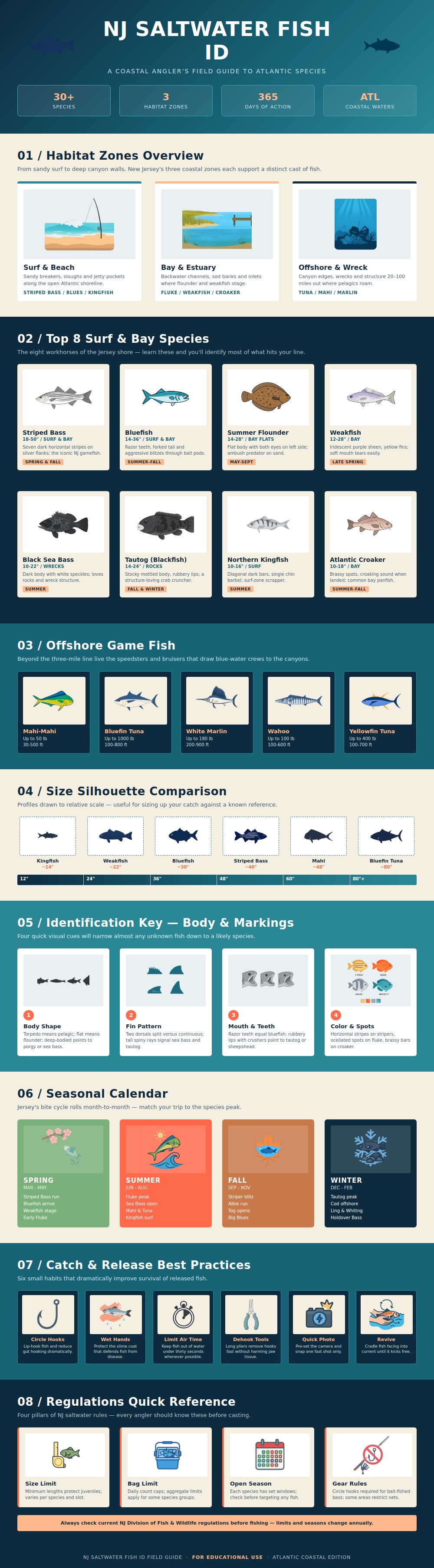
To be able to identify the fish in the New Jersey Atlantic coastal waters, you will have to learn about the specific habitat, specific fish species, and the physical characteristic of the fish. In order to understand which fish species lives in the water, you must understand the different habitat of the New Jersey coast. There are three primary habitat types along the coast: surf beaches, bay estuaries, and offshore canyons.
Surf beaches are areas where the waves crashes against the shore. These habitat is where striped bass and bluefish live. Bay estuaries are areas of calmer water where summer flounder and croaker are found.
How to Identify Fish in New Jersey Coastal Waters
Offshore canyons are deep area of water that are located further than the shore. These areas are where tuna and mahi-mahi lives. In order to identify the fish species in these habitat, it is necessary for you to learn how to recognize the most common fish species in New Jersey’s coastal waters.
Striped bass live in the spring and fall season, and have seven dark stripe on their silver sides. Bluefish live in the summer month and have forked tail and sharp teeth. Summer flounder are a flat species, with the eyes on one side of their body.
Summer flounder live in the bay flat. Weakfish have a purple iridescence on their bodies, and have fragile mouth. Black sea bass live near shipwreck, and tautog live near rocks, as they have strong lip that they use to eat crabs.
Kingfish have diagonal bar on their bodies, and croaker fish have spot on their bodies. Because the fish species that live in the offshore canyon are generally much larger than the fish that live in the nearshore area, such as the surf beaches and bays, different method may be used to identify these fish species. For instance, mahi-mahi species have blunt forehead, while bluefin tuna swim at high speed through the water.
White marlin have pointed bill, and wahoo fish have tiger like stripes on their bodies. Yellowfin tuna have distinctive fin on their bodies, and are often found in deep water area. You can identify these fish by their silhouette, as well as by the comparison of their bodies to a known size.
If you encounter an unfamiliar fish species in these water, there are four physical cue that can help you to identify that fish. The first of these cue is the body shape of the fish. Different body shape indicate the type of movement that the fish make through the water.
For instance, torpedo shaped fish are used for fast movement, while flat body shape indicate the fish for which lives on the bottom of the water. The second cue is the fins of the fish, which can indicate the habitat of that fish species. The third physical cue to consider is the fish’s mouth, which can indicate the type of food that the fish eat.
The fourth cue to consider is the color and pattern of the fish’s body, which allow for the separation of fish species that might otherwise appear to be similar to one another. Another factor to consider in identifying the fish species of New Jersey’s Atlantic coastal waters is the factor of the season. Fish species that live during specific season can increase your likelihood of finding and catching that type of fish during those time of the year.
For instance, striped bass and weakfish live during the spring season, while summer flounder and black sea bass live during the summer. Striped bass and bluefish live in the fall, and tautog live during the winter month. Finally, it is important to follow the fishing regulation that are in place for New Jersey’s coastal waters.
Size limit help to ensure that fishers dont all remove young fish from the water. Bag limit ensure that fishermen do not catch to much of the fish species in the area. Fishing season help to ensure that fishermen only fish during specific time of the year, and gear regulation help to ensure that fishermen are using appropriate fishing gear for the area.
These regulation are updated each year, so fishermen should of be sure to check the update to the New Jersey state fish and wildlife each year. If you are planning to keep any of the fish that you catch, it is important to ensure that you handle the fish properly. If you plan to release the fish back into it’s habitat, you should use circle hook when catching the fish.
This prevent injury to the fish. Use wet hand to touch the fish, as this will protect the slime coat of the fish. Remove the hook with pliers, but ensure the fish is removed from the water for less than thirty seconds.
Place the fish back into the water in a moving current to help revive the fish, and make sure the fish is swimming strong before its release.
