🌊 Aquarium Turnover Rate Calculator
Calculate ideal pump flow rate and water turnover cycles for any aquarium setup
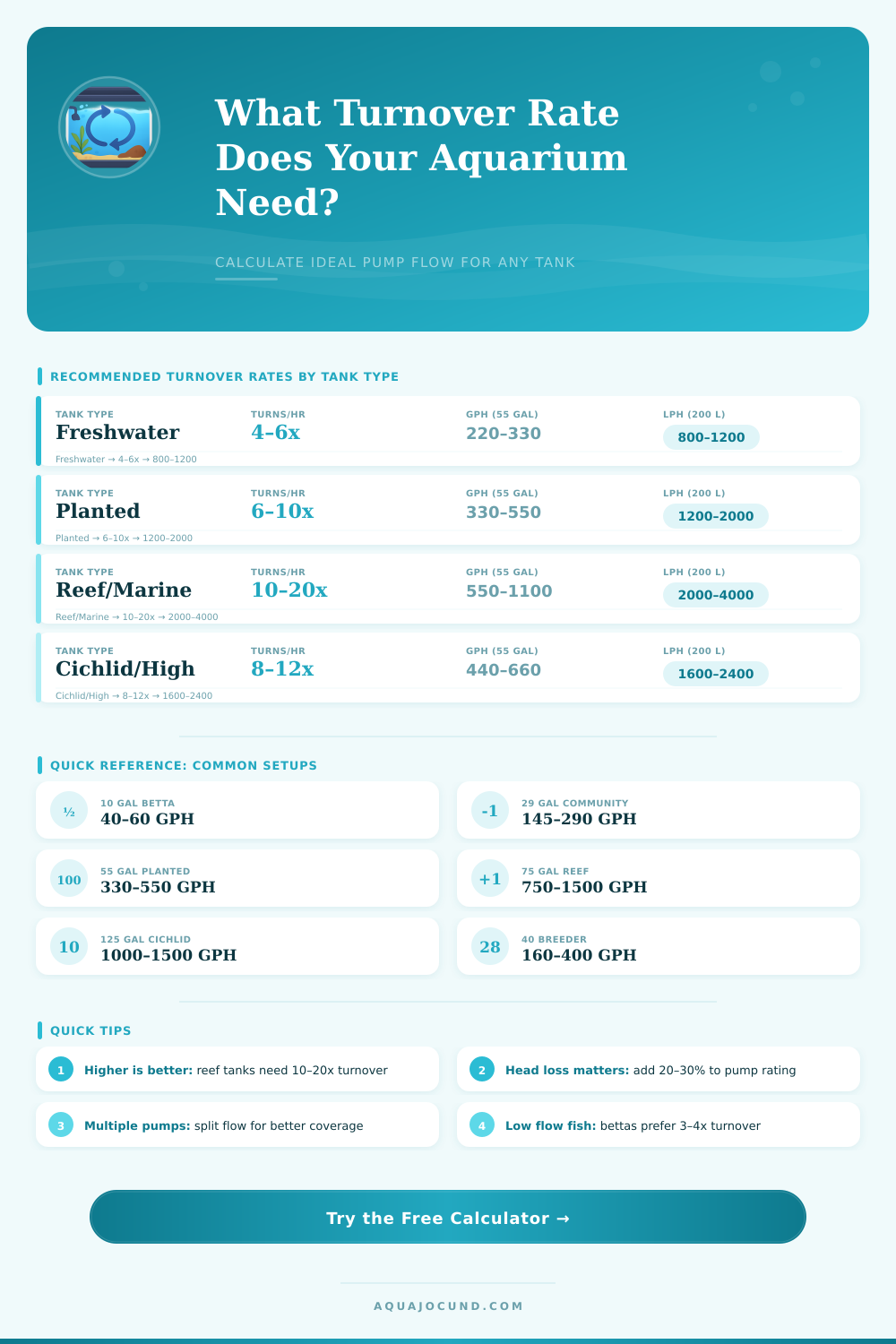
| Tank Type | Turnover/Hr | Min GPH (55 gal) | Max GPH (55 gal) |
|---|---|---|---|
| Freshwater Community | 4–6x | 220 | 330 |
| Planted Tank | 6–10x | 330 | 550 |
| Reef / Marine | 10–20x | 550 | 1,100 |
| Cichlid / High Bioload | 8–12x | 440 | 660 |
| Shrimp / Low Flow | 3–5x | 165 | 275 |
| Goldfish | 6–8x | 330 | 440 |
| Discus | 5–8x | 275 | 440 |
| Axolotl / Sensitive | 2–4x | 110 | 220 |
| Tank Name | Dimensions (in) | Gallons | Liters |
|---|---|---|---|
| 5 gal Mini | 16 × 8 × 10 | 5 | 19 |
| 10 gal Standard | 20 × 10 × 12 | 10 | 38 |
| 20 Long | 30 × 12 × 12 | 20 | 76 |
| 29 gal Standard | 30 × 12 × 18 | 29 | 110 |
| 40 Breeder | 36 × 18 × 16 | 40 | 151 |
| 55 gal Standard | 48 × 13 × 20 | 55 | 208 |
| 75 gal Standard | 48 × 18 × 20 | 75 | 284 |
| 125 gal Standard | 72 × 18 × 22 | 125 | 473 |
| Filter Type | Typical GPH | Best For | Turnover Notes |
|---|---|---|---|
| Sponge Filter | 20–80 | Shrimp, Fry | Low flow, gentle |
| HOB (Hang-On-Back) | 100–400 | Community, Planted | Moderate, surface agitation |
| Canister Filter | 150–600 | Large Freshwater | High capacity, head loss |
| Powerhead / Wavemaker | 200–2000 | Reef, Cichlid | Circulation only, no media |
| Sump System | 300–1500 | Reef, Marine | High volume, flexible |
| Internal Filter | 50–200 | Small Tanks | Compact, limited media |
The turnover rate is a measurement of how many times the total volumes of water in the aquarium passes through the filtration system during one hour. The turnover rate is a critical factor in maintaining the health of the aquarium because the turnover rate control the oxygen levels in the water, removes waste from the tanks, and distribute the nutrients to the aquarium organisms. If the turnover rate is too low, the water in the aquarium can become dirty for the fish, and they may not have enough oxygen to survive.
However, if the turnover rate is too high, the aquarium water may become too violent for certain types of fish. Different types of aquariums requires different turnover rates. For instance, a community freshwater aquarium need a turnover rate of four to six cycles per hour.
How to Set the Right Turnover Rate for Your Aquarium
This rate is enough to remove the debris from the tank without creating too much turbulence in the water. A planted aquarium require a turnover rate of six to ten cycles per hour to adequately deliver the carbon dioxide and nutrient to the plants. A reef aquarium requires a turnover rate of ten to twenty cycles per hour to mimic the ocean current and to prevent the waste from these tanks from settling on the coral.
Cichlid tanks require a turnover rate of eight to twelve cycles per hour because these fish produce a high amount of waste. Aquariums with sensitive animals like shrimp or axolotls requires a turnover rate of only two to five cycles per hour to prevent the animals from getting stressed out from strong water movement in the tank. In addition to the type of tank that is in the tank, the head loss will also impact the turnover rate.
Head loss occur due to the length of the hose for the aquarium water, the number of elbow fittings in the tank, and the number of vertical lift in the tank water. The more head loss in the tank, the more stronger the water pump has to be to overcome the head loss. In some cases, the pump strength will have to be twenty percent more than the initial calculation based off the required turnover rate.
Using multiple smaller water pumps may be more effective than one large water pump in some cases because it can eliminate dead spot in the water. The type of fish in the aquarium will impact the turnover rate for that aquarium. For instance, tanks with goldfish will require a higher turnover rate because goldfish produce a higher amount of waste.
Tanks with betta fish will require a lower turnover rate because these fish prefers low instances of water turbulence. If the aquarium owner ignores the type of livestock in the tank, they may provide an incorrect turnover rate for the aquarium. For instance, if an aquarium is planted with fish but use a low turnover rate for the tank, the plants may yellow over time due to a lack of nutrient in the water.
The turnover rate of the aquarium can be calculate by determining the volume of the aquarium and the multiplier required for the type of tank. Additionally, you has to add extra power to the calculation for head loss. The result of this calculation will be the ideal water pump rating for the aquarium in gallons per hour or liters per minute.
Maintaining the correct turnover rate will allow the aquarium to have the correct levels of oxygenation, temperature stability, and waste removal throughout the aquarium water.