🐠 Angelfish Genetics Calculator
Predict offspring phenotypes and genotypes from Pterophyllum scalare breeding crosses
♀️ Parent 1
♂️ Parent 2
Offspring Genotype & Phenotype Breakdown
| Genotype | Phenotype | Probability | Visual |
|---|
Angelfish Genetics Reference
| Gene Locus | Alleles | Effect | Dominance |
|---|---|---|---|
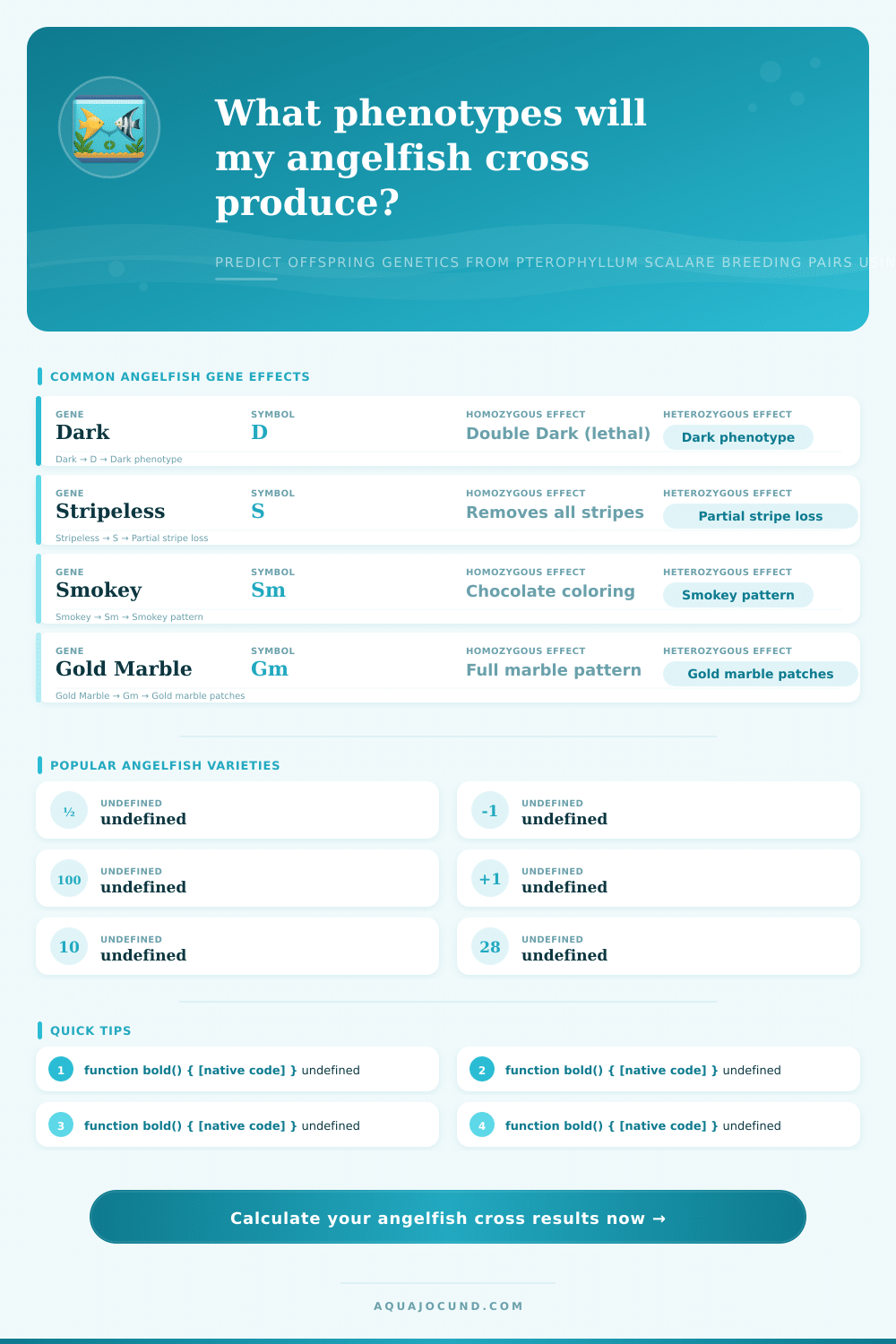
| Dark (D) | +, D | Increases melanin; D/D is Double Dark | Incomplete dominant |
| Stripeless (S) | +, S | S/S removes stripes; S/+ partial | Incomplete dominant |
| Zebra (Z) | +, Z | Z/+ extra stripes; Z/Z more pronounced | Incomplete dominant |
| Smokey (Sm) | +, Sm | Sm/+ Smokey; Sm/Sm Chocolate | Incomplete dominant |
| Gold Marble (Gm) | +, Gm | Gm/+ marble pattern; Gm/Gm extended | Incomplete dominant |
| Pearlscale (p) | +, p | p/p pearlscale texture | Recessive |
| Veil (V) | +, V | V/+ elongated fins; V/V super veil | Incomplete dominant |
| Gold (g) | +, g | g/g removes dark pigment | Recessive |
| Albino (a) | +, a | a/a albino, no melanin | Recessive |
| Phenotype | Genotype | Key Traits | Rarity |
|---|---|---|---|
| Wild Type Silver | All wild (+/+) | Silver body, dark vertical bars | Common |
| Black | D/+ S/S | Dark body, no stripes | Common |
| Double Black | D/D S/S | Very dark, often lethal fry | Rare |
| Koi | g/g Gm/+ | Orange, white, black patches | Popular |
| Gold | g/g | Golden body, no dark pigment | Common |
| Smokey | Sm/+ | Smokey rear half | Common |
| Chocolate | Sm/Sm | Dark chocolate brown | Moderate |
| Platinum | g/g S/S | Platinum white body | Moderate |
| Blue | S/+ Sm/+ | Blue-grey iridescent sheen | Moderate |
| Zebra | Z/+ | Extra vertical bars | Common |
| Ghost | S/+ | Faint stripes, translucent look | Common |
| Blushing | S/S | No stripes, gill blush visible | Common |
| Cross | Expected Offspring | Carrier % | Notes |
|---|---|---|---|
| Silver × Silver | 100% Silver | 0% | Baseline cross |
| Black × Gold | Silver, Ghost, carriers | 100% | All carry D, S, g |
| Koi × Marble | Marble, Koi, Gold Marble, Wild | Varies | Complex multi-locus |
| Smokey × Smokey | 25% Wild, 50% Smokey, 25% Chocolate | 0% | Classic 1:2:1 ratio |
| Ghost × Ghost | 25% Wild, 50% Ghost, 25% Blushing | 0% | Stripeless segregation |
| Albino × Wild carrier | 50% Wild (carrier), 50% Albino | 50% | Test cross pattern |
| Pattern | Description | Example | Ratio |
|---|---|---|---|
| Complete Dominance | One allele fully masks other | Not common in angelfish | 3:1 F2 |
| Incomplete Dominance | Hetero shows intermediate | D/+ Dark vs +/+ Wild | 1:2:1 F2 |
| Recessive | Needs two copies to show | g/g Gold, a/a Albino | 3:1 F2 |
| Lethal Allele | Homozygous can be fatal | D/D Double Dark | 2:1 surviving |
🍪 Dark Locus
D/+ produces Dark phenotype. D/D (Double Dark) significantly reduces fry viability. Cross two Darks and expect 25% loss.
🎨 Stripeless Locus
S/+ Ghost shows faded stripes. S/S Blushing has no stripes with visible gill cover. Interacts with Smokey for Blue.
🌟 Gold Locus
Recessive g/g removes all dark pigment. Combines with Gm for Koi. Combines with S/S for Platinum. Epistatic to Dark.
🔬 Multi-Gene Combos
Angelfish phenotypes arise from gene combinations across independent loci. Probability multiplies across each locus for total offspring ratios.
📚 Breeding Tips
- Always know the genotype of both parents for accurate predictions
- Carrier fish look wild type but carry hidden recessive alleles
- Test crosses against homozygous recessives reveal carrier status
- Keep detailed breeding records for tracking lineage and genotypes
- Raise large spawns to see rare phenotypes from complex crosses
⚠️ Important Warnings
- D/D Double Dark fry have very high mortality rates
- Avoid crossing two D/+ parents if fry loss is unacceptable
- Albino fish are light-sensitive and need subdued lighting
- Pearlscale can be fragile, handle with extra care
- Wild-caught fish may carry unknown recessive alleles
The genetics of angelfish twist in truly wild ways when one goes deep in it. As with all vertebrates, each angelfish have two copies of every gene. They inherit one from the mother and the another from the father.
The number for those fishes is 24 so each egg cell bear 24 chromosomes. In genetics one marks that by means of the letter n.
Angelfish Genes and Breeding
Everything gets complex very soon. One knows thirteen mutations of genes, that spread through nine different places in angelfish. That results in a lot of possible gene types.
Well understanding dominant and recessive genes help a lot during attempt to breed certain traits. If one crosses two different types, the children can appear unique and surprising, because many traits pass down by gene.
The strips on angelfish are codominant. One alone gene Golden do not alter the striping of the fish. Even so one stripeless or Red gene can remove the strips.
In dominant position the Dark gene can cover many patterns. Homozygous Golden with homozygous Blue give Platinum Angel. Also light during the early growth phases play big role.
Angelfish are sensitive to outsides during growth, and light afefcts their patterns most strongly.
Because of selective breeding angelfish became likewise popular as goldfish. There now exist types, that does not appear in natural state. Many of them have several names, but the basic genetic structure shows through their traits and forms.
At this stage almost every angelfish in aquariums are selective bred because of colour, size or pattern. Almost no knead to seize them in wild surroundings now.
Some colours seem more resistant than others thanks to their genetics. Golden, silver and marble fishes usually are very strong. More strange colours commonly pass through heavy crossbreeding and result in less healthy copies.
Freshwater angelfish bred in Asia are chiefly related, and breeders here rare include fresh lines.
Breeding programs usually combine crossings with outside fishes and linear farming. The goal is strengthen good traits during removing harmful recessive ones. The Association of angelfish give genetic calculator to its members, that covers all known genes in domestic freshwater angelfish.
Such calculators allow predicting results of breeding, if one includes the types of parents. Punnett squares are other practical resource for guessing, how the children could appear. The genetics of Koi angelfish also are fine.
The red trait belongs to the Koi gene type, as described inthe general book of the Library of Association of angelfish.