🩸 Reef Tank Salinity Calculator
Calculate exact salt mix amounts for your reef or saltwater aquarium — supports SG, ppt & PSU targets
| Salt Mix | lbs / 50 gal bucket | Target SG Range | Calcium (avg) | Alkalinity (avg) | Best For |
|---|---|---|---|---|---|
| Instant Ocean Standard | ~150 lbs | 1.020–1.026 | 380–400 ppm | 8–9 dKH | FOWLR, Mixed Reef |
| Reef Crystals | ~160 lbs | 1.023–1.026 | 400–430 ppm | 9–10 dKH | Mixed Reef, LPS |
| Red Sea Blue Bucket | ~175 lbs | 1.022–1.026 | 390–420 ppm | 8.3–9.5 dKH | Fish & Reef |
| Red Sea Coral Pro | ~175 lbs | 1.025–1.027 | 430–450 ppm | 11–12 dKH | SPS Dominant |
| Tropic Marin Pro-Reef | ~200 lbs | 1.025–1.026 | 420–440 ppm | 10–11 dKH | SPS / Propagation |
| Fritz RPM Reef Pro | ~160 lbs | 1.025–1.026 | 410–430 ppm | 9–10 dKH | Mixed / SPS Reef |
| Aquaforest Reef Salt | ~176 lbs | 1.025–1.026 | 420–445 ppm | 9.5–10.5 dKH | SPS / LPS Reef |
| Brightwell NeoMarine | ~160 lbs | 1.025–1.026 | 400–420 ppm | 8.5–9.5 dKH | Mixed Reef |
| Tank Name | Dimensions (in) | Volume (gal) | Volume (L) | Salt at SG 1.025 (lbs) | Salt at SG 1.025 (kg) |
|---|---|---|---|---|---|
| Nano Cube 5 Gal | 12x8x8 | 5 | 18.9 | 0.8 lbs | 0.36 kg |
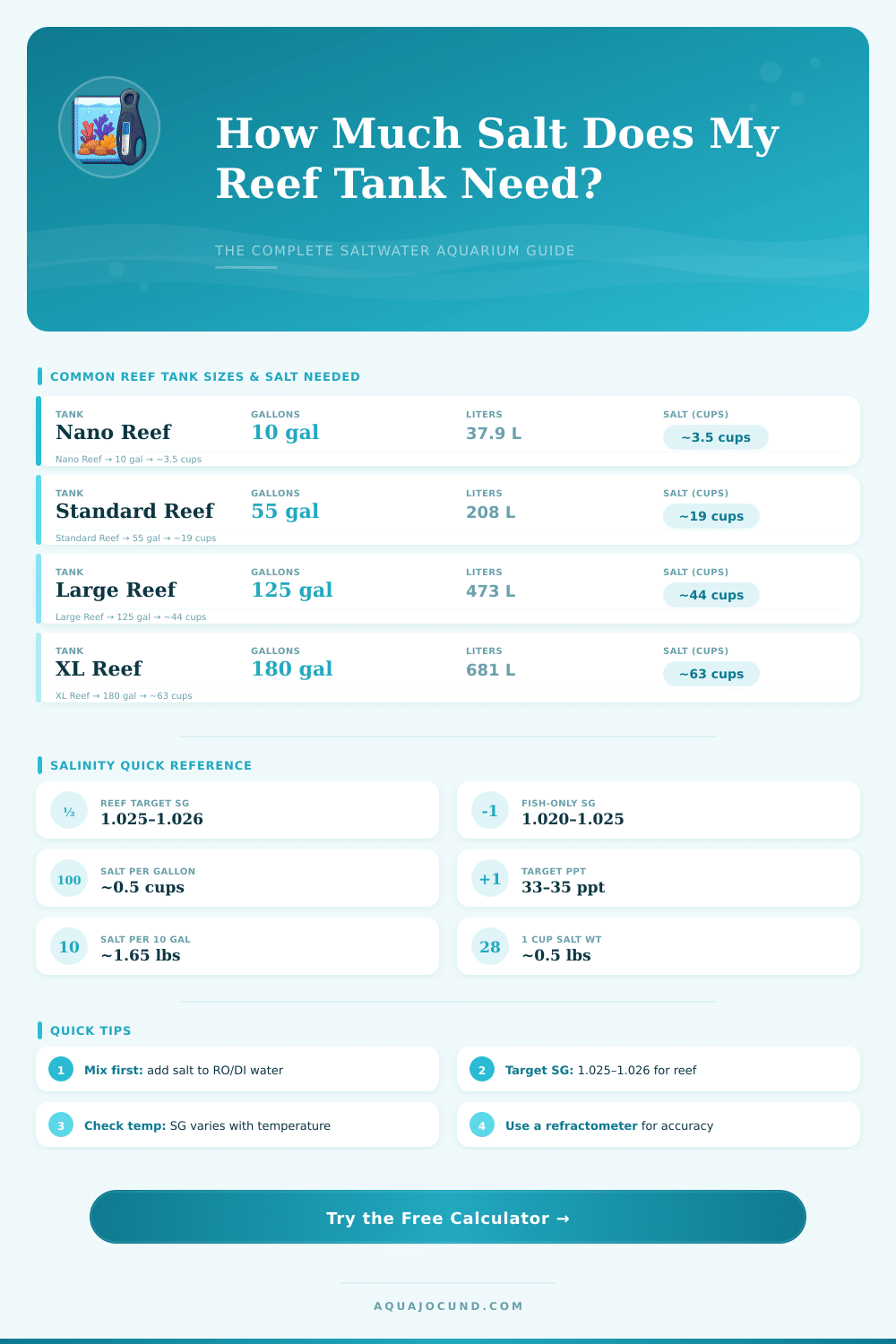
| 10 Gallon Nano | 20x10x12 | 10 | 37.9 | 1.65 lbs | 0.75 kg |
| 20 Gallon Long | 30x12x12 | 20 | 75.7 | 3.3 lbs | 1.5 kg |
| 29 Gallon | 30x12x18 | 29 | 109.8 | 4.8 lbs | 2.18 kg |
| 40 Gallon Breeder | 36x18x16 | 40 | 151.4 | 6.6 lbs | 3.0 kg |
| 55 Gallon | 48x13x21 | 55 | 208.2 | 9.1 lbs | 4.13 kg |
| 75 Gallon | 48x18x21 | 75 | 283.9 | 12.4 lbs | 5.63 kg |
| 90 Gallon | 48x18x24 | 90 | 340.7 | 14.9 lbs | 6.76 kg |
| 125 Gallon | 72x18x22 | 125 | 473.2 | 20.6 lbs | 9.35 kg |
| 180 Gallon | 72x24x28 | 180 | 681.4 | 29.7 lbs | 13.47 kg |
| Specific Gravity (SG) | ppt (g/kg) | PSU | Recommended For | Salt per Gallon (lbs) |
|---|---|---|---|---|
| 1.020 | 27.1 | 27.1 | Fish-Only (low range) | 0.130 lbs |
| 1.021 | 28.5 | 28.5 | Fish-Only | 0.137 lbs |
| 1.022 | 29.8 | 29.8 | FOWLR | 0.143 lbs |
| 1.023 | 31.2 | 31.2 | FOWLR / Mixed | 0.150 lbs |
| 1.024 | 32.5 | 32.5 | Mixed Reef | 0.156 lbs |
| 1.025 | 33.9 | 33.9 | Reef / Natural SW | 0.163 lbs |
| 1.026 | 35.2 | 35.2 | SPS / Natural SW | 0.169 lbs |
| 1.027 | 36.5 | 36.5 | SPS (upper limit) | 0.175 lbs |
The importance of reaching the right salinity in a reef tank truly can not be stressed too much (it is a basic element). The salinity shows how much dissolved salt is in the water, and natural sea water usually has around 35 parts per thousand. It matches around 1.026 specific gravity which is the usual target for many sea setups.
In reef tank systems you want to stay between 33 and 35 parts per thousand for the best result. For specific gravity, that is between 1.024 and 1.026. But there is also a broader tolerated range…
Keep Salt Levels Steady in a Reef Tank
Any values from 1.023 until 1.028 (or 34 until 36 parts per thousand) will work well. Tanks only with fish can go a bit more down, until around 1.020 or 1.021, without seriously stressing the fish. The reason is however: in reef tank setups live corals and invertebrates, that do not tolerate changes lkie this as well as fish.
Invertebrates are more sensitive to salty ranges.
Evaporation is one sneaky problem, that commonly surprises fishkeepers. When the water evaporates from the tank, the salt stays inside. Because of that the salinity gradually rises over time.
Automatic top-off systems help a lot hear, especially in smaller tanks, where changes happen quickly. Small tanks are difficult in that sense; temperature and salinity shift quite a lot quickly.
When you replace the evaporating water, use only fresh water. The salt already is in the tank, so you simply replace what left. During real water changes on the other hand, the new water must have the same salinity as in your tank.
One brand of salt mix suggests around 150 grams of salt per gallon, to reach 35 parts per thousand.
You should raise the salinity gradually. One method is to remove part of the water and replace it with fresh water with a bit more mixed salt. Another way is to add a bit more salt water through the automatic top-off over some days.
If you jump the salinity too quickly, corals and invertebrates will suffer stress. To lower it, remove small amounts and replace with water without salt over 24 hours, which usually works well.
Even if your automatic top-off runs all the time, do not skip regular checks of the salinity. A refractometer is seen as the golden standard for that, it measures the specific gravity at 20 degrees Celsius. Just remember to calibrate it regularly.
One fishkeeper found that: his refractometer showed 1.018, while the real values were 1.020, all because of old calibration. Hydrometers havethe same problem.
Indeed, staying steady matters more than exactly hitting a certain number. The salinity in the ocean changes with weather and depth anyhow. The reefs, from where most creatures come, have around 1.025 until 1.026, so try to keep things as close as possible to that, in which those creatures evolved.