🌊 Kidney Shaped Pond Volume Calculator
Calculate water volume, liner size, and pump flow rate for kidney & irregular shaped ponds
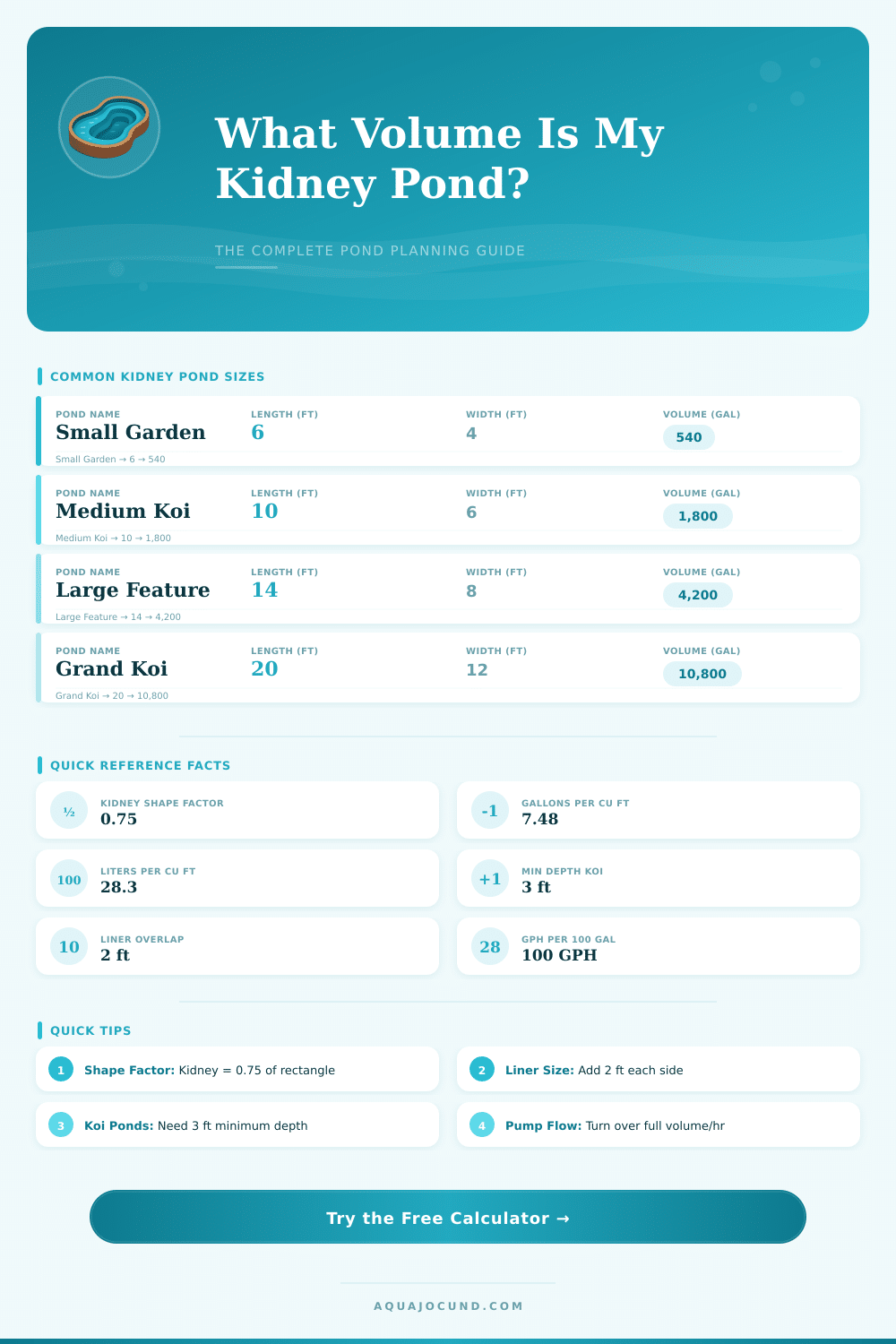
| Pond Type | Length | Width | Depth | Volume (gal) | Volume (L) |
|---|---|---|---|---|---|
| Patio Mini | 5 ft / 1.5 m | 3 ft / 0.9 m | 1.5 ft / 0.46 m | ∼378 gal | ∼1,430 L |
| Small Garden | 6 ft / 1.8 m | 4 ft / 1.2 m | 1.5 ft / 0.46 m | ∼540 gal | ∼2,044 L |
| Backyard Feature | 8 ft / 2.4 m | 5 ft / 1.5 m | 2 ft / 0.61 m | ∼898 gal | ∼3,400 L |
| Wildlife Pond | 9 ft / 2.7 m | 5.5 ft / 1.7 m | 2.5 ft / 0.76 m | ∼1,386 gal | ∼5,245 L |
| Medium Koi | 10 ft / 3.0 m | 6 ft / 1.8 m | 3 ft / 0.9 m | ∼2,019 gal | ∼7,641 L |
| Large Koi | 12 ft / 3.7 m | 7 ft / 2.1 m | 3 ft / 0.9 m | ∼2,828 gal | ∼10,703 L |
| Premium Koi | 14 ft / 4.3 m | 8 ft / 2.4 m | 3.5 ft / 1.1 m | ∼4,406 gal | ∼16,674 L |
| Estate Pond | 16 ft / 4.9 m | 10 ft / 3.0 m | 4 ft / 1.2 m | ∼7,181 gal | ∼27,182 L |
| Grand Feature | 20 ft / 6.1 m | 12 ft / 3.7 m | 4 ft / 1.2 m | ∼10,771 gal | ∼40,773 L |
| Pond Volume | Min Pump (GPH) | Koi Pond (GPH) | Min Pump (LPH) | Koi Pond (LPH) |
|---|---|---|---|---|
| 500 gal / 1,893 L | 500 GPH | 1,000 GPH | 1,893 LPH | 3,785 LPH |
| 1,000 gal / 3,785 L | 1,000 GPH | 2,000 GPH | 3,785 LPH | 7,571 LPH |
| 2,000 gal / 7,571 L | 2,000 GPH | 4,000 GPH | 7,571 LPH | 15,142 LPH |
| 3,000 gal / 11,356 L | 3,000 GPH | 6,000 GPH | 11,356 LPH | 22,712 LPH |
| 5,000 gal / 18,927 L | 5,000 GPH | 10,000 GPH | 18,927 LPH | 37,854 LPH |
| 10,000 gal / 37,854 L | 10,000 GPH | 20,000 GPH | 37,854 LPH | 75,708 LPH |
| Pond (L x W x D ft) | Liner Width (ft) | Liner Length (ft) | Liner Width (m) | Liner Length (m) |
|---|---|---|---|---|
| 6 x 4 x 1.5 | 10 ft | 12 ft | 3.0 m | 3.7 m |
| 8 x 5 x 2 | 13 ft | 16 ft | 4.0 m | 4.9 m |
| 10 x 6 x 3 | 16 ft | 20 ft | 4.9 m | 6.1 m |
| 12 x 7 x 3 | 17 ft | 22 ft | 5.2 m | 6.7 m |
| 14 x 8 x 3.5 | 19 ft | 25 ft | 5.8 m | 7.6 m |
| 16 x 10 x 4 | 22 ft | 28 ft | 6.7 m | 8.5 m |
| 20 x 12 x 4 | 24 ft | 32 ft | 7.3 m | 9.8 m |
Knowing the Volume of your Pond does genuinely matter a lot. Whether you need to figure out how many fish it can hold, or you need to choose the right gear for running and cleaning everything depends on knowing the amount of gallons or liters that you have. A calculator for Pond Volume removes the need to guess the water size, considering the shape, the size of the Pond and the power of the pump.
For a simple rectangular Pond the math is easy; simply multiply the length by the width and the depth. If you work with metres, multiply those three values then multiply by 1000 to get liters. When you use feet and inches, recall that one cubic foot matches around 7.5 gallons, which helps to quickly do the conversions.
How to Find Your Pond’s Volume
For round Pond the math is a bit different. Since 3.142 times the square of the radius you find the surface area, then multiply by the depth. Or use this simple formula: the Volume match 0.8 times the length, width and depth for round forms.
When your Pond has sloping banks or odd shape, measure the average depth and split the basin in smaller rectangles, to count every part on its own.
Big Pond commonly measure in acre-feet, which is honestly way simpler than the math for huge spaces. Multiply the acres of your Pond by the average depth in feet, to reach acre-feet. One acre-foot holds around 325 851 gallons.
That is a real lot of water. So, if you have half an acre Pond with average depth of 4 feet, you have around 2 acre-feet. This converts to about 651 702 gallons.
To get a good average depth, take measures from several places around the Pond and average them.
There is also a chemical way, if you want to avoid too precise numbers. The formula multiplies 120 by the amount of salt that you added in pounds, then splits that by the difference of the salt level before and after the addition.
When you already know the Volume, choosing fish and tools becomes much more simple. In my experience, a good starting point is 1000 gallons for koi fish, plus 300 to 500 gallons for every extra fish. The filter should ideally run three times threw the whole Pond Volume.
For a 1000-gallon Pond you need a pump that moves 1000 gallons each hour, and if you double the size of the Pond, double also the power of the pump.
In real life the measures do not always work out. Someone that built a Pond of around 13 by 7 by 3.5 feet, counted 2385 gallons, but hoped closer to 2000 after thinking about the rough measures. Streams add to the whole, the normal Volume plus the basin give the full picture, and most streams average around 2 inches of depth.
Calculators for Pond Volume also help to figure out the size of the liners and theminimum need of pumps, which genuinely saves a ton of time during planning.