🐠 Plywood Aquarium Glass Thickness Calculator
Calculate the minimum safe glass or acrylic thickness for your custom plywood aquarium build
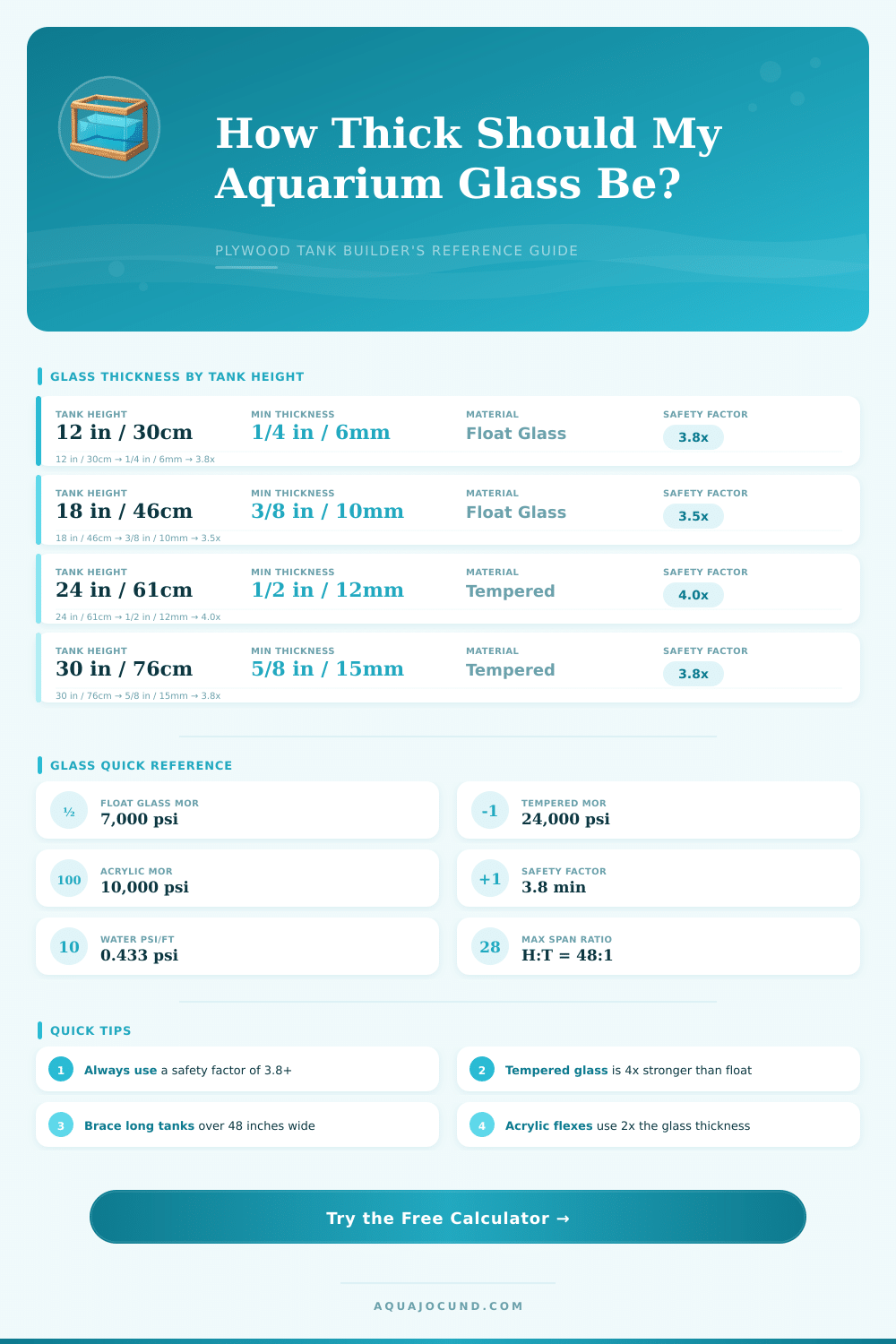
| Nominal Thickness | Actual (in) | Actual (mm) | Max Tank Height (in) | Max Tank Height (cm) | Notes |
|---|---|---|---|---|---|
| 1/4 in (6mm) | 0.250 | 6.35 | 12 | 30 | Small nano & betta tanks |
| 3/8 in (10mm) | 0.375 | 9.53 | 18 | 46 | 20–40 gallon range |
| 1/2 in (12mm) | 0.500 | 12.70 | 24 | 61 | 55–75 gallon range |
| 5/8 in (15mm) | 0.625 | 15.88 | 30 | 76 | 100–125 gallon range |
| 3/4 in (19mm) | 0.750 | 19.05 | 36 | 91 | 150–200 gallon range |
| 1 in (25mm) | 1.000 | 25.40 | 48 | 122 | 250+ gallon display tanks |
| Tank Name | Dimensions (in) | Volume (gal) | Volume (L) | Rec. Glass | Water Weight (lbs) |
|---|---|---|---|---|---|
| 5 Gal Nano | 16 x 8 x 10 | 5 | 18.9 | 1/4 in | 44 |
| 10 Gal Betta | 20 x 10 x 12 | 10 | 37.9 | 1/4 in | 84 |
| 20 Gal Long | 30 x 12 x 12 | 20 | 75.7 | 1/4 in | 170 |
| 29 Gal Community | 30 x 12 x 18 | 29 | 109.8 | 3/8 in | 242 |
| 40 Gal Breeder | 36 x 18 x 16 | 40 | 151.4 | 3/8 in | 334 |
| 55 Gal Planted | 48 x 13 x 21 | 55 | 208.2 | 1/2 in | 459 |
| 75 Gal Cichlid | 48 x 18 x 24 | 75 | 283.9 | 1/2 in | 626 |
| 125 Gal Reef | 72 x 18 x 24 | 125 | 473.2 | 5/8 in | 1044 |
| 180 Gal Display | 72 x 24 x 24 | 180 | 681.4 | 3/4 in | 1502 |
| 240 Gal Monster | 96 x 24 x 24 | 240 | 908.5 | 1 in | 2002 |
| Depth | Depth (cm) | Pressure at Bottom (psi) | Pressure (kPa) | Rec. Min Thickness |
|---|---|---|---|---|
| 6 in | 15 cm | 0.217 | 1.50 | 1/4 in (6mm) |
| 12 in | 30 cm | 0.433 | 2.99 | 1/4 in (6mm) |
| 18 in | 46 cm | 0.650 | 4.48 | 3/8 in (10mm) |
| 24 in | 61 cm | 0.866 | 5.97 | 1/2 in (12mm) |
| 30 in | 76 cm | 1.083 | 7.47 | 5/8 in (15mm) |
| 36 in | 91 cm | 1.299 | 8.96 | 3/4 in (19mm) |
| 48 in | 122 cm | 1.732 | 11.94 | 1 in (25mm) |
Election of the right Thickness for glass in aquarium is actual key. It decides whether your tank stays safe, lasts the time and gives you years of use without issues. Everything depends mainly on the size of the tank; small models allow thinner glass while big or tall ones require much stronger material.
The water pressure from the depth is the main cause here. The higher the level of water the thicker must be the glass to resist that force. Small tanks that stay shallow can use rimless style with glass of around 1/10 until 1/8 inches.
How to Pick the Right Glass Thickness for Your Aquarium
Tank of 24 inches sits in the bottom limit of that range, and 1/4-inch glass costs only little. Common 40-gallon wide tank also use 1/4 inches, that seems the ideal according to my experience.
When you consider tanks longer than 4 feet, 12 mm glass starts to be smart. For truly tall, between 1,5 and 2 metres, one requires up to 20 mm Thickness. For those in the range of 1 until 1,4 metres, usually enough around 12 mm.
Deeper models require more Thickness to escape bending and unwanted curvatures. Here the point though: with upper and bottom braces, one can use somethign as 3/8 inches for the sides, especially if the centre of the tank is braced and has edges.
Online calculators help well to estimate what you require. They give advice about Thickness according to your measures, and also compute the volume, the area of glass surface and the whole weight. Even so, they not always get it exactly.
I found case with tank of 48 in 24 in 24 inches, where the calculator advised 1/2-inch glass, but it still bent clearly in reality.
Most folks apply safety factor around 3,8. It does not guarantee full security, but almost removes the danger of brake, unless the glass itself is damaged or of low quality already. Rimless tank with 5 mm glass reaches that safe limit, although the computers pointed that 4,4 mm would be enough.
Run the codes through several calculators and compare the results is truly the wisest step.
Tempered against regular glass deserves separate attention. Tempered glass is around five times stronger than the regular, that is big benefit. Even so, one does not advise it for very big aquariums, and fish tanks widely do not use it a lot, especially the big ones.
The bottom of your tank suffers mainly press forces instead of bending tension, so in theory it is possible to use a bit thinner glass here than at the walls.
Acrylic is other good choice. PMMA has almost half of the density of glass, while it offers almost double pull strength. It bends easier and has lower light bending rate, what allows thinner panels and clearer sight.
The downside? Acrylic costs much more. Even so, nothingbad about using more Thickness than strictly needed, it is good protection.