📏 Aquarium Acrylic & Glass Thickness Calculator
Calculate the minimum safe panel thickness for acrylic or glass aquariums based on tank dimensions and water pressure.
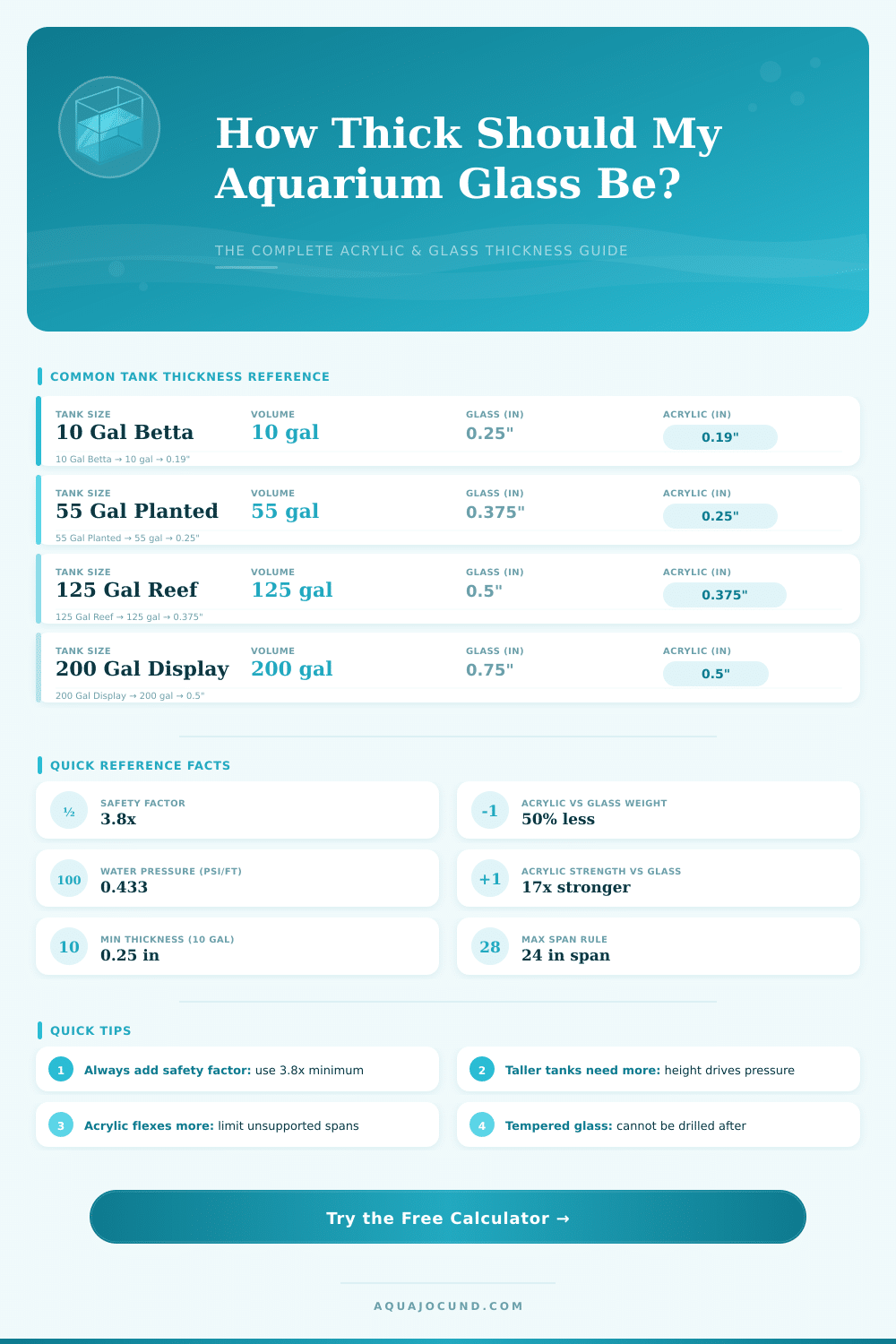
| Tank Name | Dimensions (L x W x H in) | Volume (gal / L) | Min Glass (in / mm) | Min Acrylic (in / mm) |
|---|---|---|---|---|
| Nano Cube 5 Gal | 12 x 8 x 8 | 5 gal / 19 L | 0.19 in / 5 mm | 0.19 in / 5 mm |
| 10 Gal Standard | 20 x 10 x 12 | 10 gal / 38 L | 0.25 in / 6 mm | 0.19 in / 5 mm |
| 20 Gal Long | 30 x 12 x 12 | 20 gal / 76 L | 0.25 in / 6 mm | 0.19 in / 5 mm |
| 29 Gal Standard | 30 x 12 x 18 | 29 gal / 110 L | 0.25 in / 6 mm | 0.25 in / 6 mm |
| 40 Gal Breeder | 36 x 18 x 16 | 40 gal / 151 L | 0.31 in / 8 mm | 0.25 in / 6 mm |
| 55 Gal Standard | 48 x 13 x 21 | 55 gal / 208 L | 0.375 in / 10 mm | 0.25 in / 6 mm |
| 75 Gal Standard | 48 x 18 x 21 | 75 gal / 284 L | 0.375 in / 10 mm | 0.25 in / 6 mm |
| 90 Gal Standard | 48 x 18 x 24 | 90 gal / 341 L | 0.5 in / 13 mm | 0.375 in / 10 mm |
| 125 Gal Standard | 72 x 18 x 22 | 125 gal / 473 L | 0.5 in / 13 mm | 0.375 in / 10 mm |
| 180 Gal Standard | 72 x 24 x 25 | 180 gal / 681 L | 0.75 in / 19 mm | 0.5 in / 13 mm |
| 240 Gal Standard | 96 x 24 x 25 | 240 gal / 908 L | 0.75 in / 19 mm | 0.5 in / 13 mm |
| Material | Tensile Str. (MPa) | Density (g/cm³) | Modulus (GPa) | Impact Resist. | Best Use |
|---|---|---|---|---|---|
| Annealed (Float) Glass | 19.3 | 2.49 | 70 | Low | Standard aquariums |
| Tempered Glass | 69 | 2.49 | 70 | Medium | High-volume tanks |
| Laminated Glass | 30 | 2.55 | 70 | High (no shattering) | Public displays |
| Borosilicate Glass | 28 | 2.23 | 63 | Low | Lab & clarity tanks |
| Cast Acrylic (PMMA) | 72 | 1.18 | 3.2 | High | Large custom tanks |
| Extruded Acrylic | 55 | 1.18 | 3.0 | Medium | Small/mid aquariums |
| UV-Resistant Acrylic | 70 | 1.19 | 3.2 | High | Reef/outdoor tanks |
| Polycarbonate (PC) | 62 | 1.20 | 2.4 | Very High | Sump/utility tanks |
| Water Depth | Pressure (PSI) | Pressure (kPa) | Pressure (kg/cm²) | Example Tank Height |
|---|---|---|---|---|
| 6 in / 15 cm | 0.22 PSI | 1.5 kPa | 0.015 | Nano / Pico tank |
| 12 in / 30 cm | 0.43 PSI | 3.0 kPa | 0.030 | 10–20 gal standard |
| 18 in / 46 cm | 0.65 PSI | 4.5 kPa | 0.045 | 29–55 gal standard |
| 21 in / 53 cm | 0.76 PSI | 5.2 kPa | 0.053 | 55–75 gal standard |
| 24 in / 61 cm | 0.87 PSI | 6.0 kPa | 0.060 | 90–125 gal standard |
| 30 in / 76 cm | 1.08 PSI | 7.5 kPa | 0.075 | 180–300 gal large |
| 36 in / 91 cm | 1.30 PSI | 9.0 kPa | 0.090 | 400+ gal custom |
Acrylic Aquarium tanks always need proper Thickness, even though they stay much more slim than glass ones. They handle water pressure much more well and carry themselves easily. On the other hand, finding the right Thickness often confuses especially if different programs give different results.
For typical home Aquarium tanks up to 24 inches of depth, glass of 6 to 12 mm thick works usually. In big public setups one must use panels more than 50 mm thick, sometimes even layered. Acrylic Glass is often preferred for the actual giants among the tanks.
How Thick Should an Acrylic Aquarium Be
For instance, one famous Aquarium stores 7500 cubic meters of water and uses an Acrylic Glass panel of 8.2 by 22.5 metres with 60 cm of Thickness. Other impressive copy has windows two feet thick, with 4574 square feet of view and 185 tons of Acrylic Glass.
The height of the Aquarium decides mainly about the needed Thickness. A tank long 72 inches and high 24 inches needs same Acrylic Glass Thickness as one long 120 inches but also high. The pressure of water grows only when the height rises, not the width nor the length.
Tanks in 1.5 to 2 metres of height must have 20 mm Thickness. For 1 to 1.4 metres, 12 mm works well. Everything more than fore feet long needs at least 12 mm glass.
Acrylic Glass can bend over time. Half-inch Acrylic Glass works, but it will bend a bit. Three-quarter-inch version is stronger and will not bend.
Quarter-inch Acrylic Glass will sag under its own wait even in small open spaces. Acrylic Glass Aquarium tanks need at least half-inch Thickness already for quite a lot of small models. Even 30 mm thick Acrylic Glass stays clear and without bending.
When the top is stuck on an Acrylic Glass tank, one suggests 0.375 inches of Thickness. With an open top, a safety factor of 1.5 raises that to 0.563 inches. For a tank of 8 by 2 by 2 feet, three-quarter-inch Acrylic Glass gives strong structure.
So, if one raises it to four feet, the Thickness jumps to 1.5 inches.
Calculators for glass Thickness are useful in practice. They not only find the Thickness, but also count the volume of the Aquarium, the surface area, the weight of glass, of water and the whole mass. But sometimes the results seem weird.
Some noticed, that a 48 by 24 by 24 inch tank with half-inch glass bent a lot, even though the calculator said it was safe. A 20-inch high tank can use 8 mm glass, even though a stable and flat base matters a lot. The height does create bigimpact.
Acrylic Glass weighs less than glass, so it costs more. One-inch thick glass cuts hard, just like closing and moving it because of the weight. It also blocks clear sight.
Even so, for builders of custom tanks, we check the numbers with a calculator and add a bit of extra Thickness for calm, that is a wise step.