🧂 Aquarium Salt Calculator
Calculate the exact amount of salt needed for your fish tank — freshwater tonic, brackish, or marine setups
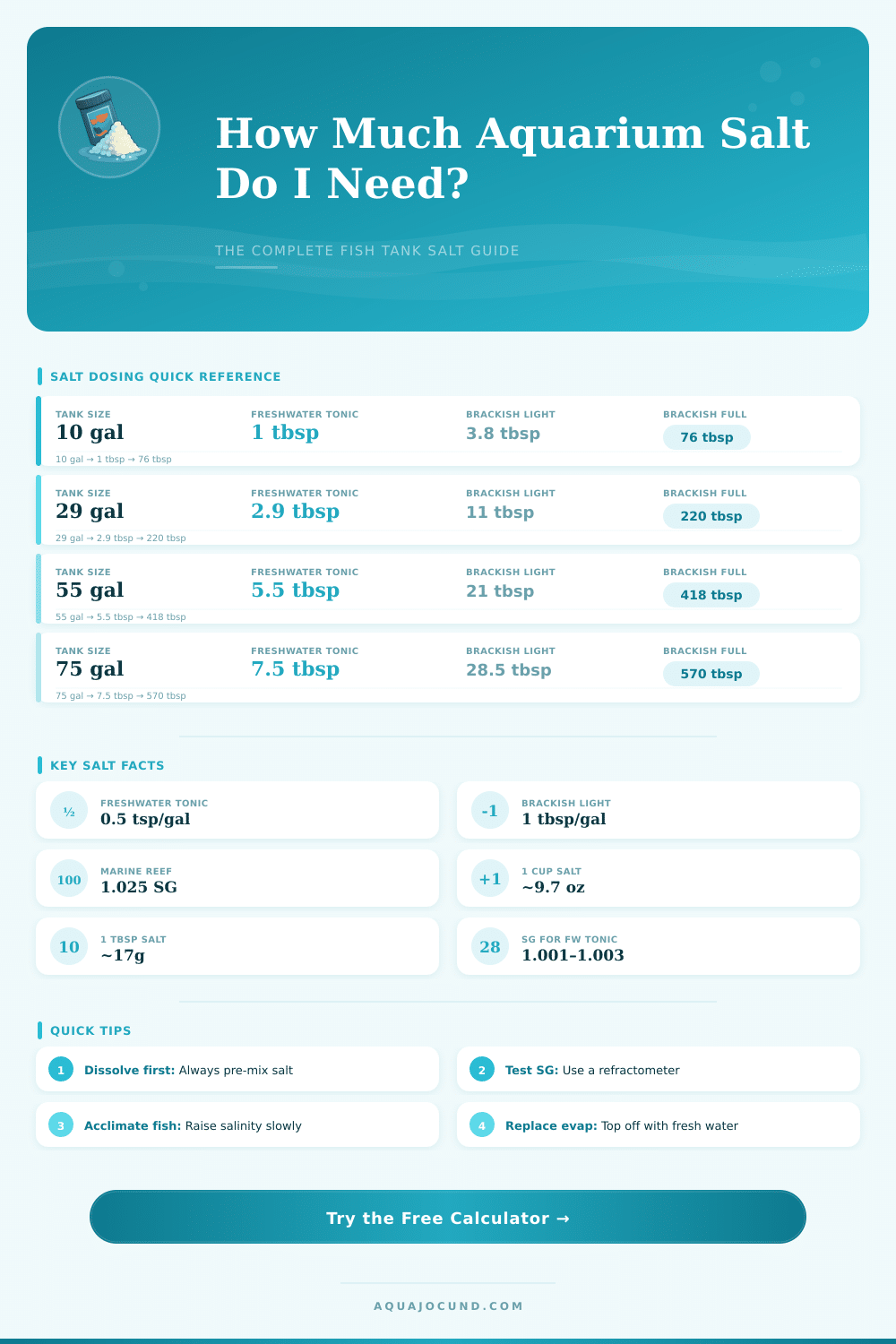
| Application | Specific Gravity | Salinity (ppt) | Salt per Gallon | Salt per Liter |
|---|---|---|---|---|
| Freshwater Tonic | 1.001–1.003 | 1–4 ppt | ~0.5 tsp (~3g) | ~0.8 g/L |
| Disease Prevention | 1.002–1.004 | 3–6 ppt | ~1 tbsp/5 gal | ~1.3 g/L |
| Brackish Light | 1.005 | 7 ppt | ~1 tbsp (~7g) | ~7 g/L |
| Brackish Medium | 1.010 | 14 ppt | ~2 tbsp (~14g) | ~14 g/L |
| Brackish Full | 1.015 | 20 ppt | ~3 tbsp (~20g) | ~20 g/L |
| Marine Fish Only | 1.020 | 27 ppt | ~6.5 tbsp (~27g) | ~27 g/L |
| Marine / Reef | 1.025 | 35 ppt | ~8.5 tbsp (~35g) | ~35 g/L |
| Tank Name | Dimensions (L x W x H in) | Volume (gal) | Volume (L) | Water Volume (90%) |
|---|---|---|---|---|
| Nano Cube 5 Gal | 12 x 12 x 12 | 5 gal | 18.9 L | 4.5 gal |
| 10 Gallon Standard | 20 x 10 x 12 | 10 gal | 37.9 L | 9 gal |
| 20 Gallon Long | 30 x 12 x 12 | 20 gal | 75.7 L | 18 gal |
| 29 Gallon | 30 x 12 x 18 | 29 gal | 109.8 L | 26 gal |
| 40 Gallon Breeder | 36 x 18 x 17 | 40 gal | 151.4 L | 36 gal |
| 55 Gallon | 48 x 13 x 21 | 55 gal | 208.2 L | 49.5 gal |
| 75 Gallon | 48 x 18 x 21 | 75 gal | 283.9 L | 67.5 gal |
| 90 Gallon | 48 x 24 x 24 | 90 gal | 340.7 L | 81 gal |
| 125 Gallon | 72 x 18 x 22 | 125 gal | 473.2 L | 112.5 gal |
| 180 Gallon | 72 x 24 x 25 | 180 gal | 681.4 L | 162 gal |
| Salt Amount | Grams (g) | Ounces (oz) | Tablespoons (tbsp) | Teaspoons (tsp) |
|---|---|---|---|---|
| 1 teaspoon | 6 g | 0.21 oz | 0.33 tbsp | 1 tsp |
| 1 tablespoon | 17 g | 0.60 oz | 1 tbsp | 3 tsp |
| 1/4 cup | 69 g | 2.43 oz | 4 tbsp | 12 tsp |
| 1/2 cup | 138 g | 4.87 oz | 8 tbsp | 24 tsp |
| 1 cup | 275 g | 9.70 oz | 16 tbsp | 48 tsp |
| 1 pound (lb) | 454 g | 16 oz | 26.7 tbsp | 80 tsp |
| 1 kilogram (kg) | 1000 g | 35.27 oz | 58.8 tbsp | 176 tsp |
Aquarium Salt is made up of dried sea water. It carries mainly sodium chloride, without other stuff. One finds in it big crystals, that dissolve soon in water.
That separates it from sea Salt mixes, for example Instant Ocean, that includes extra minerals, that only saltwater fish require. So these are two entirely different products.
Aquarium Salt: What It Is and How to Use It
One of the main benefits of Aquarium Salt is that it helps freshwater fish reduce stress. It backs good gill function and improve the breathing of fish. It also provides natural minerals, that fish require for reaching best colour and health.
Fish always struggle against water flow, because water always enters their salty bodies. By adding a little Salt, fish can use their energy for other things, for instance defend against diseases.
Salt helps fish “coat themselves with slime”, what simply said stimualte their natural slime covering. It is useful especially during adding of fresh fish. Also it can reduce the harmful effects of high nitrite levels.
Chloride ions bind with something in the gills, what blocks the intake of nitrites, like this Salt preserves fish against nitrite spikes.
Salt works well against almost all outside parasites on freshwater fish. Even so specific medicine for that parasite stays more effective, because it always kills appearing parasites. One uses Salt commonly too address fungal infections and parasites.
Here the spot, where things become a bit hard. Some fish, like skinless species, have more severe water loss and suffer badly because of Salt. Cori-catfishes are a sample.
So always check, whether some fish in the Aquarium is sensitive to it. Bettas do not last Salt well, and too much can create real danger.
When you add Salt, dissolve it before. Mix it in glass water before putting in the Aquarium is good method. Salt does not leave from the Aquarium.
It simply goes away by water changes, so you must add more after every such change. Add it slowly, to escape straining the fish.
About replacements, plain cooking Salt works and cost much less. Usual table salt commonly carry added iodine, what does not work for fish. Pure sea Salt without iodine is good choice.
Flavored or scented salts should never be used. Aquarium Salt, rock salt and table salt all are sodium chloride, but Aquarium Salt cost more because of its cleaning.
If one uses Salt according to directions in low amounts, it should not hurt good bacteria. Aquarium Salt raises saltlevels, but it doesnot affect the pH.