🐠 Aquarium Stocking Calculator
Calculate how many fish your tank can safely support using proven stocking rules
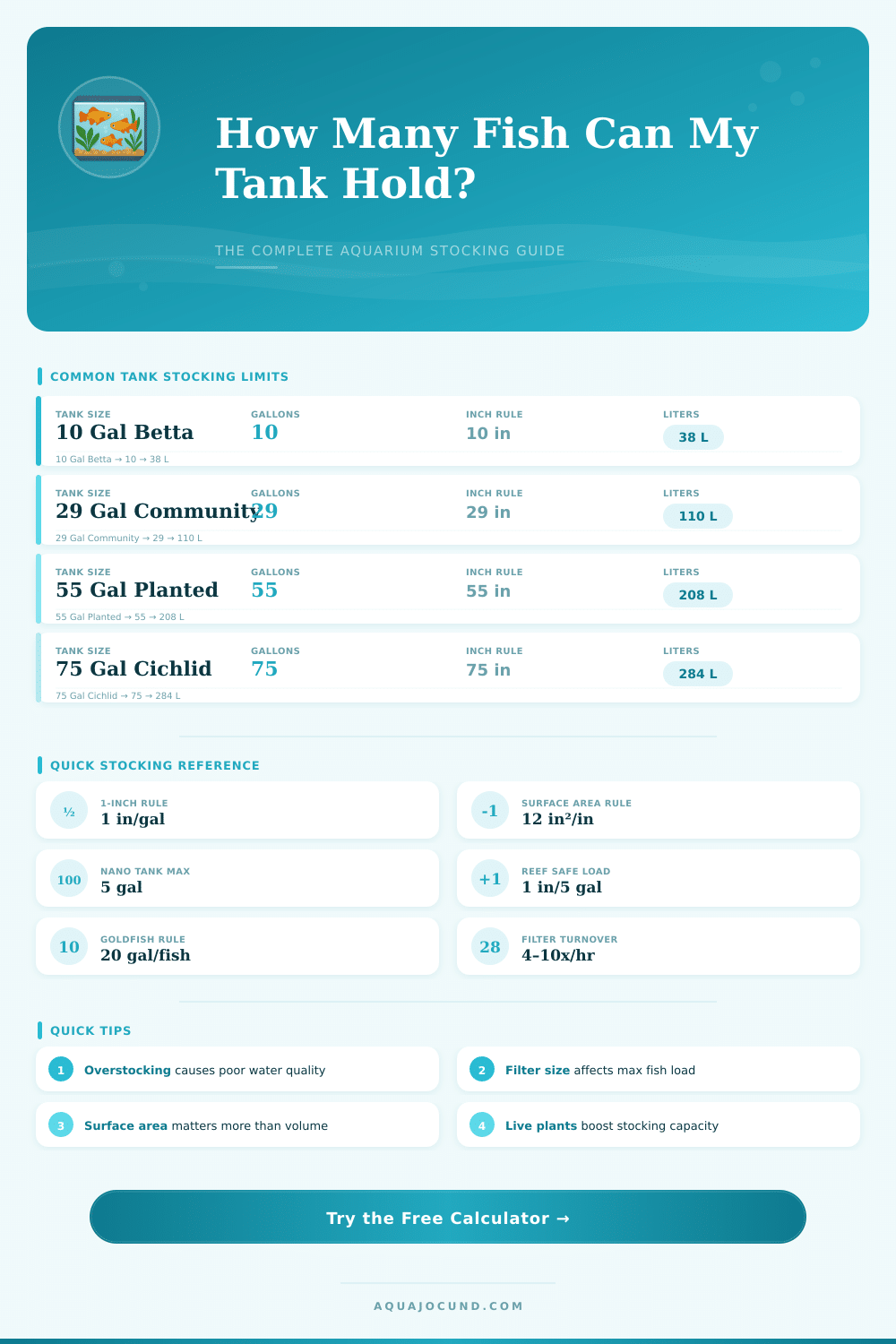
| Tank Name | Dimensions (L×W×H in) | Volume (gal) | Volume (L) | Surface Area (in²) | 1-in Rule Max |
|---|---|---|---|---|---|
| Nano / Pico | 12 × 6 × 8 | 2.5 | 9.5 | 72 | 6 in total |
| 5 Gallon | 16 × 8 × 10 | 5 | 19 | 128 | 5 in total |
| 10 Gallon | 20 × 10 × 12 | 10 | 38 | 200 | 10 in total |
| 20 Gallon High | 24 × 12 × 16 | 20 | 76 | 288 | 20 in total |
| 20 Gallon Long | 30 × 12 × 12 | 20 | 76 | 360 | 20 in total |
| 29 Gallon | 30 × 12 × 18 | 29 | 110 | 360 | 29 in total |
| 40 Gal Breeder | 36 × 18 × 16 | 40 | 151 | 648 | 40 in total |
| 55 Gallon | 48 × 13 × 21 | 55 | 208 | 624 | 55 in total |
| 75 Gallon | 48 × 18 × 21 | 75 | 284 | 864 | 75 in total |
| 90 Gallon | 48 × 18 × 24 | 90 | 341 | 864 | 90 in total |
| 125 Gallon | 72 × 18 × 22 | 125 | 473 | 1296 | 125 in total |
| 180 Gallon | 72 × 24 × 25 | 180 | 681 | 1728 | 180 in total |
| Fish / Tank Type | Base Multiplier | Recommended Rule | Notes |
|---|---|---|---|
| Tropical Community | 1.0× | 1 in per gallon | Standard baseline rule |
| Betta (Sorority) | 0.9× | 1 in per gallon | Allow territory spacing |
| Cichlid / Aggressive | 0.65–0.75× | Surface area rule | High waste producers |
| Goldfish | 0.5× | 20 gal first fish | Very high bio-load |
| Reef / Marine | 0.2× | 1 in per 5 gal | Much stricter limits |
| Heavily Planted | 1.35× | 1 in per gallon+ | Plants process waste |
| Shrimp / Nano | 1.0× | ~10 shrimp per 2 gal | Very low bio-load |
| Predator / Large | 0.4–0.6× | Surface area rule | Need very large tanks |
| Tank Size | Min Flow (GPH) | Ideal Flow (GPH) | Filter Type | Turnover Rate |
|---|---|---|---|---|
| Up to 10 gal | 40 | 50–100 | Sponge / HOB | 5–10x/hr |
| 10–29 gal | 100 | 100–290 | HOB | 4–10x/hr |
| 30–55 gal | 200 | 200–550 | HOB / Canister | 4–10x/hr |
| 55–100 gal | 300 | 400–1000 | Canister | 4–8x/hr |
| 100+ gal | 500 | 600–1500+ | Canister / Sump | 4–8x/hr |
Count how many fish fit in your Aquarium is one of those questions that always appears in fish-keeping communities. Truly getting that right has big influence so that your fish stay healthy and active. There are some good resources for help here, and the website AqAdvisor is among the most commonly used options.
It is a basic calculator designed specially for owners of tropical fish that want to set their Stocking plans. What sets it apart is the help of community input, the more users apply and exchange experiences, the more precise the calculations become over time.
How Many Fish Fit in Your Aquarium
Here you find also another free calculator for Stocking, that covers around 800 different species of fish. That allows you estimate the real capacity of your Aquarium, check whether a particular fish fits with the others, and easily convert between liters and gallons without big effort. Such resources truly are useful when you plan which inhabitants go in your setup.
Here the key point of the method of AqAdvisor, it intends to be conservative on purpose. The focus rests on the long health of the fish and the care of Aquarium conditions, not on the maximum amount of creatures. Some fish keepers reckon that it is too careful, and they keep their Aquariums at more than 100 percent according to the calculation without problems.
Even so, for beginners, that carfeul approach likely protects you against some serious troubles later.
In old advice about Aquarium keeping commonly one mentions the rule one inch per gallon. The thought is: one inch of fish body for one gallon of water, so a three-inch betta would need three gallons. But really, it does not cover everything.
It works as a rough guide, although it falls short in many ways. A more useful guide that gives good results is one pound of fish for eight to ten gallons in a good Aquarium.
Overstocking causes real troubles. The fish need space to grow and keep their health. In small Aquariums, for instance 12-gallon, the biological load becomes the main concern.
So regular tests of the water with proper gear help too control nitrates and keep the pH stable. In a 10-gallon Aquarium especially, you have only little margin for mistakes.
If you successfully did a cycle without fish and your Aquarium processes two ppm of ammonia in 24 to 48 hours, no need to add fish slowly. Even so, there is no reason to rush. Plan your group of snails?
Add them first, so that their population settles before you add fish that could chase them. Leave your most aggressive or territorial species for the finish.
Calculators for Stocking commonly give surprisingly detailed advice. For instance, one finds a range of hardness of 5 to 12 dH, a schedule for water changes at around 26 percent weekly and Stocking level at roughly 82 percent. Such details help to keep everything in good balance.
When you set up bigger Aquariums, choosing biggersize almost always helps, because small setups are more difficult to keep.