PPT Salinity Calculator
Build reef water from RO/DI, translate SG and conductivity into ppt, and plan correction water that moves a marine tank safely instead of chasing numbers after the fact.
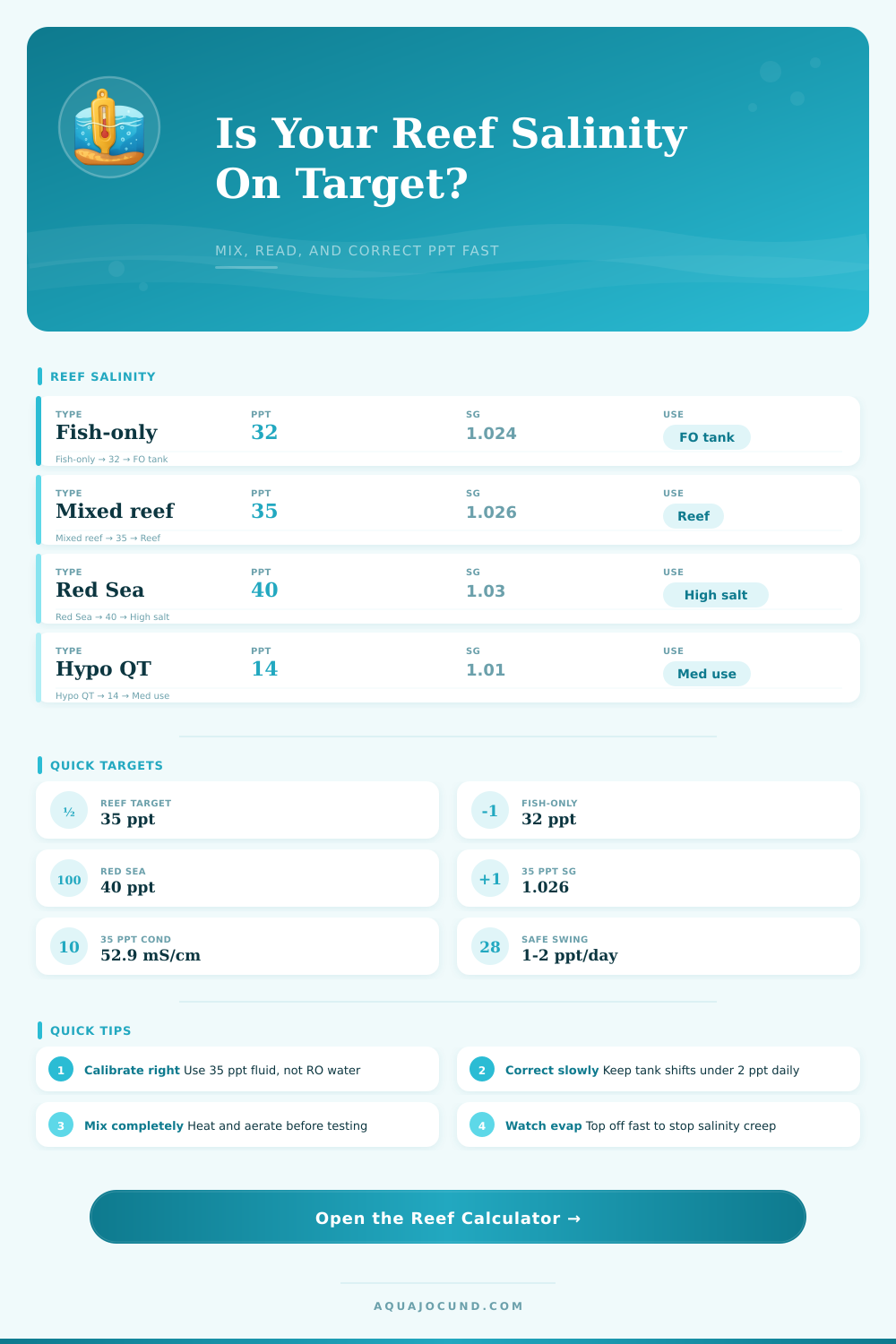
Lower salinity eases osmoregulation for many hardy fish and helps keep operating cost down during large fish systems.
A forgiving zone for mixed coral growth where nutrient export, dosing, and weekly water changes stay straightforward.
The classic target band for reef tanks that want balanced coral color, predictable test kits, and stable dosing math.
Tighter salinity control supports demanding acropora systems where alk, calcium, and magnesium swings show up quickly.
| Band | Ppt | SG @25C | Cond | Typical use |
|---|---|---|---|---|
| Brackish edge | 5 to 18 | 1.004 to 1.014 | 7.5 to 27.6 | Estuary and acclimation |
| Fish-only | 30 to 33 | 1.023 to 1.025 | 45.3 to 49.8 | Hardy marine fish |
| Reef standard | 34 to 35 | 1.026 to 1.026 | 51.3 to 52.9 | Mixed reef baseline |
| SPS tight | 35 to 36 | 1.026 to 1.027 | 52.9 to 54.4 | High demand corals |
| Red Sea style | 38 to 40 | 1.028 to 1.030 | 57.5 to 60.7 | Warm, high salt systems |
| Hypo quarantine | 12 to 16 | 1.009 to 1.012 | 18.1 to 24.4 | Medical use only |
| Batch | 32 ppt | 35 ppt | 40 ppt | Use |
|---|---|---|---|---|
| 10 L | 347 g | 380 g | 434 g | Nano change |
| 20 L | 694 g | 760 g | 868 g | Small sump |
| 50 L | 1.74 kg | 1.90 kg | 2.17 kg | Weekly station |
| 5 gal | 657 g | 718 g | 821 g | Bucket mix |
| 25 gal | 3.29 kg | 3.59 kg | 4.11 kg | Large change |
| Evap loss | New ppt | New SG | What it means |
|---|---|---|---|
| 0.5% | 35.18 | 1.0264 | Nearly invisible drift |
| 1.0% | 35.35 | 1.0265 | Daily top-off gap |
| 2.0% | 35.71 | 1.0268 | Corals may notice |
| 3.0% | 36.08 | 1.0271 | Small tanks swing fast |
| 5.0% | 36.84 | 1.0276 | Correction should be staged |
| Mix | g/L @35 | Alk | Ca | Mg | Profile |
|---|---|---|---|---|---|
| Instant Ocean | 38.2 | 10.5 | 400 | 1350 | Budget stable |
| Reef Crystals | 38.8 | 12.0 | 440 | 1440 | Coral heavy |
| Tropic Marin Pro | 37.5 | 7.5 | 440 | 1350 | Lower alk |
| Red Sea Blue | 38.0 | 8.0 | 420 | 1280 | Natural sea |
| Coral Pro | 39.5 | 12.2 | 465 | 1390 | Hot mix |
| Fritz RPM | 38.3 | 8.5 | 430 | 1400 | Balanced |
| Aquaforest | 38.6 | 8.0 | 430 | 1360 | Reef standard |
| Nyos | 38.7 | 8.3 | 440 | 1330 | Clean mix |
Salinity are the measurement of the amount of salt that is dissolved in water, and it is a critical factor in determine the health of the marine life in an aquarium. Salinity is measured in parts per thousand (ppt). Salinity play the most greatest role in determining how the cells of the fish and corals in the aquarium manage fluid balance within there bodies.
If the salinity level are too high or too low for the species within the aquarium, those inhabitants may experience osmotic stress cause by the change in salinity levels. Depending on the type of aquarium that is established, there will be different requirement as to the level of salinity that exists within the water. For example, a fish only tank may require a salinity level of 32 ppt to allow the fish to breathe more easy.
How to Keep the Right Salt Level in an Aquarium
However, a coral tank may require a salinity level of 40 ppt to allow the corals to thrive. Regardless of the type of inhabitant that are desired in the tank, you should adjust the salinity to the needs of the inhabitants. To establish the salinity within the aquarium, the salt will be mixed with the water.
To ensure that the salinity reading are accurate, the water used to mix the salt should be RO (reverse osmosis) or DI (deionized) water. To establish the salinity level, the dry salt will be added to a specific volume of RO or DI water. Different salt mix should not be used within the same tank because each type of salt contain different levels of mineral necessary for the fish and corals to perform critical biological functions.
A small alteration of the amount of salt that is added to the aquarium will have a large impact upon the salinity level of the water. Additionally, another factor that you should take into consideration is the temperature of the water within the aquarium. The salinity level of the water should be measured at a temperature of 25C. If the salinity level was measured at a higher or lower temperature, the results would be inaccurate due to the impact that temperature can have upon the rate of evaporation of the water in the tank.
One of the processes that can increase the salinity within the aquarium is through the evaporation of the water within the tank. As the water in the aquarium evaporates, the salt remain within the tank. Therefore, the remaining water within the tank becomes more concentrated with the salt, which result in the increase in salinity within the aquarium.
Additionally, because the amount of water that evaporates from small tanks is greater than the amount of water that evaporates from large tanks of the same type, small tanks are more susceptibility to spikes in salinity. To prevent these spikes in salinity, auto top off systems can be employed within the aquarium. If the salinity becomes too high for the inhabitants of the aquarium, fresh water will need to be added to the tank to dilute the salt within the water.
However, fresh water should be added slow to the aquarium to avoid shocking the inhabitants of the tank. Conversely, if the salinity within the tank is too low, salt water will need to be added to increase the salinity of the tank. Again, salt water should be added slowly to the tank to prevent shocking the inhabitants of the aquarium.
A variety of instrument can be used to measure the salinity within the aquarium. One instrument that can be used is a refractometer. Refractometers are used to measure the salinity of the water within the tank, but the instruments must be regularly calibrated to ensure that the measurements of salinity are accurate.
Refractometers may display inaccurate measurements if there is a drift in the calibration of the instruments. Another instrument that is used to measure the salinity in the tank is a hydrometer. Hydrometers are devices that measure the density of the water in the tank.
However, the readings on the hydrometer will not be accurate if there are bubble within the tank that may affect the accuracy of the readings. A third instrument that can be utilized to measure the salinity within the aquarium is a conductivity probe. Conductivity probes measure the conductivity of the water in the tank.
However, the conductivity probe will need to be rinsed regularly to ensure that dosing medicine or salt dont accumulate on the probe and impact the accuracy of the salinity measurements. The specific gravity reading from a refractometer can be used to cross check the salinity reading from a conductivity probe. Stability in the salinity levels within the aquarium is important for the health of the fish and corals in the tank.
If the salinity levels are stable within the tank, the fish and corals will not need to utilize any energy perform their biological functions. Furthermore, if the salinity levels are maintained at the levels that are necessary for the corals and fish, the corals will extend their tentacles to catch the food particle in the tank, and the fish will remain healthy. Stability in the salinity level means that the salinity should not be rapidly changed within the tank.
Instead, staged change to the salinity levels will allow for the inhabitants of the tank to acclimate to the changes. Another factor to consider when adjusting the salinity level is the net volume of the aquarium.