🐟 Mercury Calculator Fish
Estimate weekly mercury exposure from seafood servings, compare your intake to the EPA reference dose, and see safer meal spacing for adults, kids, and pregnancy planning.
| Step | Formula | Value |
|---|---|---|
| Species mercury | Base ppm x source x prep x mix | -- |
| Mercury per meal | Serving grams x adjusted ppm | -- |
| Weekly intake | Per meal x meals per week | -- |
| Daily body burden | Weekly ug / body kg / 7 | -- |
| Protected limit | 0.1 ug/kg/day x profile x goal | -- |
| Serving cap | Weekly budget / per meal | -- |
Salmon and Sardines
Usually below 0.03 ppm, making them the easiest anchors for frequent weekly seafood meals.
Shrimp and Tilapia
Consistent low readings support family meal plans when portion size and sodium are also controlled.
Light Tuna and Mahi
These fit best when you rotate species and leave several days between repeated servings.
Albacore and Swordfish
Predator fish concentrate mercury fast, so one large meal can use most of a weekly budget.
Below 60%
Routine rotation usually works well. Keep fish variety high and portion sizes steady.
60% to 100%
You are near the weekly target. Drop serving size or swap to salmon, cod, or shrimp.
100% to 150%
Reduce frequency and widen spacing before repeating the same fish next week.
Over 150%
Choose a low-mercury replacement and avoid stacking more predator fish meals.
| Fish | Typical Mercury (ppm) | Risk Band | Best Use |
|---|---|---|---|
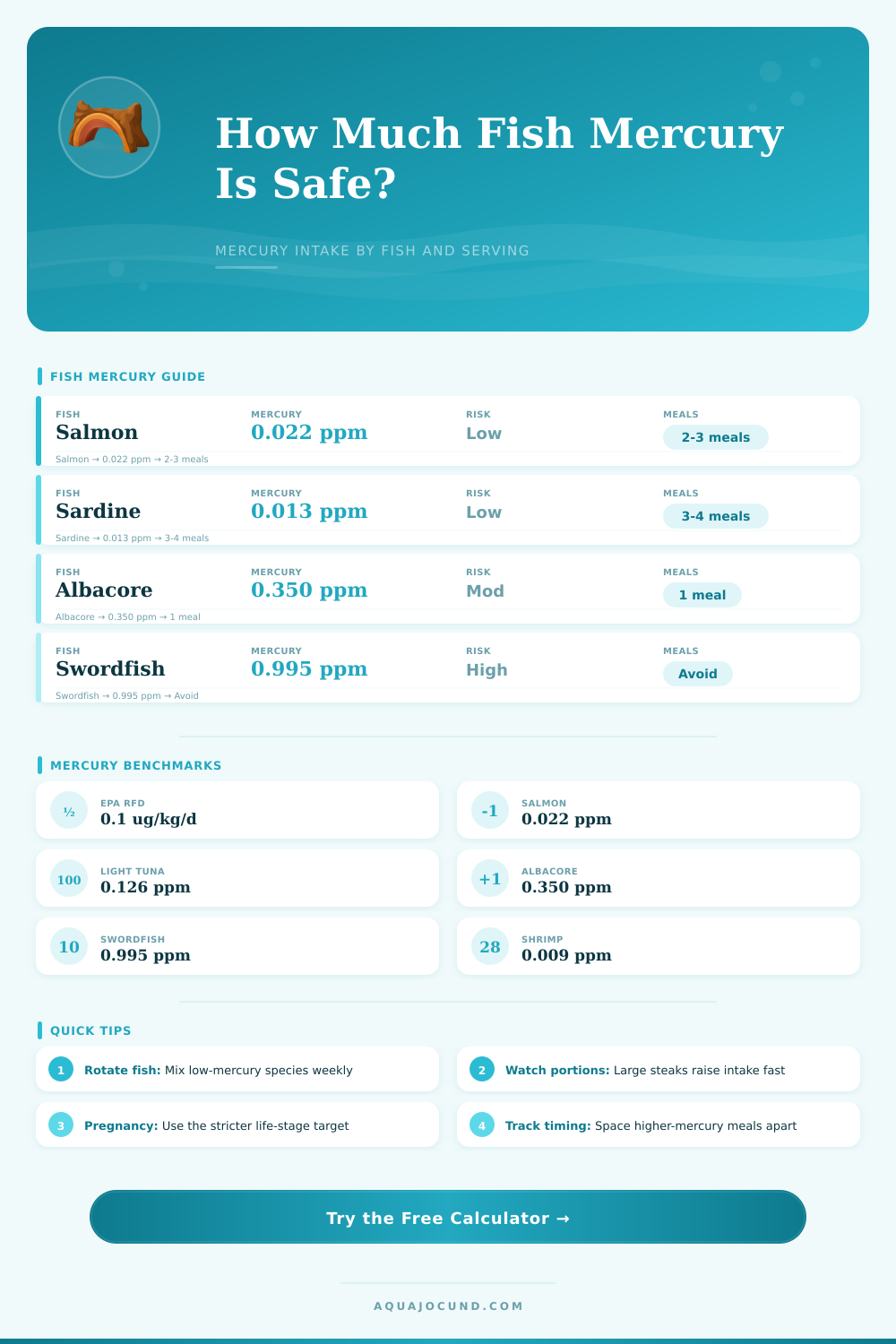
| Salmon | 0.022 | Very low | Frequent weekly meals |
| Sardines | 0.013 | Very low | Small fish rotation |
| Shrimp | 0.009 | Very low | Family seafood nights |
| Cod | 0.111 | Low | Lean white fish meals |
| Tilapia | 0.013 | Very low | Budget weekly prep |
| Light canned tuna | 0.126 | Moderate | Portioned lunch meals |
| Mahi-mahi | 0.178 | Moderate | Occasional grilled fillets |
| Albacore tuna | 0.350 | High | Limited servings only |
| Swordfish | 0.995 | Very high | Avoid for sensitive groups |
| Fish | 6 oz Serving | Meals at EPA Limit | Spacing Note |
|---|---|---|---|
| Salmon | 170 g | 12.1 | Easy weekly staple |
| Sardines | 170 g | 20.5 | Very low burden |
| Cod | 170 g | 2.4 | Keep to a few meals |
| Light canned tuna | 170 g | 2.1 | Rotate with salmon |
| Mahi-mahi | 170 g | 1.5 | Leave several days |
| Albacore tuna | 170 g | 0.8 | Less than weekly |
| Swordfish | 170 g | 0.3 | Avoid repeating |
| Profile | Limit Multiplier | Use Case | Why It Matters |
|---|---|---|---|
| General adult | 1.00 | Balanced seafood plan | Matches EPA reference dose |
| Cautious adult | 0.85 | Higher safety margin | Useful with repeat tuna intake |
| Pregnancy / trying | 0.65 | Protect fetal development | Mercury exposure is more critical |
| Child 9-13 | 0.72 | Moderate kid portions | Lower body mass raises dose |
| Child 4-8 | 0.58 | Small seafood servings | Same fish means higher load |
| Body Weight | Light Meal | Standard Meal | Large Portion |
|---|---|---|---|
| 45-70 lb | 2 oz / 57 g | 3 oz / 85 g | 4 oz / 113 g |
| 70-110 lb | 3 oz / 85 g | 4 oz / 113 g | 5 oz / 142 g |
| 110-170 lb | 4 oz / 113 g | 6 oz / 170 g | 8 oz / 227 g |
| 170+ lb | 5 oz / 142 g | 7 oz / 198 g | 9 oz / 255 g |
- Front-load low mercury fish: Build most weekly meals around salmon, shrimp, sardines, and tilapia.
- Use higher-mercury fish sparingly: Tuna steaks and swordfish can consume a full weekly budget in one sitting.
- Log restaurant portions: Many fillets are 8 to 12 ounces, not the usual 4 to 6 ounce home serving.
- Adjust for body size: Children and smaller adults reach the same mercury threshold with much less fish.
- Rotate species: Mixing low-mercury seafood lowers repeated exposure across consecutive meals.
- Keep context in mind: This tool estimates methylmercury load, not allergies, sodium, or contamination from other sources.
Mercury is another substance that is found in many different types of fish. Mercury is a substance that can build up in the body over time. Mercury is of concern for individuals if mercury can affect the nervous system, and if mercury can affect the development of children and pregnant people.
Fish provides many different nutrients to individuals, but the mercury can outweigh those nutrients if not managed proper. To manage the mercury in fish, individuals must understand which fish contain high level of mercury, and which fish contain low levels of mercury. Predatory fish are fish that consume other fish species.
How to Eat Fish Safely and Lower Mercury
Fish that are predatory often contain higher levels of mercury due to the fact that these fish consume prey fish that contain mercury. Swordfish is one type of predatory fish that contains high levels of mercury. Smaller fish species, such as sardines or shrimp, contain less mercury due to the fact that they are lower on the food chain, and do not consume as much predatory fish as other fish species.
Salmon species contain less mercury than species like swordfish. Therefore, individuals should consume smaller types of fish than predatory fish species to reduce there mercury intake. Additionally, individuals with larger body weights can consume more mercury than individuals with smaller body weights.
For instance, a child will absorb more mercury from the same pound of fish as an adult. Thus, individuals should provide smaller portion of fish to children. In addition to the type of fish that is consumed, the portion sizes of the fish can also impact the amount of mercury that is consumed.
For instance, restaurant portion of fish are much larger portions than portions cooked at home. Furthermore, by rotating the types of fish an individual consumes, the body can reduce the concentration of mercury. Additionally, preparations for fish that remove moisture from the product may lead to increased mercury concentration in the preparation.
Fish species of all age must be considered when managing mercury in fish diets. For instance, the Environmental Protection Agency (EPA) has established limits for mercury intake for various groups of individuals. For instance, the limits are different for pregnant people and children compared to adults.
Mercury can pass through the placenta to the fetus while pregnant, therefore pregnant people must take extra care when consuming fish compared to nonpregnant adults. Additionally, children under the age of ten have higher risk of mercury than adults. This is due to the fact that children have smaller bodies than adults, and will reach the mercury limits more quickly.
Therefore, specific guideline must be provided for children and pregnant people. Another way to manage mercury in fish is to space out the consumption of fish products. Fish species that contain medium amounts of mercury should be consumed every several day.
For instance, individuals should track the amount of mercury species that they consume throughout the week. For instance, if an individual stays below sixty percent of their recommended weekly mercury limit, they have time to consume there fish products for the week. However, if an individual approaches there one hundred percent weekly limit for mercury, they should reduce their fish consumption for that week.
Despite the recommendations provided for fish consumption, many individuals introduce mercury into their bodies. For instance, many individuals consume large amounts of tuna due to its protein content. By consuming excessive amounts of tuna, their mercury levels can rise to too high a level.
Additionally, many family consume the same type of white fish every week for their meals. By consuming the same type of fish every week, individuals are not rotating their fish intake, which is recommended. Therefore, individuals can replace fish species with inexpensive and low mercury fish, like tilapia.
Additionally, if individuals consume sushi, they should be mindful of the amount of tuna in their sushi products since tuna contain more mercury than most seafood products. By following these guidelines and recommendations, individuals can manage the mercury that is found in fish species. For instance, very-low mercury fish, like sardines and shrimp, can be consumed at the beginning of the week.
Additionally, fish with medium mercury levels should be consumed during other time of the week. Furthermore, individuals should take care with the portions of fish that are prepared at restaurant. By following these suggestions for fish consumption, individuals can consume the nutrients from fish, while maintaining there health and keeping their mercury levels to a safe amount.