💧 Dissolved Oxygen Calculator
Estimate oxygen saturation, reserve, daily demand, and aeration recovery time for tanks and ponds
| Breakdown | Formula | Value |
|---|---|---|
| Freshwater baseline | Temp curve | -- |
| Salinity + altitude | Correction | -- |
| Available oxygen | DO x volume | -- |
| Daily oxygen demand | Biomass model | -- |
| Target gap | Target - current | -- |
| Aeration transfer | Method rate | -- |
Community Tank
Keep DO above 6.5 mg/L and watch warm afternoons.
Koi & Goldfish
High feed loads need extra surface exchange at dawn.
Reef System
Salt reduces saturation, so skimming and flow matter.
Aquaculture
Use a large reserve and plan for night-time demand.
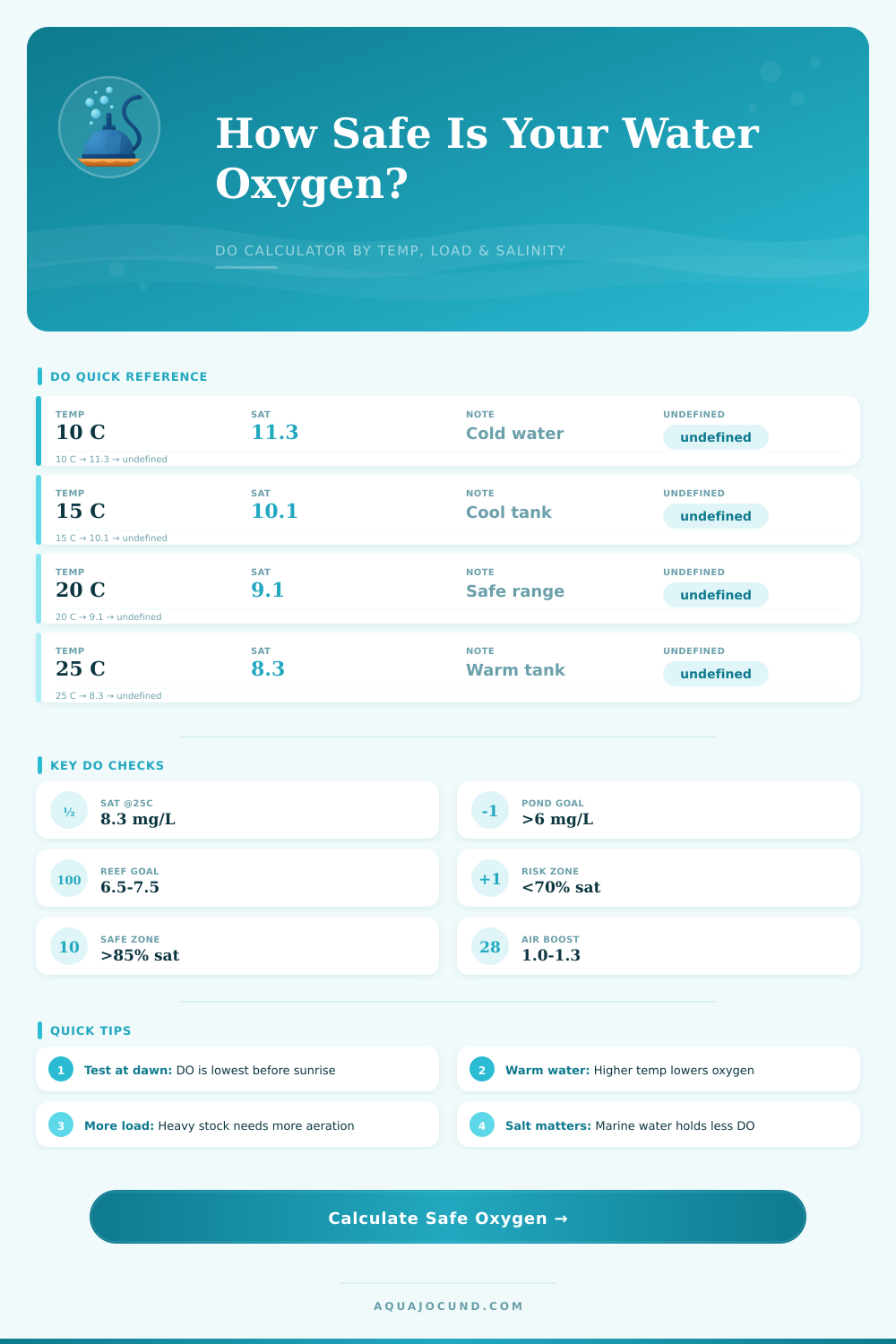
| Temp | Sat mg/L | Use |
|---|---|---|
| 10 C | 11.3 | Cold water |
| 15 C | 10.1 | Cool tank |
| 20 C | 9.1 | Safe range |
| 25 C | 8.3 | Warm tank |
| 30 C | 7.6 | Low reserve |
| Class | Factor | Best For |
|---|---|---|
| Light | 0.8 | Low fish load |
| Balanced | 1.0 | Normal stock |
| Heavy | 1.22 | Strong feeding |
| Dense | 1.42 | Peak load |
| Condition | Factor | Note |
|---|---|---|
| 0 ppt | 1.00 | Freshwater |
| 10 ppt | 0.94 | Brackish |
| 25 ppt | 0.86 | Salt-lean |
| 35 ppt | 0.80 | Marine |
| 1000 m | 0.92 | High land |
| Method | Rate | When to Use |
|---|---|---|
| Ripple | 0.70 | Gentle tanks |
| Airstone | 0.92 | Daily support |
| Diffuser | 1.05 | Even mixing |
| Venturi | 1.20 | High load |
| Waterfall | 1.35 | Pond boost |
- Check at dawn: that is when DO usually bottoms out.
- Raise surface motion: agitation often helps more than bubbles alone.
- Watch warm spells: temperature climbs can cut oxygen fast.
- Feed lightly: uneaten food drives demand and wastes oxygen.
- Match the stock: dense systems need bigger safety margins.
- Plan night aeration: plants and fish both consume oxygen after lights out.
Dissolved oxygen is a vital component of the waters in which aquatic life exist. The level of dissolved oxygen in the water must be sufficient for the fishes to survive. If the levels of dissolved oxygen in the water is too low for the fish in the water, the fish will gasp at a surface of the water to take in the dissolved oxygen that they needs to breathe.
Dissolved oxygen are not floating in the air above the water, but is held within the water itself. If the level of dissolved oxygen in the water drop, the biological health of the tank will decline. The primary factor that impact the levels of dissolved oxygen in the water is the temperature of the water.
Keeping Enough Oxygen in Your Fish Tank
Higher temperature will decrease the amount of dissolved oxygen that can be held within the water. Warm water hold less dissolved oxygen then cool water, so warm tanks will have less dissolved oxygen than cool tanks of the same volume. The salinity of the water also impact the amount of dissolved oxygen that can exist in the water.
Water that contain salt will hold less dissolved oxygen than freshwater. Finally, the altitude of the water also has an impact upon dissolved oxygen levels; higher altitudes has thinner air, and thinner air contain less oxygen for the water to absorb. Biological activity have an impact upon dissolved oxygen levels in that different type of biologicals use dissolved oxygen at different times.
For instance, plants will produce oxygen in the photosynthetic process during the daylight hour, but will use oxygen during the nighttime hours. Fish and bacteria will use dissolved oxygen continuous. Thus, if there is a heavy stocking of fish and bacteria in the tank, the amount of dissolved oxygen will drop more quick than in a lightly stocked tank.
Due to the fact that oxygen levels in the water drop at night hours, it is important to checking dissolved oxygen levels at dawn. A dissolved oxygen calculator can help in understanding the amount of dissolved oxygen that is in your system. The calculator will help to determine the relationship between the volume of water in the tank, the temperature of the water in the tank, the stocking of the tank, and the amount of aeration method that are used in that system.
For example, waterfalls and venturi jet will produce more gas exchange between the water and the air than gentle ripple at the surface of the water. Thus, if heavy stocking is present in the system, the biological component of the tank should increase the amount of aeration method to compensate for the increased use of dissolved oxygen. A common mistake is to ignore the amount of dissolved oxygen that the biomass in the tank is demand.
The amount of dissolved oxygen that is supply to the tank should always be greater than the amount of dissolved oxygen that the tanks biological components demand. If too many fish is added to the tank, or if too much food are provided to the fish, the demand for dissolved oxygen will be greater than the amount of dissolved oxygen that can be supply to the system. Thus, both the stocking and the amount of food that is provide to the tank should be managed.
For system that are heavy with biomass and biological activity, ensure that the dissolved oxygen saturation is maintained at levels that is well above 85%. To ensure healthy dissolved oxygen level, provide some degree of surface motion to the water and to aerate the system. Dissolved oxygen levels should be test regularly, and the aeration system should be increased if the dissolved oxygen levels begins to drop.
Additionally, if the temperature of the water begins to rise, chillers may be used or the tank may be shade to reduce the water temperature. Maintaining adequate dissolved oxygen and managing the temperature of the water will ensure that the aquarium environment are stable and healthy for the life within the tank.