
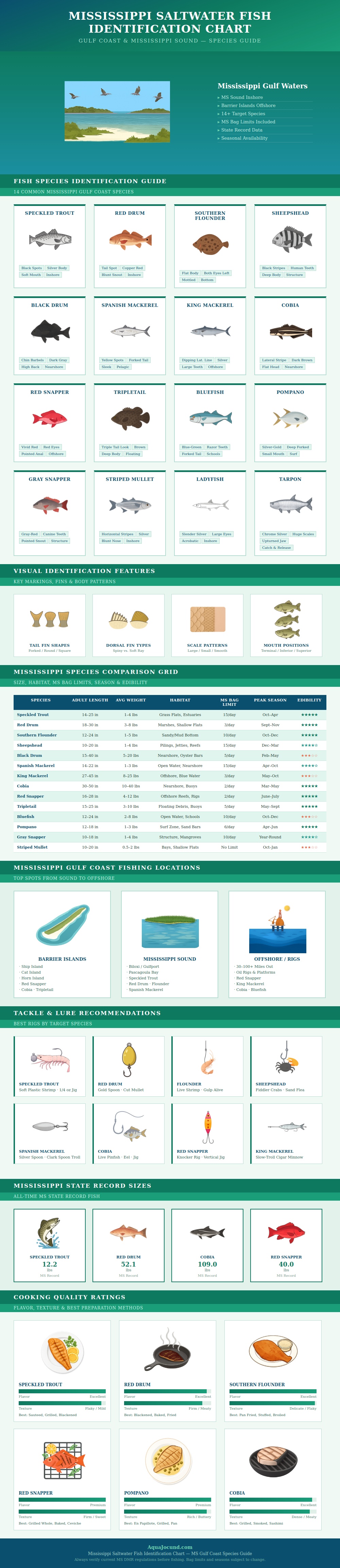
In order to fish succesfuly in an Mississippi Gulf waters, you must be able to identify the different species of fish that lives in these waters. Being able to identify the different species of fish ensures that anglers understands the bag limits of each of these fish species as set by the Mississippi Department of Marine Resources. If anglers dont correctly identify the species of the fish that they catches, they may either end up with fish past there legal limit, or they may not be able to successfully catch the types of fish that they wish catch.
Within the Mississippi Sound, two of the common fish species that lives in these waters are the speckled trout and the red drum. Speckled trout has silver bodies and black spots on there backs, and tend to live in grass flats in the Sound. Red drum have coppery red bodies, a black spot on their tail, and have blunt snout.
How to Identify and Catch Fish in the Mississippi Sound
These markings on the body of these fish can help anglers to identify their species. Additionally, the shape of the fishs fins may also help to identify the species of the fish. For example, fish with forked tails, such as Spanish mackerel, are typically fast fish that live in an open water, while fish with squared-off or rounded tails live on the bottom of the Sound.
Because each species of fish lives in different habitats within the Sound, anglers must go to the area within the Sound where the fish species that they wish to catch lives. For example, pompano live near sandbars in the surf, so anglers must go into the surf to where these fish live. Additionally, speckled trout, red drum, and flounder lives in the Sound areas around Gulfport and Pascagoula Bay.
Cobia live near buoys at Ship Island or Horn Island, and red snapper lives near the offshore oil rig. Anglers must go to these different habitat in order to catch the different species of fish. Each species of fish require a certain type of fishing tackle to catch them effectively.
For example, anglers can use soft plastic shrimp on a light jighead to catch speckled trout. Anglers can use gold spoons to catch red drum, as well as anglers can use live shrimp or gulp bait to catch flounder. Additionally, sheepshead can be found near jetties where fiddler crab live, while vertical jigs can be used to catch red snapper near the offshore oil rigs.
Without using the correct type of tackle for the species of fish that anglers wish to catch, they will not be successful in catching those species of fish. The Mississippi Department of Marine Resources set limits to the amount of fish that anglers can catch within the Sound. For instance, the bag limit for speckled trout is fifteen fish per day, while the bag limit for red drum are three fish per day.
These limits must be followed to ensure that the population of these fish species are sustainable within the Sound. The quality of the meat of these fish species also differ from one another. For instance, speckled trout has mild meat that is good for sautéing, while red drum has firm meat that is good for baking.
Flounder has delicate fish that is good for frying, while red snapper has firm meat that is good for grilling. Additionally, cobia has dense and meaty texture in its flesh, making it good for smoking. Though black drum, for instance, can have more tender flesh when the fish are small in size, the other fish species that lives in the Sound have high quality meat that anglers can enjoy eating.
