🌊 PPM to PPT Salinity Calculator
Convert TDS or EC readings into ppt salinity, estimate specific gravity, and calculate how much aquarium salt mix is needed to reach a target.
📋 Calculation Breakdown
| PPM Reading | PPT Salinity | Estimated SG | Aquarium Context |
|---|---|---|---|
| 50 ppm | 0.05 ppt | 1.0000 | Very soft freshwater |
| 150 ppm | 0.15 ppt | 1.0001 | Typical planted freshwater |
| 500 ppm | 0.50 ppt | 1.0004 | Hard freshwater / livebearer range |
| 1,000 ppm | 1.00 ppt | 1.0008 | Light freshwater salt level |
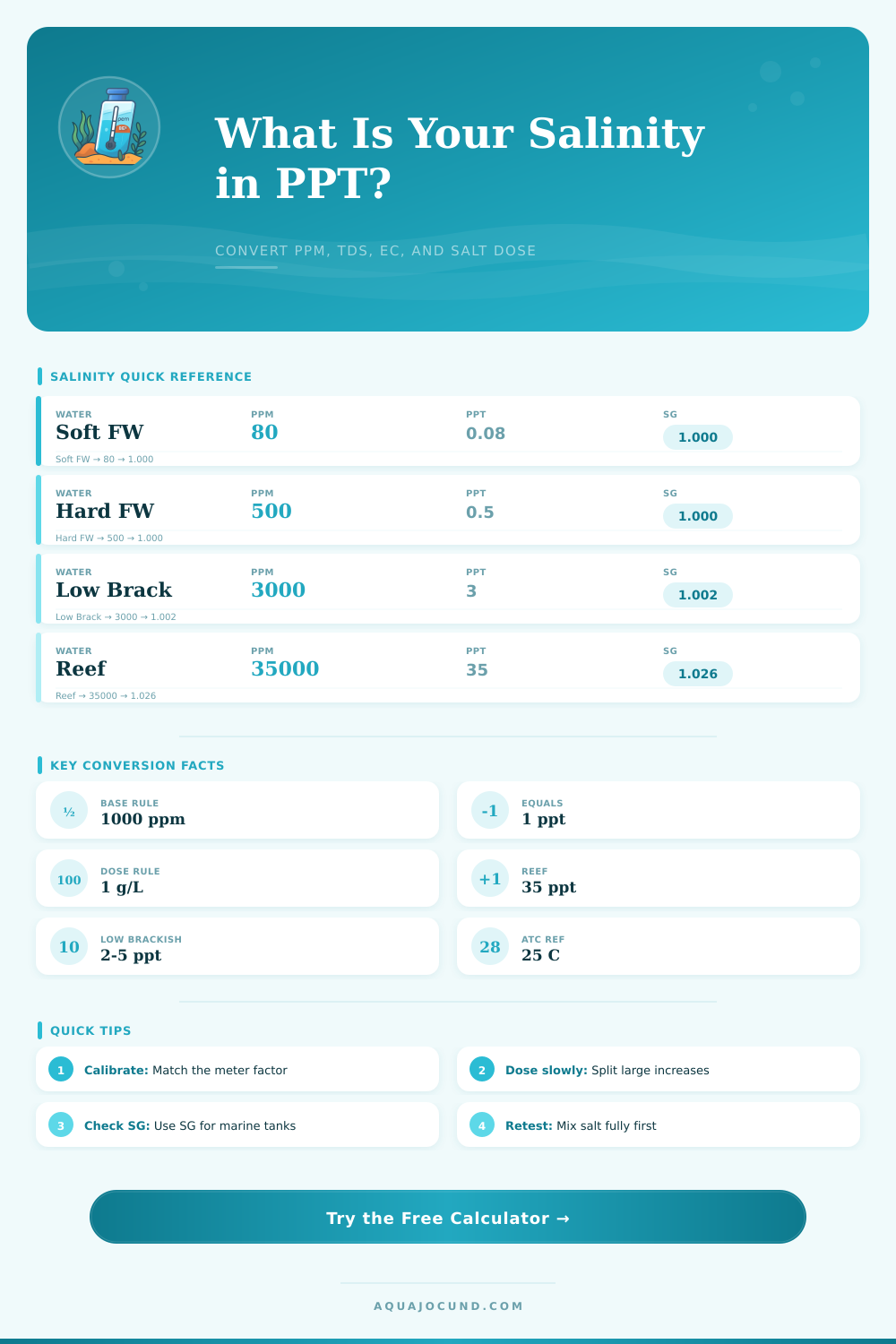
| 3,000 ppm | 3.00 ppt | 1.0023 | Low brackish |
| 8,000 ppm | 8.00 ppt | 1.0060 | Mid brackish |
| 15,000 ppm | 15.00 ppt | 1.0113 | High brackish |
| 35,000 ppm | 35.00 ppt | 1.0263 | Natural seawater / reef |
| System | Target PPT | Approx PPM | Notes |
|---|---|---|---|
| Soft freshwater fish | 0.03 to 0.15 | 30 to 150 | Discus, tetras, many planted tanks |
| Hard freshwater fish | 0.25 to 0.70 | 250 to 700 | Livebearers and mineral-rich setups |
| Freshwater tonic salt | 0.5 to 1.5 | 500 to 1,500 | Short-term support only when appropriate |
| Low brackish | 2 to 5 | 2,000 to 5,000 | Bumblebee gobies and light brackish systems |
| Mid brackish | 6 to 12 | 6,000 to 12,000 | Figure 8 puffers and similar fish |
| High brackish | 12 to 22 | 12,000 to 22,000 | Juvenile green spotted puffers |
| Marine fish-only | 30 to 35 | 30,000 to 35,000 | Lower end may be used in quarantine |
| Reef aquarium | 34 to 36 | 34,000 to 36,000 | Use a refractometer for final control |
| Meter / Source | Factor Used | Best Use | Calculator Treatment |
|---|---|---|---|
| True ppm or mg/L | 1.00 | Known dissolved salt mass | Uses reading directly |
| NaCl 500 scale | 0.50 | Aquarium salt and brackish work | Uses reading as NaCl-equivalent ppm |
| KCl 550 scale | 0.55 | Many hobby TDS meters | Normalizes to NaCl scale |
| 442 / 700 scale | 0.70 | Freshwater mineral mixes | Normalizes to NaCl scale |
| EC in microS/cm | 0.50 | Conductivity probes | EC multiplied by 0.50 |
| Refractometer SG | Not ppm | Marine and reef tanks | Use SG result as a cross-check |
| Desired Increase | Per Liter | Per US Gallon | Practical Meaning |
|---|---|---|---|
| +0.25 ppt | 0.25 g | 0.95 g | Small freshwater mineral adjustment |
| +0.50 ppt | 0.50 g | 1.89 g | Hardwater or gentle tonic range |
| +1.00 ppt | 1.00 g | 3.79 g | One part per thousand increase |
| +3.00 ppt | 3.00 g | 11.36 g | Low brackish startup step |
| +8.00 ppt | 8.00 g | 30.28 g | Mid brackish mix strength |
| +35.00 ppt | 35.00 g | 132.49 g | Approximate seawater mix before testing |
🧪 Match the Measurement Tool
TDS meters are estimates. A 500-scale NaCl meter, 700-scale meter, EC probe, and refractometer can describe the same water differently. Use the matching source option, then verify marine or reef salinity with a calibrated refractometer.
🌊 Raise Salinity Gradually
Large jumps stress fish and invertebrates. For livestock already in the tank, dissolve salt outside the aquarium and spread major increases across multiple water changes unless your species care plan says otherwise.
You might encounter a situation in which the TDS meter reading for your aquarium water differ from the instructions for the salt container. This is because TDS meters and salt containers uses different units of measurement. The TDS meter might read 3,000 ppm while the instruction for the salt container say 3 ppt.
Salinity is not a single measurement but a collection of various measurement for the same concept. The confusion between these two measurements might arise from the difference between ppm and ppt. Part per million measurements are used for measuring mineral buildup in freshwater tank.
Why TDS Meter Readings Differ From Salt Instructions
For saltwater tanks, the standard unit of measurement are parts per thousand, or ppt. This is to make the numbers easy to comprehend. Additionally, 1,000 ppm is equal to 1 ppt.
The problem with TDS meters, however, is that they might not provide an accurate reading of the ppm levels. TDS meters do not count the number of salt molecule in the tanks water. Instead, the meter measure the electrical conductivity of the water.
Based off the conductivity of the water, the TDS meter calculate the salt concentration in the water. TDS meters comes with two scales: the KCl scale and the NaCl scale. If you set the TDS meter to the KCl scale, the reading will not be accurate if the salt concentration in the water is being measured.
It is important to account for these different scale on the TDS meters so as to not add to much salt to the aquarium. Another factor to consider is the temperature of the water. The salinity reading of the water will change with the temperature of the water.
The conductivity of the water will change with the temperature. This means that the water will have a different reading with a TDS meter if it is took at a different temperature. Some TDS meters will have automatic temperature compensation.
If the TDS meter dont have automatic temperature compensation, the user must manually adjust the reading. The user must account for the temperature of the water the TDS meter is measuring. With the accurate reading of the ppt measurement of the water in the aquarium, the next step is to determine how much salt to add to the water.
It is not recommended to add salt direct into the display tank. Adding salt quick to the tank will shock the fish in the tank. Salt affect the osmosis of the water in the fishs body.
The salt must be added slowly to the tank to allow the water to reach equilibrium with the fish’s bodies. The user should mix the salt in a separate bucket before being add to the aquarium. The salt should be dissolve in the separate bucket.
Additionally, the salt water in the bucket should be of the same temperature as the water in the aquarium. For freshwater tanks that will transition to brackish tanks, adding the salt gradual over the course of a week or more is recommended to allow the fish to adjust to the change in the salinity of the water. Precision in measuring the amount of salt to add to the aquarium water is important for reef tanks.
Salt will negatively impact the coral if add incorrectly. Specific gravity is another measurement that many use to measure salinity in aquarium tank. While calculators can calculate the specific gravity of the tank water, the most accurate measurement are the refractometer.
This tool will physically verify the salinity of the water in relation to the ppm and ppt measurement. Understanding the relationship between the ppm and ppt measurements allow for individuals to manage the water chemistry of the aquarium. Water chemistry can be managed more effectively if the factors mentioned in this article is accounted for.
Maintaining stability of the water is the best way to ensure the health of the aquarium’s aquatic resident.