🌊 Salinity Calculator g/kg
Calculate aquarium salt mix by water mass, target salinity, tank shape, and correction method.
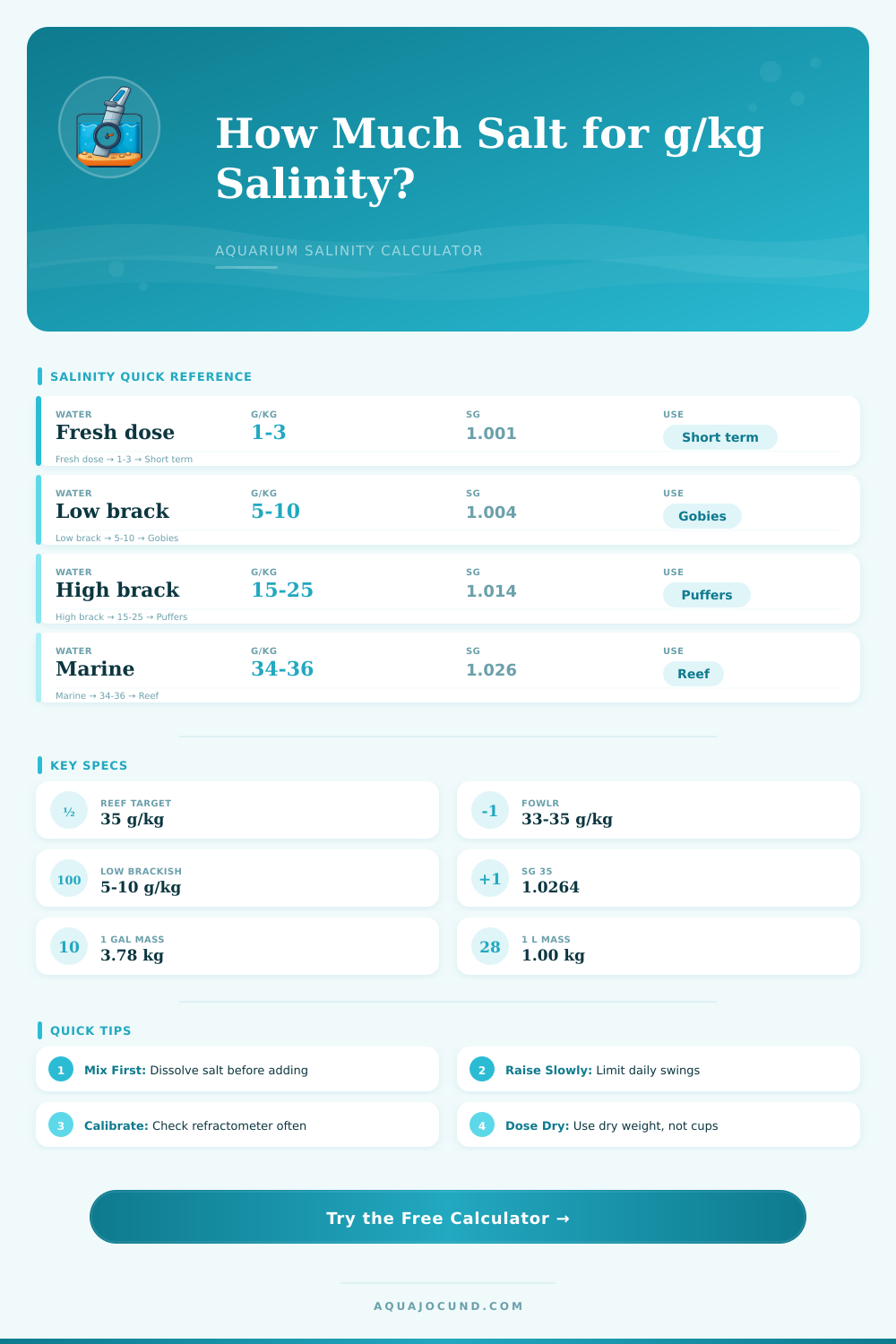
| Water Type | Salinity g/kg | Approx SG | Typical Livestock | Change Rate |
|---|---|---|---|---|
| Freshwater support dose | 1-3 | 1.0008-1.0023 | Short-term freshwater use only | Small daily steps |
| Low brackish | 5-10 | 1.0038-1.0076 | Bumblebee gobies, some shrimp | 1-2 g/kg daily |
| Moderate brackish | 10-18 | 1.0076-1.0136 | Mollies, archerfish juveniles | 2 g/kg daily |
| High brackish | 18-28 | 1.0136-1.0210 | Figure 8 puffers, monos, scats | 2-3 g/kg daily |
| Fish-only marine | 30-35 | 1.0225-1.0264 | Marine fish, live rock systems | Match water changes |
| Reef aquarium | 34-36 | 1.0257-1.0272 | Corals, invertebrates, reef fish | Keep very stable |
| Salt Type | Calculator Potency | Mineral Profile | Best Use | Mixing Note |
|---|---|---|---|---|
| Reef salt mix | 97% | Major, minor, buffer ions | Reef aquariums and coral systems | Aerate and heat before testing |
| Marine fish-only mix | 96% | Marine base ions, moderate buffers | FOWLR and predator tanks | Recheck SG after full clearing |
| Brackish mix | 95% | Marine-derived blended salts | Brackish fish and invertebrates | Raise slowly across several days |
| Plain aquarium salt | 99% | Mostly sodium chloride | Freshwater support or short dips | Not a complete marine mix |
| Pond salt | 98% | Low additive sodium chloride | Koi ponds and large freshwater vats | Weigh dry salt for accuracy |
| Lab-grade sodium chloride | 100% | Single salt compound | Calibration and controlled tests | Does not recreate seawater chemistry |
| Tank | Typical Dimensions | Net Volume After 12% | Salt for 10 g/kg | Salt for 35 g/kg |
|---|---|---|---|---|
| 5 gal | 16 x 8 x 10 in | 4.4 gal / 16.6 L | 168 g | 599 g |
| 10 gal | 20 x 10 x 12 in | 8.8 gal / 33.3 L | 336 g | 1.20 kg |
| 20 long | 30 x 12 x 12 in | 16.5 gal / 62.4 L | 630 g | 2.25 kg |
| 29 gal | 30 x 12 x 18 in | 24.7 gal / 93.5 L | 944 g | 3.37 kg |
| 40 breeder | 36 x 18 x 17 in | 35.9 gal / 136 L | 1.37 kg | 4.91 kg |
| 55 gal | 48 x 13 x 21 in | 49.9 gal / 189 L | 1.91 kg | 6.82 kg |
| 75 gal | 48 x 18 x 21 in | 69.2 gal / 262 L | 2.65 kg | 9.47 kg |
| 125 gal | 72 x 18 x 22 in | 108 gal / 409 L | 4.13 kg | 14.8 kg |
| Goal | Formula Used | Most Useful For | Important Limit |
|---|---|---|---|
| Raise | Dry salt into existing water mass | New brackish or marine ramp-up | Dose in stages for livestock |
| New Mix | Target g/kg from zero salinity | Fresh saltwater batches | Test after salt fully dissolves |
| Water Change | New water salinity needed for chosen percent | Correcting small SG errors | May exceed practical mix strength |
| Dilute | Freshwater fraction to lower salinity | Reducing over-salted tanks | Lower slowly with sensitive animals |
Weigh salt by grams or ounces. Cups vary by grain size, moisture, and brand. Mix in a separate container, heat and circulate it, then confirm with a calibrated refractometer before adding it to livestock.
Do not chase numbers quickly. Fish and invertebrates tolerate stable salinity better than sudden corrections. Split large increases or decreases across multiple water changes when animals are present.
Salinity are the measurement of the salt concentration within a body of water. The livestock within an aquarium require stable salinity to survive. When measuring the salinity of an aquarium using a refractometer, the reading obtained from the refractometer may not reflect the actual salinity of the water.
If an individual adds to many salt to the water of an aquarium, they will eventualy have to add freshwater to dilute the water. This process of over-salting the water followed by over-diluting the water can stress the livestock within an aquarium. To avoid stressing the livestock within an aquarium, an individual must understand how to calculate the amount of salt that should be added to the water to maintain the salinity level required for the livestock to survive.
How to Measure and Keep Aquarium Salt Levels Stable
Salinity is often measured in grams of salt per kilogram of water. This unit of measurement is more precise than measuring the volume of the salt that is added to the water. Salt possess mass.
Additionally, salt molecules occupy physical space within the water. When calculating the salinity of water, if an individual use the volume of the water as a measurement unit, the calculations will not reflect the actual salinity of the water. An individual must calculate the actual volume of the water within the aquarium.
The manufacturer of the aquarium often labels the volume of an aquarium as the nominal volume. The nominal volume of an aquarium is not the same as the actual volume of water that the aquarium can hold. The actual volume of water in an aquarium is less than the nominal volume if the aquarium contain sand, live rock, and bulkheads.
These items contain mass. Additionally, they take up the same amount of space as the water in the aquarium. Because of this, the actual volume of an aquarium is less than the nominal volume of the aquarium.
If an individual calculates the amount of salt that should be added to an aquarium without accounting for the displacement of water by aquarium contents, the individual will add too much salt to the water. An individual must also take into account the type of salt that is to be added to the water. For example, the type of salt that is used in freshwater aquarium is different than the type of salt used in saltwater aquariums.
Additionally, salt mixes available from aquarium shops often contain extra minerals, such as strontium and buffers. These minerals has mass; they are an additional component to the salt mix. The presence of these minerals can impact the salinity of the water.
An individual must consider the potency of the salt mix that they will be using. The potency of a salt mix determine the amount of salt that is required to reach the desired salinity level in the aquarium. An individual must also take into account the temperature of the water in the aquarium.
The density of water changes with the temperature of the water. The warmer the water, the less dense the water becomes. Conversely, the colder the water, the more dense the water molecules become.
Because of the relationship between salinity and density, the temperature of the water will impact the salinity of the water. An individual must take into account the temperature of the water within the aquarium. If an individual measures the salinity of the water when the water is warm, and then measures the salinity again when the water is colder, the salinity readings will be different.
To correct the salinity of an aquarium, an individual can either add dry salt to the aquarium or perform a water change. Adding dry salt to the aquarium is a fast method of correcting salinity error. However, if an individual adds dry salt to the water without first dissolving the salt in water, the salinity of the water may spike in certain localized area of the aquarium.
Performing a water change is a safer method of correcting salinity errors for the livestock in the aquarium. During a water change, the individual must mix the aquarium water and freshwater together in a specific ratio to achieve a higher salinity level for the new water. The new water with a higher salinity level will raise the average salinity level in the aquarium.
Salinity changes should not be made quickly within an aquarium. Fish and invertebrates can tolerate many different condition within their aquarium environment. However, rapid changes in salinity will negatively impact the health of the fish and invertebrates within the aquarium.
If an individual must change the salinity of the aquarium by a significant amount, the individual must execute the change over several days to allow the fish osmotic pressure to adjust to the new salinity of the water. An individual desires to maintain the salinity of the water within an aquarium at the same level for the health of the fish and invertebrates that live within the water. Salinity must remain consistent for the livestock within the aquarium to avoid the development of disease and to encourage their growth.