Pond Rock Calculator
Estimate shoreline border stone, submerged shelf gravel, accent boulder weight, and water displacement from one pond layout. Switch units, compare rock blends, and plan a realistic reserve.
| Blend | Bulk density | Best depth | Typical use |
|---|---|---|---|
| Pea gravel | 96 lb/ft³ | 2–3 in | Plant shelves and gentle entries |
| River rock | 105 lb/ft³ | 3–4 in | Natural shoreline and mixed pond edges |
| Rounded cobble | 104 lb/ft³ | 4–5 in | Broader shelves with casual texture |
| Granite boulders | 108 lb/ft³ | 4–6 in | Heavy edge lock and focal clusters |
| Basalt armor stone | 112 lb/ft³ | 4–6 in | Formal runs, spillways, hard corners |
| Limestone ledge | 95 lb/ft³ | 3–5 in | Layered banks and retaining lips |
| Slate flats | 90 lb/ft³ | 2–4 in | Thin shelves, cap pieces, tidy rims |
| Lava stone | 62 lb/ft³ | 4–5 in | Bog shelves and light biofilter fill |
| Pond | Dimensions | Footprint | Typical rock plan |
|---|---|---|---|
| Patio accent | 6 × 8 ft | 48 sq ft | 120–170 lb |
| Wildlife oval | 8 × 12 ft | 75 sq ft | 260–360 lb |
| Formal square | 8 × 8 ft | 64 sq ft | 210–320 lb |
| Stream run | 6 × 18 ft | 78 sq ft | 380–560 lb |
| Koi rectangle | 10 × 14 ft | 140 sq ft | 520–760 lb |
| Natural kidney | 11 × 16 ft | 127 sq ft | 560–860 lb |
| Large feature | 14 × 20 ft | 280 sq ft | 1.1–1.6 tons |
| Use case | Typical depth | Loading guide | Best fit |
|---|---|---|---|
| Pea shelf cover | 2 in | 16 lb per sq ft | Plant baskets and shallow ledges |
| River edge band | 3 in | 26 lb per sq ft | Most decorative borders |
| Cobble lock course | 4 in | 35 lb per sq ft | Natural edges that need hold |
| Basalt armor line | 5 in | 47 lb per sq ft | Hard rain paths and cascades |
| Accent stone | 10 in | 18–28 lb each | Small focal pieces |
| Accent stone | 14 in | 55–85 lb each | Bank anchors and corner sets |
| Accent stone | 18 in | 120–180 lb each | Statement edges and spillway tops |
When you are building a pond, calculating the amount of pond rock that is need for the project is an essential task. If you buy to little pond rock, the pond’s edge will begin to erode. If you buy to many pond rock, you will spend money on rock that you will not utilize in the construction of the pond.
In determining the amount of pond rock that you need for your project, you must consider both the shape of the pond and the type of pond rock that you will use. The shape of the pond will impact the length of the shoreline that must be cover in pond rock. Rectangular ponds are easy to measure, but ponds in the shape of an oval or a kidney is more difficult to measure.
How Much Pond Rock Do You Need
Instead of guessing the perimeter of the pond, measuring the shoreline of the pond with a string will provide you with a more accurate measurement of the length of the border that needs to be covered in pond rock. Additionally, the width of the border for the pond will impact the amount of pond rock that is needed. For instance, the border of a pond that is to be used as a wildlife pond will be wider than the border of a koi pond.
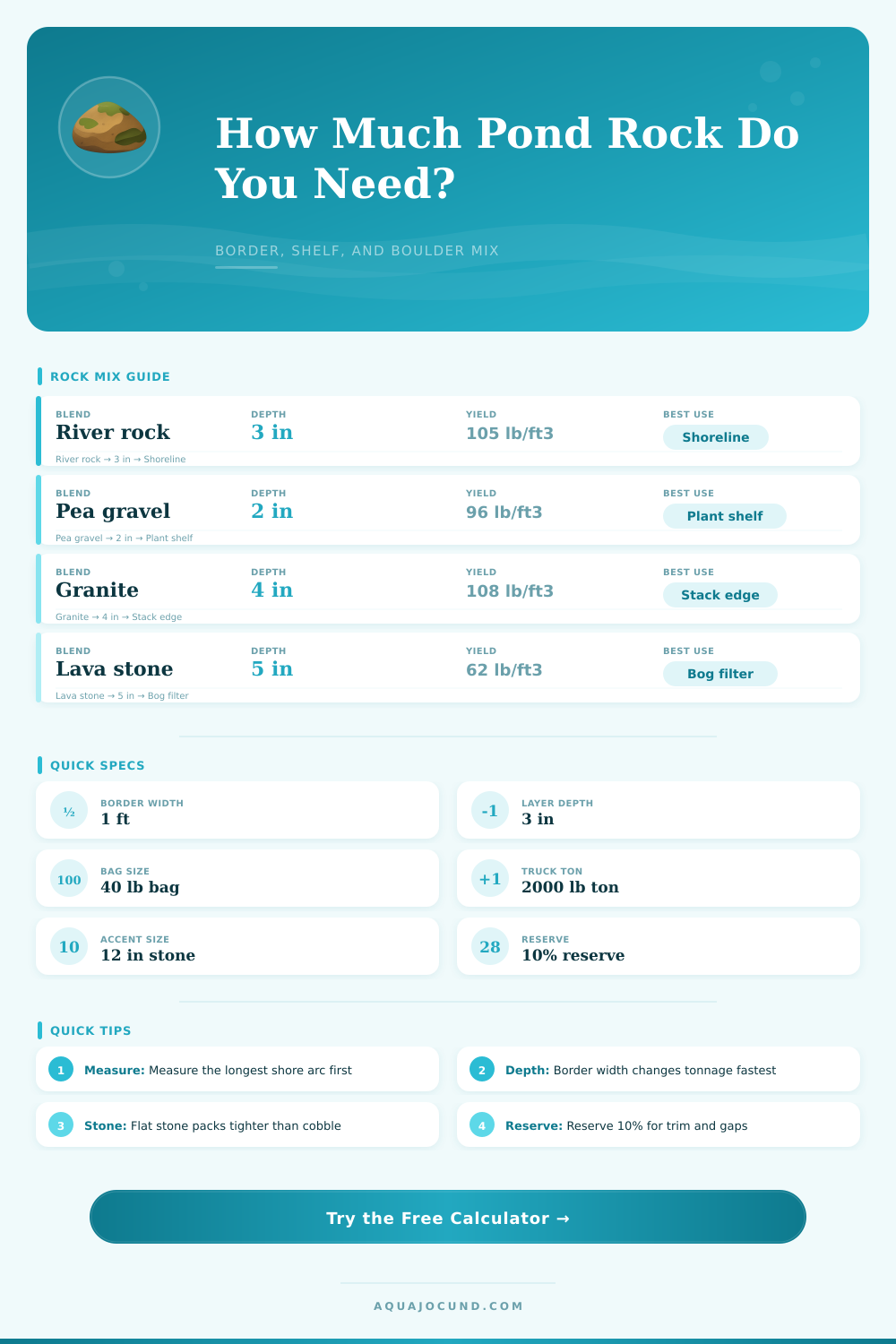
The type of pond rock that is used will impact the total weight of the pond rock. For instance, river rock weighs approximately 105 pounds per cubic foot. Because river rock have voids in the stones, it is often used for wildlife ponds as they require drainage.
Pea gravel weighs approximately 96 pounds per cubic foot. Pea gravel allows the roots of pond plants to breathe, so it is used in constructing plant shelves. Lava stone weigh approximately 62 pounds per cubic foot.
Because lava stone is porous, it is often used in constructing bog filters for the pond. Additionally, the depth of the pond rock will be between 2 and 5 inch. Flat stones, such as slate stones will pack tightly together, but rounded stones, such as cobbles will require deeper beds for stability.
The depth of the pond rock will also impact the stability of the ponds edge. For instance, a bed of 3 inches deep will not be able to hold 4-inch boulders. The depth of the boulders will have to be 5 or 6 inches deep in order for them to be stable on the pond’s edge.
Depending upon the profile of the pond’s edge, the amount of pond rock will change. For example, if the pond features a boulder bank, more heavy rock will be needed to line the perimeter of the bank. Instead, if the pond features a natural mix of pond rock, there will be a balance in the weight of the pond rock that you will use to line both the border of the pond and the shelves in the pond.
Should you plan to add accent stones to the pond, you will need to add the weight of the accent stones to the total weight calculation for the pond rock. Additionally, it is a good idea to purchase 10% extra pond rock in case some of the rock is needed to fill in the gaps between rocks of the pond or to purchase trim pieces of rock. Should the pond feature any submerged shelves in addition to the dry borders, additional calculations will need to be made regarding the amount of pond rock.
For example, if you place gravel on a shelf that is submerged in the pond, the gravel will displace the amount of water in that part of the pond. For this reason, the pond will hold less water then the depth of the pond liner indicates. Additionally, dry borders for the pond will impact the total weight of the pond rock that is needed to be ordered, but the submerged shelves will impact the total amount of water the pond can hold.
The amount of water that a pond can hold will impact the size of the pump that will be needed for that pond. In order to determine the amount of pond rock that is needed for the pond, you can use the standard measurements for rock weights. Small ponds that are 6-by-8 feet in size may require between 120 and 170 pounds of river rock.
You can move this amount of river rock by hand when placing the rock into the pond. For larger ponds that are 14-by-20 feet in size, there may be the need for 1.1 to 1.6 tons of granite for covering the perimeter of the pond. This amount of rock is heavy and will require the use of a skid steer to move such rocks into the pond.
In addition to calculating the amount of rock that is needed to line the pond, you will also need to consider other factors regarding purchasing the rock. For example, wet rock weighs 20% more than dry rock. Thus, if you are purchasing the pond rock, you should ensure that the pond rock will be delivered on a dry day.
Another consideration is the access to the site where the pond will be constructed. For example, if the gate to the site is narrow, you may need to purchase bagged pea gravel instead of boulders in bulk. It is also important to avoid ignoring the slope of the ground on which the pond will be constructed.
For example, if the ground features uneven slopes, it will be necessary to construct stepped ledges into the banks of the pond. These ledges will require additional amounts of pond rock to line the banks of the pond. Thus, if you take the time to calculate the shape, depth and weight of the pond rock correctly, you will have the correct amount of pond rock for your construction project.