🌡️ Cichlid Fish Water Temperature Checker
Enter your cichlid species and current water temperature to get ideal range analysis, heater sizing, and temperature health status.
| Cichlid Species Group | Min Temp (°F / °C) | Max Temp (°F / °C) | Ideal Range (°F) | Optimal (°F) |
|---|---|---|---|---|
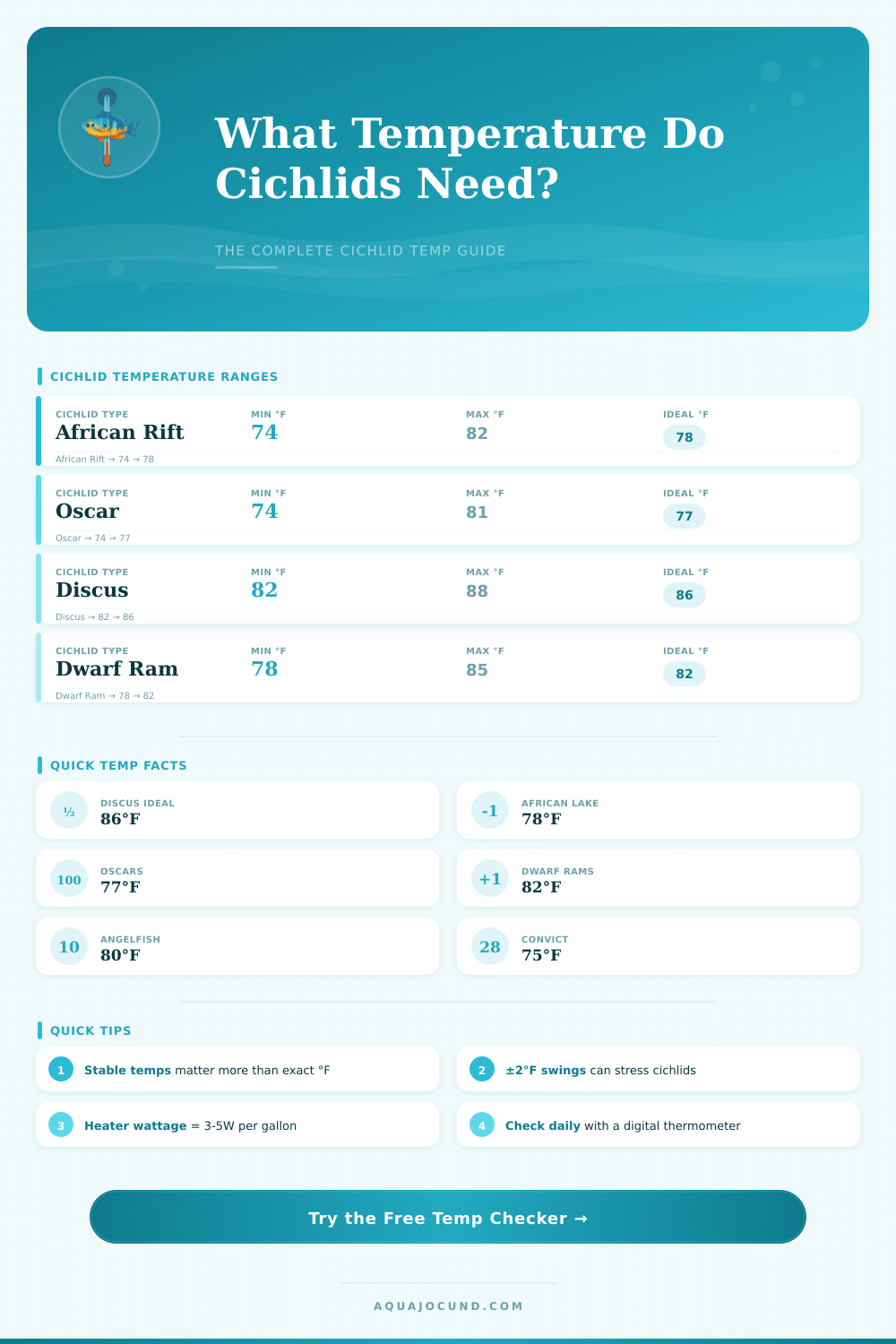
| African Mbuna (Lake Malawi) | 74°F / 23.3°C | 82°F / 27.8°C | 76°–80°F | 78°F |
| African Peacock / Hap (Malawi) | 74°F / 23.3°C | 82°F / 27.8°C | 76°–80°F | 78°F |
| Tanganyika Cichlids | 73°F / 22.8°C | 81°F / 27.2°C | 75°–79°F | 77°F |
| Victorian Cichlids | 73°F / 22.8°C | 80°F / 26.7°C | 74°–78°F | 76°F |
| Oscar (Astronotus) | 74°F / 23.3°C | 81°F / 27.2°C | 75°–80°F | 77°F |
| Discus (Symphysodon) | 82°F / 27.8°C | 88°F / 31.1°C | 84°–88°F | 86°F |
| Angelfish (Pterophyllum) | 75°F / 23.9°C | 84°F / 28.9°C | 78°–82°F | 80°F |
| Dwarf Ram / German Blue Ram | 78°F / 25.6°C | 85°F / 29.4°C | 80°–84°F | 82°F |
| Firemouth Cichlid | 70°F / 21.1°C | 80°F / 26.7°C | 73°–78°F | 76°F |
| Convict Cichlid | 68°F / 20°C | 80°F / 26.7°C | 72°–78°F | 75°F |
| Green Terror | 68°F / 20°C | 77°F / 25°C | 70°–76°F | 73°F |
| Flowerhorn Cichlid | 78°F / 25.6°C | 85°F / 29.4°C | 80°–84°F | 82°F |
| Tank Name | Dimensions (L x W x H in) | Volume (Gal / L) | Std Heater (W) | Discus Heater (W) |
|---|---|---|---|---|
| 10 Gallon Nano | 20 x 10 x 12 | 10 gal / 37.9 L | 50W | 75W |
| 20 Gallon High | 24 x 12 x 16 | 20 gal / 75.7 L | 75W | 150W |
| 29 Gallon Standard | 30 x 12 x 18 | 29 gal / 109.8 L | 100W | 200W |
| 40 Gallon Breeder | 36 x 18 x 16 | 40 gal / 151.4 L | 150W | 250W |
| 55 Gallon Standard | 48 x 13 x 21 | 55 gal / 208.2 L | 200W | 350W |
| 75 Gallon Standard | 48 x 18 x 21 | 75 gal / 283.9 L | 300W | 500W |
| 90 Gallon Standard | 48 x 18 x 24 | 90 gal / 340.7 L | 350W | 600W |
| 125 Gallon Standard | 72 x 18 x 22 | 125 gal / 473.2 L | 500W | 800W |
| °F | °C | Status for Most Cichlids | Notes |
|---|---|---|---|
| 65°F | 18.3°C | ❌ Too Cold | Risk of ich, lethargy, immune failure |
| 68°F | 20°C | ⚠️ Borderline | OK for Convict & Green Terror only |
| 72°F | 22.2°C | ⚠️ Slightly Cool | Acceptable for hardy Central American types |
| 75°F | 23.9°C | ✅ Acceptable | Low end of most African cichlid ranges |
| 78°F | 25.6°C | ✅ Optimal | Ideal for Mbuna, Malawi, Tanganyika types |
| 80°F | 26.7°C | ✅ Optimal | Great for Angelfish, Oscars, S. American |
| 82°F | 27.8°C | ✅ Optimal | Ideal for Rams, Flowerhorn, Discus low-end |
| 86°F | 30°C | ✅ Discus Optimal | Required for Discus; stressful for others |
| 88°F | 31.1°C | ⚠️ High | Max for Discus; too hot for all others |
| 90°F | 32.2°C | ❌ Too Hot | Dangerous for all cichlids, oxygen depletion |
Temperature is one of those things that can help or hurt your fishing experience. Every species has its own tastes, and if you pass the limit with too high values, you find real trouble. Tropical fishes live best in the range of 75 to 80 degrees while fishes for cold water, like goldfish, like to stay under 70.
Species for middle temperatures? They feel well between both worlds, in a comfortable center.
Right Water Temperatures for Fish in Your Tank
When one sets up an average aquarium, the most species do well between 24 and 28 degrees Celsius, which matches around 75 to 82 degrees Fahrenheit. Many fish keepers choose 78 degrees as a solid base for tropical setups. In a tank with fishes of different needs, one usually finds a compromise for the difference.
A value around 25 degrees Celsius most commonly keeps the shared fishes happy, without forcing some from their comfortable area.
Goldfish are truly easygoing and handle normal room temperatures between 60 and 75 degrees. Fancy types with long tails favor something nearer to 65 to 72. If one heats the water to 78 degrees, because one has tropics?
Goldfish handle that, yes, but they will not thank you. Mollies like warmer water, between 74 and 80 degrees. Discus fish?
Those need it really warm. Neon tetras fit between 70 and 78, although the most seem happiest around 75. Cherry tetras and rummy-nose tetras can take much more warm water (even to 86 degrees), for years without problems.
Bettas must stay in the window of 76 to 82 degrees. If the Water Temperature falls outside that range for a long time, health troubles start to appear. The lowest limit for betta is 76, but honest, 78 to 80 work more well.
Here the thing with fishes: they do not like sudden change. A jump of temperature more then some degrees stresses them and opens the door to diseases. Small changes of one or two degrees during a day?
That is fine and does not bother them. Stability is better than chasing perfect numbers each time. Keeping the Water Temperature a bit warmer, around 80 to 82 degrees, can help against ich, a parasite that lives in cool 70-degree water.
Every tank needs a good thermometer that one truly can trust. Both underwater and hanging heaters exist, and the most come with automatic control of Water Temperature. Tropical fishes usually need a heater at least in winter.
But summer changes the situation. Hot water does not hold oxygen well, so an extra air stone becomes your friend. If the Water Temperature jumps too high, one can float ice bags in the tank to bringit down.
Steady high temperatures speed up the body of fishes, which can shorten their lifetime over time. Keeping the heater on a slightly low level also helps, because if something breaks, the water does not heat up too quickly.