🐠 Angelfish Water Temperature Checker
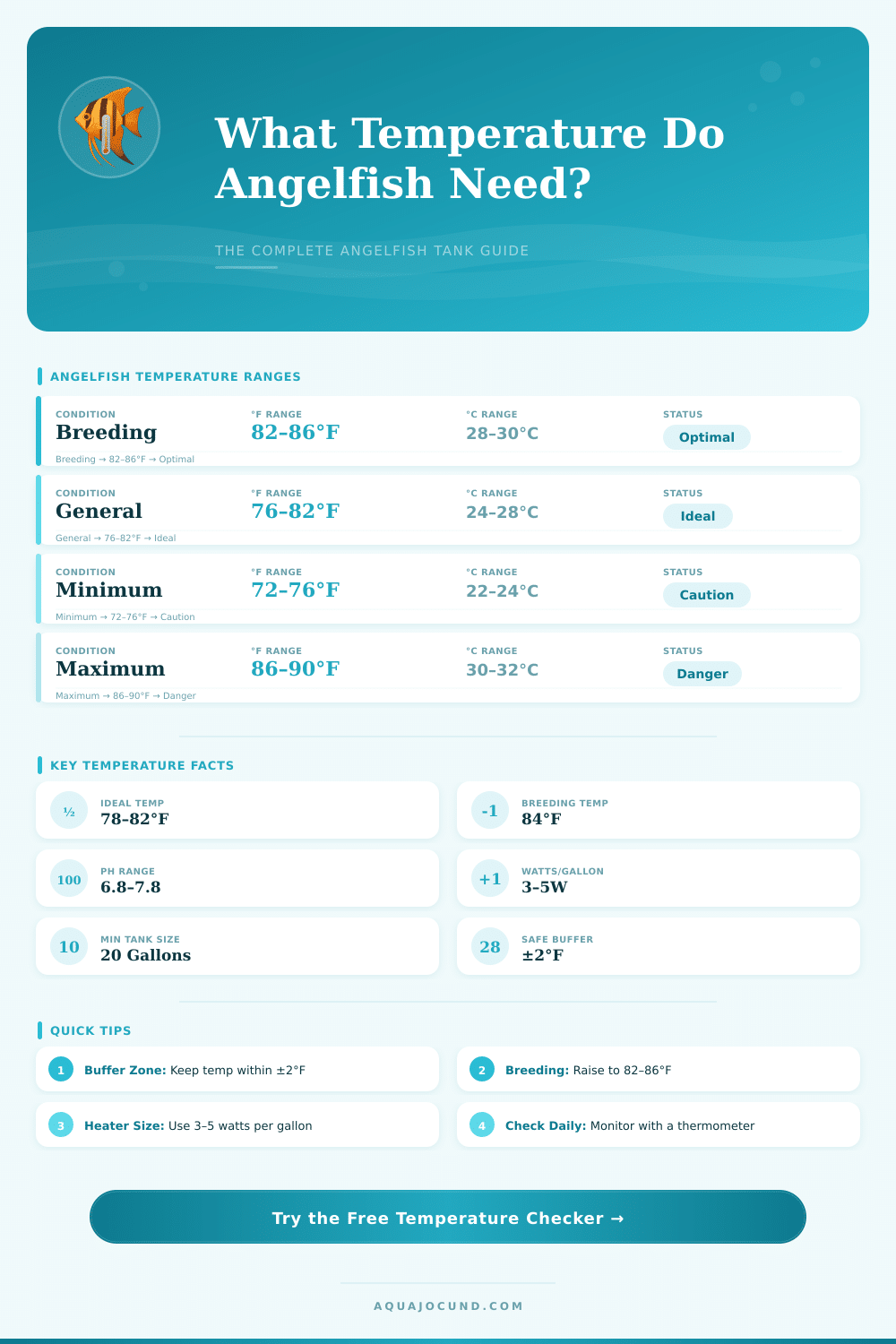
Check if your water temperature is safe, ideal, or dangerous for angelfish — get heater size recommendations and tank data instantly.
| Scenario | Temp Range (°F) | Temp Range (°C) | Heater Wattage | Status |
|---|---|---|---|---|
| General Community | 76–80°F | 24–27°C | 3W/gal | Good |
| Planted Tank | 76–82°F | 24–28°C | 3–4W/gal | Optimal |
| Breeding Setup | 82–86°F | 28–30°C | 4–5W/gal | Optimal |
| Show / Display | 78–82°F | 26–28°C | 3–4W/gal | Optimal |
| Juvenile Grow-Out | 80–84°F | 27–29°C | 4W/gal | Good |
| Quarantine Tank | 80–84°F | 27–29°C | 5W/gal | Elevated |
| Too Cold (<72°F) | Below 72°F | Below 22°C | Upgrade Heater | Danger |
| Too Hot (>88°F) | Above 88°F | Above 31°C | Reduce/Cool | Danger |
| Tank Name | Dimensions (L×W×H in) | Volume (gal) | Volume (L) | Rec. Heater |
|---|---|---|---|---|
| 10 Gallon Nano | 20 × 10 × 12 | 10 gal | 38 L | 50W |
| 20 Gallon Long | 30 × 12 × 12 | 20 gal | 76 L | 75W |
| 29 Gallon Standard | 30 × 12 × 18 | 29 gal | 110 L | 100W |
| 40 Gallon Breeder | 36 × 18 × 16 | 40 gal | 151 L | 150W |
| 55 Gallon Standard | 48 × 13 × 21 | 55 gal | 208 L | 200W |
| 75 Gallon Standard | 48 × 18 × 21 | 75 gal | 284 L | 250W |
| 90 Gallon Standard | 48 × 18 × 24 | 90 gal | 341 L | 300W |
| 125 Gallon Standard | 72 × 18 × 22 | 125 gal | 473 L | 400W |
| Heater Type | Best For | Accuracy | Max Tank Size | Notes |
|---|---|---|---|---|
| Submersible | All tanks | –2°F | Any size | Most common type |
| Inline | Canister systems | ଐ.5°F | 100+ gal | Hidden; very accurate |
| Substrate Cable | Planted tanks | °F | 75 gal | Roots benefit from warmth |
| Sump Heater | Large tanks | °F | 200+ gal | Safe; fish can't touch it |
| Dual Combo | Breeding/Show | ଐ.5°F | Any size | Redundancy for safety |
| No Heater | Warm climates only | Varies | — | Risk if room temp drops |
Keeping the right water temperature in aquariums is more important than many believe. Most tropical fish like to settle in water between 75 and 80 degrees Fahrenheit which matches around 24 to 27 degrees Celsius. Cold water fish, like goldfish, like a bit colder surroundings, usually between 60 and 75 degrees Fahrenheit.
Goldfish specifically benefit at 65 to 68 degrees, and 70 degrees already is the maximum heat for them.
Right Water Temperature for Your Aquarium
Some species however require even higher values. Discus fish like around 80 to 82 degrees Fahrenheit, and during breeding they maybe require water up to 86 degrees warm. Angel fish fare well between 74 and 82 degrees, with their best zone at 77 to 78.
Neon tetras can exist in water of 70 to 78 degrees, but the best is exactly around 75.
Fast change of water temperature or frequent shifts can really stress the fish. So set up the aquarium tools carefully. When the room conditions stay warm during the whole year or the home sits in a tropical region, maybe you do not require a heater.
If a heater even so is needed, best is keep the heat steady and alter it only for special cases, for instance for treating disease or for starting breeding.
Warm season can create real troubles. When the surrounding air long term heats the aquarium to the high 80s degrees, we must act to cool it. A simple way is replace the usual cover of the tank with a screen and direct a fan over the water surface.
Turn the heaters of the tank off in warm days and close curtains also help too lower the heat to a better level.
High water temperature indeed holds fewer oxygen, which matters bad for the fish. At around 79 degrees Fahrenheit it also becomes more hard to keep CO2 settled in the water, because the ability of gases to dissolve sinks when the heat grows. That partly explains why planted aquariums at higher values commonly have more problems with algae.
Planted aquariums around 72 to 75 degrees usually suffer less because of algae.
Freshwater aquariums widely should have water temperature between 22 and 28 degrees Celsius, with middle value per species preferred. Searching the exact needs of every species is the wise approach. Many temperature ranges available online are only general tips, not strict rules.
In big aquariums above 55 gallons the heat can mildly range between two spots. Little differences, like 76 against 78 degrees, probably do not harm the fish. Saltwater aquariums only for fish widely like between 75 and 82 degrees.
For coral setups stability is key, so choose a fixed water temperature andescape shifts seriously help to stop problems like bleaching of corals.