🌡️ Tropical Fish Water Temperature Checker
Check ideal temperatures for your tropical fish, calculate heater wattage, and verify your tank settings in °F and °C
| Fish Species | Min °F (°C) | Ideal °F (°C) | Max °F (°C) | Tolerance |
|---|---|---|---|---|
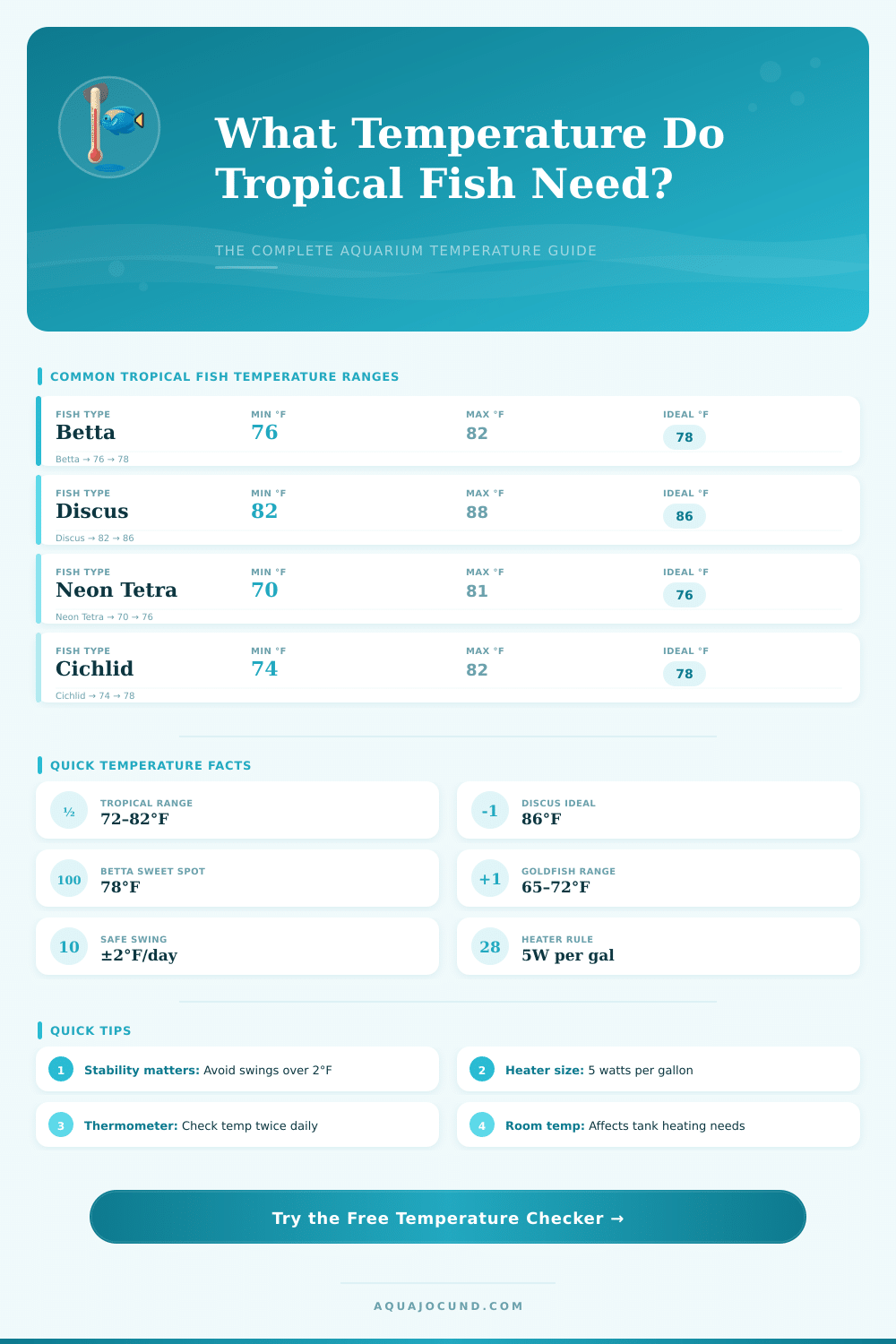
| Betta Fish | 76°F (24.4°C) | 78°F (25.6°C) | 82°F (27.8°C) | Moderate |
| Neon Tetra | 70°F (21.1°C) | 76°F (24.4°C) | 81°F (27.2°C) | High |
| Discus | 82°F (27.8°C) | 86°F (30°C) | 88°F (31.1°C) | Low |
| African Cichlid | 74°F (23.3°C) | 78°F (25.6°C) | 82°F (27.8°C) | High |
| Guppy | 72°F (22.2°C) | 76°F (24.4°C) | 82°F (27.8°C) | High |
| Angelfish | 78°F (25.6°C) | 80°F (26.7°C) | 84°F (28.9°C) | Moderate |
| Corydoras Catfish | 72°F (22.2°C) | 76°F (24.4°C) | 79°F (26.1°C) | Moderate |
| Oscar | 74°F (23.3°C) | 78°F (25.6°C) | 81°F (27.2°C) | High |
| Rainbowfish | 74°F (23.3°C) | 77°F (25°C) | 81°F (27.2°C) | High |
| Freshwater Shrimp | 70°F (21.1°C) | 74°F (23.3°C) | 78°F (25.6°C) | Low |
| Goldfish | 65°F (18.3°C) | 68°F (20°C) | 72°F (22.2°C) | High |
| Generic Tropical | 72°F (22.2°C) | 78°F (25.6°C) | 82°F (27.8°C) | High |
| Tank Size | Volume (Gal / L) | Min Watts (ΔT 5°F) | Rec Watts (ΔT 10°F) | Max Watts (ΔT 20°F) |
|---|---|---|---|---|
| Nano / Pico | 5 gal / 19 L | 25W | 50W | 75W |
| Small | 10 gal / 38 L | 50W | 75W | 100W |
| Medium | 20 gal / 76 L | 75W | 100W | 150W |
| Standard | 29 gal / 110 L | 100W | 150W | 200W |
| Large | 55 gal / 208 L | 150W | 200W | 300W |
| Extra Large | 75 gal / 284 L | 200W | 300W | 400W |
| Show Tank | 125 gal / 473 L | 300W | 500W | 600W |
| Tank Name | Dimensions (L x W x H in) | Volume (Gal) | Volume (L) |
|---|---|---|---|
| 5 Gallon Nano | 16 x 8 x 10 | 5 | 18.9 |
| 10 Gallon Standard | 20 x 10 x 12 | 10 | 37.9 |
| 20 Gallon Long | 30 x 12 x 12 | 20 | 75.7 |
| 29 Gallon | 30 x 12 x 18 | 29 | 109.8 |
| 40 Gallon Breeder | 36 x 18 x 16 | 40 | 151.4 |
| 55 Gallon | 48 x 13 x 21 | 55 | 208.2 |
| 75 Gallon | 48 x 18 x 21 | 75 | 283.9 |
| 125 Gallon | 72 x 18 x 22 | 125 | 473.2 |
| Material | Insulation Factor | Heat Loss Rate | Heater Efficiency |
|---|---|---|---|
| Standard Glass | Low (1.0x base) | High | ~85% |
| Tempered Glass | Low (1.0x base) | High | ~85% |
| Acrylic | Medium (0.85x) | Medium | ~90% |
| Rimless Glass | Low (1.05x) | Very High | ~82% |
| Polycarbonate | Good (0.75x) | Low | ~93% |
| Stainless Steel Frame | Low (1.0x base) | High | ~85% |
The water temperature in a tank affects more than many folks think. Every species of fish has its own ideal range for heat, and if one goes outside those, the stress can quickly build. Tropical fish usually like living in around 24 to 27 degrees Celsius while species from fresh water best feel themselves between 16 and 24 degrees.
Before choosing your first fish well know what conditions make certain species comfortable.
Why Water Temperature Is Important for Fish
Most tropical fish setups work best at 24 to 27 degrees Celsius, that is around 76 to 80 degrees Fahrenheit for those that use the imperial system. For tropical tanks you need a reliable heater. Here where things become tricky: some fish, like discus, truly require very warm waters, while cory species favour a bit cooler conditions.
Goldfish, on the other hand? They belong to cold water fish and commonly do not require a heater. The room water temperature between 16 and 24 degeres answer them entirely well.
Mollies can adapt well somewhere between 23 and 27 degrees. Betta fish feel themselves best at around 27 degrees, if the heat falls too much, they start to act lazy, like maybe they hibernate. Keeping bettas in only 23 degrees seems to them a bit cool, truly.
They favour to stay between 26 and 27 degrees.
When one fills their tank, choose fish whose needs about water temperature well match. Problems emerge when one species wants exactly what another wants to escape. This average way seems good on paper, but in practice it stresses both parties, one always feels too cold, while the other too warm.
Mix tropical and cold water fish together? That simply invites misfortune, because one half of the group always will live in bad surroundings.
Sudden changes in water temperature or big swings strongly stress the aquatic life. A small tank can quickly warm or cool according to what happens around it. Really that sudden move causes the biggest damage.
Try to stay always close to the ideal value, instead of chasing a perfect number.
Too fast raising of the water temperature quickly ages the fish. Their hearts must work harder, they use more energy just to stay alive, and warm water holds less oxygen then cold. Like this your fish needs more oxygen, while the tank delivers less.
That creates a truly bad mix.
When one works with the water temperature, do it slowly. One degree a day helps to keep everything smooth. Simple stick thermometers?
They commonly show more the air on the glass than the real water. Take rather a proper aquarium thermometer (it is cheap and faithful). Lay it in the water for a moment, and you knowthe truth.
Without a heater the tank runs at room temperature, and if it feels a bit cool in your hand, the fish inside probably are in good state.