🐟 Fish Farming Yield Per Acre Calculator
Estimate annual harvest weight based on pond size, species, stocking density, and farming intensity
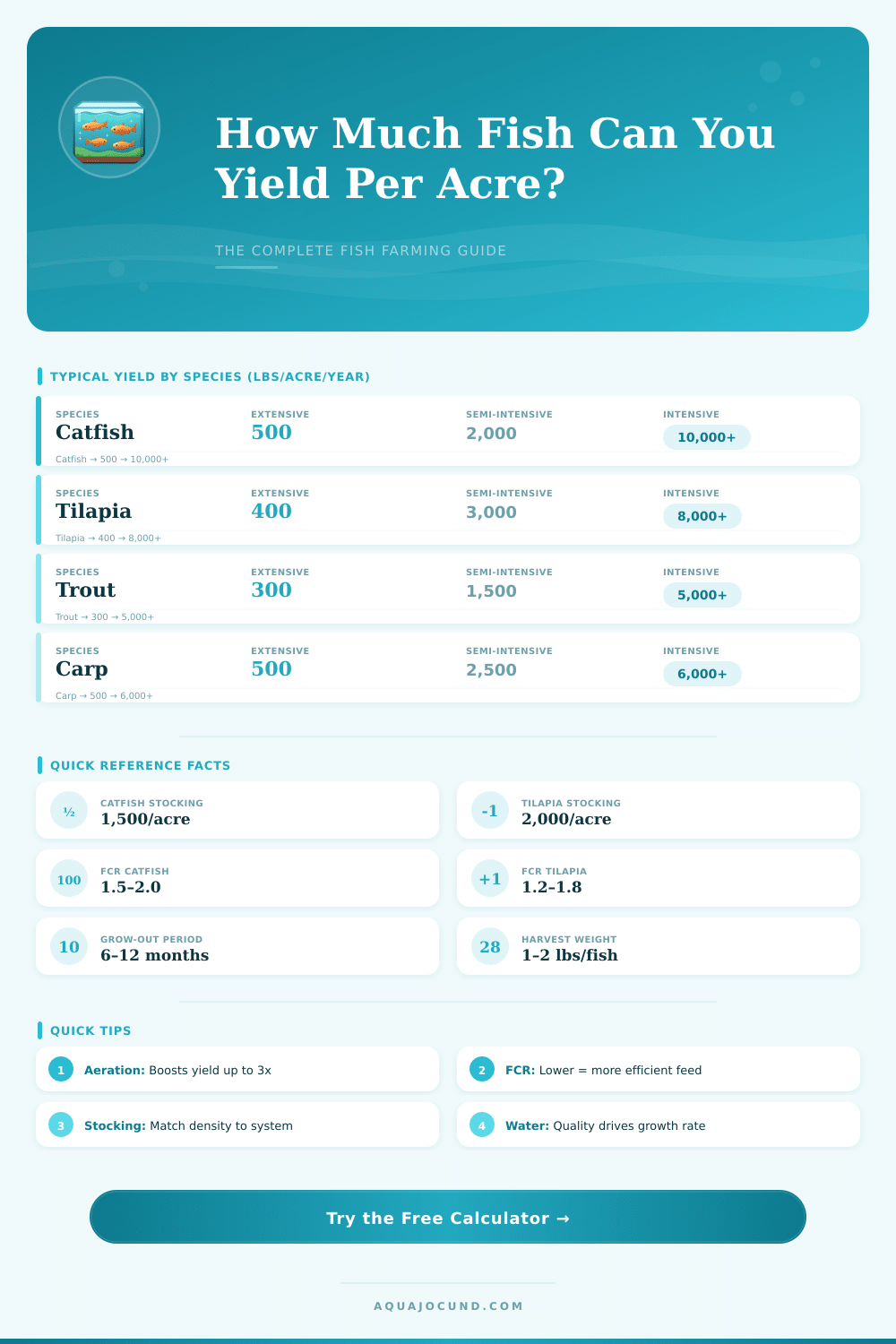
| Species | Extensive (lbs/acre) | Semi-Intensive (lbs/acre) | Intensive (lbs/acre) | FCR Range | Grow-out (months) |
|---|---|---|---|---|---|
| Channel Catfish | 300–600 | 1,500–3,000 | 5,000–10,000 | 1.5–2.0 | 5–7 |
| Tilapia (Nile) | 300–500 | 2,000–4,000 | 5,000–8,000 | 1.2–1.8 | 6–9 |
| Rainbow Trout | 200–400 | 1,000–2,500 | 3,000–5,000 | 1.2–1.6 | 10–18 |
| Common Carp | 400–700 | 1,500–3,500 | 3,000–6,000 | 2.0–3.0 | 12–18 |
| Largemouth Bass | 200–400 | 500–1,500 | 1,000–3,000 | 2.0–3.0 | 12–18 |
| Pacific White Shrimp | 300–600 | 1,000–3,000 | 3,000–8,000 | 1.4–2.0 | 3–5 |
| Atlantic Salmon (cage) | N/A | 5,000–10,000 | 10,000–20,000 | 1.1–1.3 | 18–24 |
| Pangasius / Basa | N/A | 5,000–15,000 | 15,000–40,000 | 1.5–2.0 | 6–9 |
| Yellow Perch | 150–300 | 500–1,500 | 1,500–4,000 | 1.5–2.0 | 14–24 |
| Species | Extensive (fish/acre) | Semi-Intensive (fish/acre) | Intensive (fish/acre) | Stocking Wt (g/fish) |
|---|---|---|---|---|
| Channel Catfish | 500–1,000 | 1,500–3,000 | 4,000–8,000 | 10–20g |
| Tilapia | 500–1,000 | 2,000–5,000 | 5,000–15,000 | 25–50g |
| Rainbow Trout | 200–500 | 1,000–3,000 | 3,000–10,000 | 20–50g |
| Common Carp | 500–1,000 | 1,000–3,000 | 3,000–6,000 | 30–100g |
| Largemouth Bass | 100–300 | 300–800 | 800–2,000 | 10–30g |
| Pacific White Shrimp | 5,000–10,000 | 15,000–40,000 | 40,000–150,000 | 1–2g PL |
| Atlantic Salmon | N/A | 5–15 kg/m³ | 15–35 kg/m³ | 80–150g |
| Pangasius | N/A | 5–15/m³ | 20–60/m³ | 30–100g |
| Farming System | Water Volume Needed | Aeration Requirement | Typical FCR | Yield Multiplier vs Extensive |
|---|---|---|---|---|
| Extensive Pond | 3–6 ft deep / acre | None | 2.5–4.0 | 1× (baseline) |
| Semi-Intensive Pond | 3–6 ft deep / acre | 1–2 HP/acre | 1.8–2.5 | 3–8× |
| Intensive Pond | 4–8 ft deep / acre | 3–10 HP/acre | 1.2–2.0 | 10–20× |
| Cage Culture | Open water body | Natural water flow | 1.1–1.5 | 20–50× (per area) |
| Raceway / RAS | High flow / recirculated | Continuous oxygen | 1.0–1.4 | 50–200× |
This briefly, the amount of fish produced through Fish Farming becomes always more important. Think about this: half of the main fisheries of the world already are fully used or worsening because of overfishing and environmental harm. Because the hunting of wild fish around the globe already reached its ceiling the supply of seafood has no direction other than Fish Farming.
The increase of the population, bigger incomes and the famous heart-healthy value of fish all force the demand to rise, we expect at least a 35 percent jump only in the coming twenty years.
Why Fish Farming Is Important
Here what pushes Fish Farming to be this attractive compared to the traditional wild hunting: fish can use the whole water surroundings, from the surface until the bottom. Land animals, on the other hand, stay set on the soil. If farmers choose fitting species, apply strict environmental control and plan the feeding wisely, one can reach annual Yield of almost 6 250 pounds each acre of pond water.
That alone already is wonderful. Even so fresh Fish Farming methods surpass that standard. Using multi-crop pond systems, farmres succeeded to expand the annual catfish Yield to more than 12 000 pounds each acre.
That doubles the result of usual modes. Moreover, beyond the numbers, fish in such setups have more chances to stay healthy and reach the wanted sizes for the market.
Checking of the water quality? It is everything. If one feeds the water right, preserve its clarity and rule the pH level, this causes big improvements in the Yield.
On condition that the water does not overload with nourishments and the oxygen stays plenty. Some of the most efficient pools indeed use added plant types together with particular fish. Different fish species handle different levels of stocking, and elements like the water temperature and the settled oxygen directly affect how many fish can live in any space.
Even tiny artificial filtered pool filled with carp ore tilapia can give good Yield, depending on the local climate.
In areas like Jiangsu, the Fish Farming Yield arrived at around 5,73 tons each hectare, such amounts greatly surpass the natural rivers and water reserves. Fish Farming also delivers more protein-rich calories each hectare than crops like cassava or rice. The facts themselves prove that.
But challenges grow. Fish populations weaken and suffer higher death rates when ocean temperatures beat records. Scientific studies show that this could lower the global fish Yield by up to 30 percent in cases of high problems, with possible lasting harm.
Meanwhile, the growth of salmon Fish Farming requires more wild feed fish for nourishment, and everything happens when 75 percent of the watched fisheries already is at the limit or passing its maximum sustainable amount. The main secret is to fit the Fish Farming modes to the natural behavior of every species, so that each group reaches its full growthpotential without waste of nourishment. Until the end, the profitable spots depend on cost control while one ensures strong and stable Yield.