💧 Aquarium Water Change Calculator
Calculate exactly how many gallons or liters to remove & replace for a healthy tank.
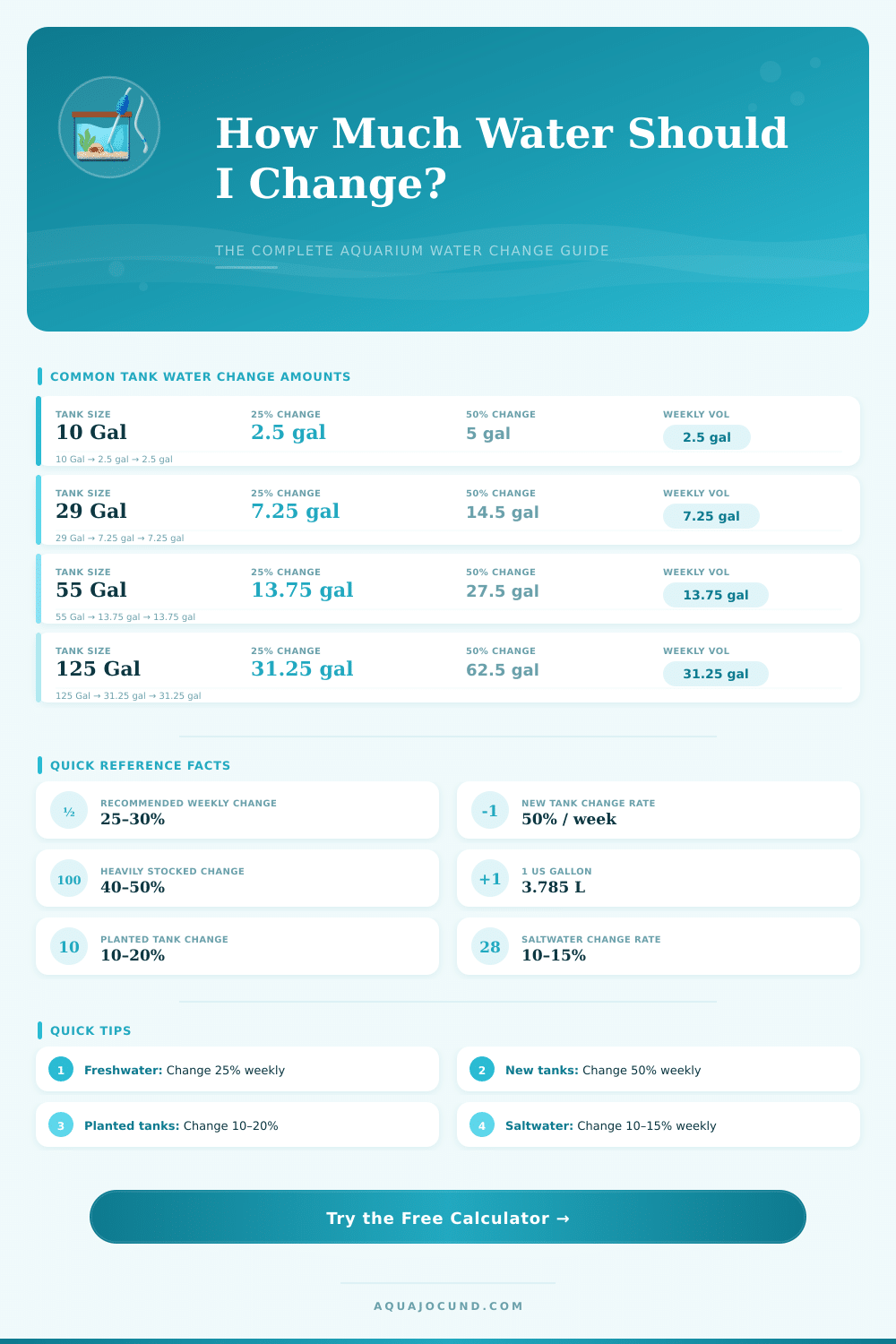
| Tank Name | Dimensions (L x W x H in) | Volume (US Gal) | Volume (Liters) | 25% Change | 50% Change |
|---|---|---|---|---|---|
| Nano / Pico | 12 x 6 x 8 | 3.7 | 14.0 | 0.93 gal | 1.85 gal |
| 5 Gallon | 16 x 8 x 10 | 5.5 | 20.8 | 1.4 gal | 2.75 gal |
| 10 Gallon | 20 x 10 x 12 | 10.4 | 39.4 | 2.6 gal | 5.2 gal |
| 20 Gallon Long | 30 x 12 x 12 | 18.7 | 70.8 | 4.7 gal | 9.4 gal |
| 29 Gallon | 30 x 12 x 18 | 28.1 | 106.3 | 7.0 gal | 14.0 gal |
| 40 Gallon Breeder | 36 x 18 x 16 | 43.3 | 163.9 | 10.8 gal | 21.7 gal |
| 55 Gallon | 48 x 13 x 21 | 55.4 | 209.7 | 13.9 gal | 27.7 gal |
| 75 Gallon | 48 x 18 x 21 | 76.7 | 290.4 | 19.2 gal | 38.4 gal |
| 90 Gallon | 48 x 18 x 24 | 87.7 | 332.0 | 21.9 gal | 43.9 gal |
| 125 Gallon | 72 x 18 x 22 | 119.2 | 451.3 | 29.8 gal | 59.6 gal |
| 150 Gallon | 72 x 18 x 28 | 151.8 | 574.8 | 38.0 gal | 75.9 gal |
| 180 Gallon | 72 x 24 x 25 | 180.0 | 681.4 | 45.0 gal | 90.0 gal |
| Dechlorinator Type | Dose Rate | 10 gal (38 L) | 25 gal (95 L) | 50 gal (189 L) | 100 gal (379 L) |
|---|---|---|---|---|---|
| Standard (drops) | 1 drop / gal | 10 drops | 25 drops | 50 drops | 100 drops |
| Seachem Prime | 1 mL / 50 gal (2.5 mL / 50 gal for heavy metals) | 0.2 mL | 0.5 mL | 1.0 mL | 2.0 mL |
| API Stress Coat | 5 mL / 10 gal | 5 mL | 12.5 mL | 25 mL | 50 mL |
| Seachem Safe (powder) | 100 mg / 50 gal | 20 mg | 50 mg | 100 mg | 200 mg |
| US Gallons | Liters | UK Gallons | Cubic Inches | Cubic Feet |
|---|---|---|---|---|
| 1 | 3.785 | 0.833 | 231 | 0.134 |
| 5 | 18.93 | 4.16 | 1,155 | 0.668 |
| 10 | 37.85 | 8.33 | 2,310 | 1.337 |
| 20 | 75.71 | 16.65 | 4,620 | 2.674 |
| 25 | 94.64 | 20.82 | 5,775 | 3.342 |
| 50 | 189.27 | 41.63 | 11,550 | 6.684 |
| 100 | 378.54 | 83.27 | 23,100 | 13.37 |
Water Change in an Aquarium ranks between the main tasks for keeping fishes healthy and happy. Regular Water Change for instance exchange around 30 percent of the water takes good care of the conditions in the Aquarium. The main target of such changes is protect the fishes while too big changes stress them and the plants.
Partial Water Change remove organic garbage, especially if one siphons the sludge of the bottom. Like this one stops the increase of algae and keeps minerals and nutrients in good amounts for fishes as well as plants. Almost every bad thing that enters the Aquarium, stays here until one dumps it.
How to Change the Water in Your Aquarium
In the natural world the water never sits still. Brooks, rivers and lakes receive new water from rain or melted snow during the whole year. In an Aquarium the usual Water Change like this acts virtually as the rain.
How often must one do that? It ranges. Some folks exchange the water weekly, others every two weeks or even only once monthly.
A common method is remove 25 to 30 percent weekly. For big tanks with many fishes, at least one cleaning every two weeks makes sense. Aquariums without live plants maybe require more frequent changes, to control nitrates and other waste at low level.
Strongly planted tanks sometimes can wait more long between two changes, because teh plants absorb nitrates.
When one simply dumps only the surface of the water instead of actual change, the garbage and extra minerals do not evaporate. They only build up and become more focused over time. Measure the whole amount of dissolved stuff for some weeks and it proves clearly, that only surface disposals due not suffice.
For the practical method, a siphon and bucket form the main tools that one requires. A five-gallon bucket is the standard, and marks for volumes on it help to estimate how much water goes. Lay the broad end of the siphon in the tank, let the water flow through the tube and drain the old water in the bucket on the floor.
A product like the Marina Aqua Vac connects to the kitchen tap and simplifies the whole process. A garden hose with adapter for the tap also works for filling thetank.
Adding new water, it must have almost the same heat as the water in the tank. Use conditioner only for the added part, not for the whole. A full volume costs extra money without any benefit.
Sudden whole change can surprise the fishes, so slow adding is wiser.
A full 100 percent Water Change is a bad notion, because it strips the filter and the soil to air, which can injure the useful bacteria living here.