🐠 Fish Stocking Density Calculator
Calculate the ideal number of fish for your aquarium based on tank size, fish type, and stocking method
| Fish Category | Rule (in/gal) | Rule (cm/L) | Example Fish | Notes |
|---|---|---|---|---|
| Tropical Community | 1 in/gal | 2.54 cm/L | Tetra, Rasbora, Platy | Most common rule |
| Planted Tank | 1.25 in/gal | 3.18 cm/L | Discus, Apistogramma | Plants aid bio filtration |
| Cichlid / Aggressive | 0.5 in/gal | 1.27 cm/L | Oscar, Mbuna, Convict | Territory needed |
| Goldfish | 0.33 in/gal | 0.84 cm/L | Common, Fancy Goldfish | High bioload fish |
| Reef / Saltwater | 0.25 in/gal | 0.63 cm/L | Clownfish, Tang, Wrasse | Lower density required |
| Nano Fish | 0.75 in/gal | 1.90 cm/L | Chili Rasbora, Ember Tetra | Small bioload |
| Large Fish | 0.2 in/gal | 0.51 cm/L | Arowana, Catfish, Pacu | Very high bioload |
| Predator / Monster | 0.1 in/gal | 0.25 cm/L | Snakehead, Alligator Gar | Specialist tanks only |
| Tank Name | Dimensions (L×W×H in) | Volume (gal) | Volume (L) | Max Small Fish (1in/gal) |
|---|---|---|---|---|
| Nano 5 Gallon | 16×8×10 | 5.5 | 20.8 | 5 |
| 10 Gallon Standard | 20×10×12 | 10.4 | 39.4 | 10 |
| 20 Gallon High | 24×12×16 | 19.5 | 73.8 | 19 |
| 20 Gallon Long | 30×12×12 | 20.2 | 76.5 | 20 |
| 29 Gallon | 30×12×18 | 29.5 | 111.7 | 29 |
| 40 Gallon Breeder | 36×18×16 | 38.4 | 145.3 | 38 |
| 55 Gallon | 48×12×21 | 54.8 | 207.5 | 54 |
| 75 Gallon | 48×18×21 | 82.2 | 311.1 | 82 |
| 90 Gallon | 48×18×24 | 93.9 | 355.4 | 93 |
| 125 Gallon | 72×18×22 | 126.3 | 478.2 | 126 |
| Filter Type | Recommended Flow | Capacity Adjustment | Best For |
|---|---|---|---|
| Under-Filtered / HOB Weak | <3x tank volume/hr | −20% | Lightly stocked tanks |
| Standard HOB Filter | 4–5x tank volume/hr | No adjustment | Community tanks |
| Over-Filtered / Sump | 6–8x tank volume/hr | +20% | Reef, cichlids |
| High-End Canister | 8–10x tank volume/hr | +30% | Planted, discus |
The Stocking Density of Fish relates directly to the amount or mass of Fish that one can keep in a set volume of water. To count the right Stocking Density for Fish, the task is harder than for land animals, because Fish live in three-sided surroundings. Land animals, for instance birds, exist in two dimensions, hence their density one measures according to square metre.
Fish so must be measured according to square metre or cubic metre of water.
How Many Fish Should You Keep
In systems of intense fish farming, as pure cages or flowing water setups, the Stocking Density is shown by means of the number or weight of Fish for a given surface or water volume. The skill to bear Fish in pool or tank depends on the used method of water management. System with flowing water fits to care about bigger number of Fish each square metre in pool or each cubic metre in tank.
Always exist factors that affects the exact Stocking Density in any setup.
Fish that one raised in the lowest density, reached the biggest weight in the end and the best sign of growth. Also they had good rate of turning of food. The impact failed in higher densities, although the rates of survival stayed alike.
The behaviour during feeding was almost same through the groups, but Fish in the highest density ate a bit more slowly. Clearly, the quality of meet and the shape did not change because of the Stocking Density in every case.
If one packs too many Fish in limited space, that causes stress and changes in the functions of the body of Fish. The level of dissolved oxygen drops, when the Stocking Density grows. In the highest density, one found the most bottom oxygen level.
Simply setting the Stocking Density by means of rules does not always work well. A better way is to set accepted levels for things as water quality, health, feeding and behaviour, to estimate the ideal density for every species and lifestage.
Salmon pens well show that. On average, one salmon pen carries only two to four percent of salmon, and the rest is water. Keeping density at that level helps the Fish stay healthy and reduce the risk of diseases.
The Stocking Density depends also strongly on the system of filtering. Even tender Fish as discus can live in high densities, if the filtering is quite good.
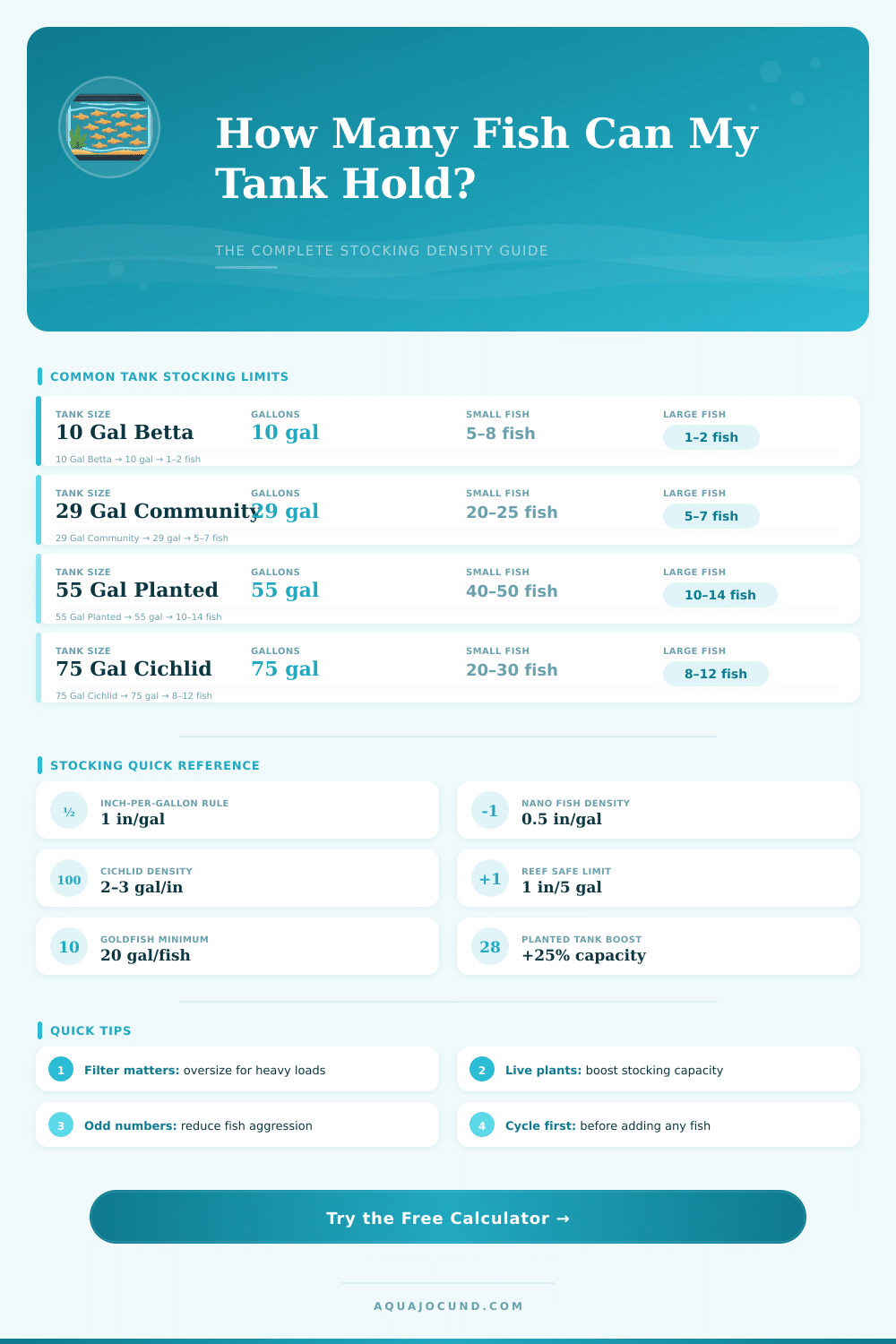
For home tanks the old rule of one inch each gallon is common, but not reliable. One measures Fish according to their length, not according to the amount of waste that they produce. A three-inch fancy goldfish does not make so much waste as a three-inch pleco or goldfish.
The ratio of Fish to water surface area of one to seven is seen as the best guide for Stocking Density in a tank. A good general rule is one pound of Fish for every eight to ten gallons of water. Start by means of lower levels of Stocking Density and slowly add more Fish, while one watches the water quality, is a wiseway.