🐡 Guppy Fish Water Temperature Checker
Enter your current tank temperature to instantly check if it's safe, ideal, or dangerous for guppies
📊 Temperature Check Results
| Zone | °F Range | °C Range | Effect on Guppies | Status |
|---|---|---|---|---|
| Lethal Cold | Below 60°F | Below 15.6°C | Organ failure, rapid death | Lethal |
| Danger Cold | 60–65°F | 15.6–18.3°C | Immune failure, disease risk very high | Danger |
| Stress Cold | 65–72°F | 18.3–22.2°C | Lethargy, clamped fins, ich susceptibility | Stress |
| Acceptable Low | 72–74°F | 22.2–23.3°C | Tolerated but not optimal, slower activity | Acceptable |
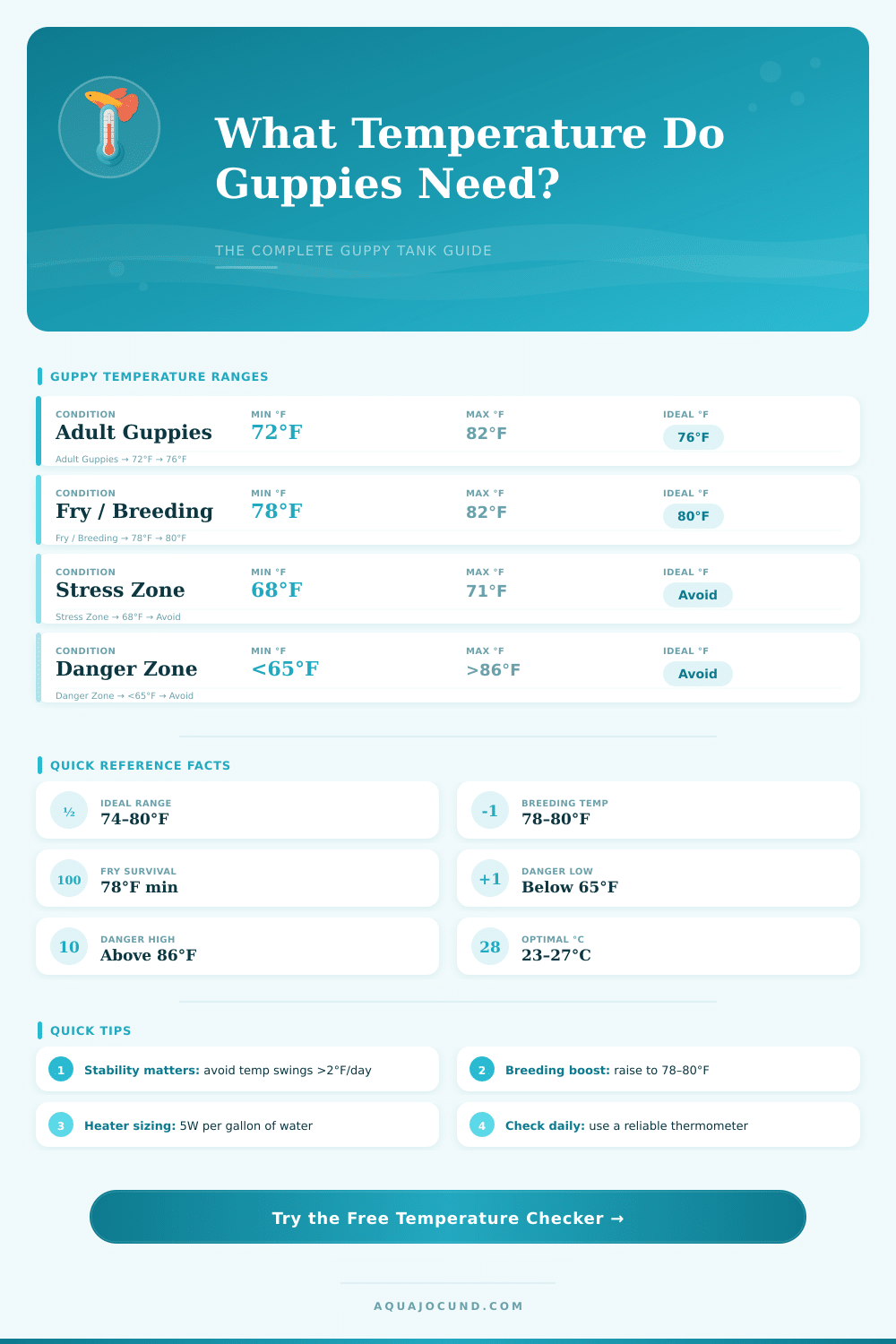
| Optimal | 74–80°F | 23.3–26.7°C | Best health, activity, color, and lifespan | Optimal |
| Breeding Ideal | 78–80°F | 25.6–26.7°C | Peak reproduction, fry survival rate highest | Optimal |
| Acceptable High | 80–82°F | 26.7–27.8°C | Increased metabolism, more feeding needed | Acceptable |
| Stress Hot | 82–86°F | 27.8–30°C | Oxygen depletion risk, stress behaviors | Stress |
| Danger Hot | 86–90°F | 30–32.2°C | Rapid breathing, surface gasping, organ stress | Danger |
| Lethal Hot | Above 90°F | Above 32.2°C | Fatal within hours | Lethal |
| Tank Size | Volume (gal) | Volume (L) | Min Watts | Recommended Watts | Temp Rise Capacity |
|---|---|---|---|---|---|
| Nano / Pico | 1–5 gal | 4–19 L | 10W | 25W | +10°F above room |
| Small | 5–10 gal | 19–38 L | 25W | 50W | +10°F above room |
| Medium-Small | 10–20 gal | 38–76 L | 50W | 75W | +10°F above room |
| Medium | 20–40 gal | 76–151 L | 100W | 150W | +10°F above room |
| Large | 40–75 gal | 151–284 L | 150W | 200W | +10°F above room |
| Extra Large | 75–125 gal | 284–473 L | 200W | 300W (x2) | +10°F above room |
| Tank Name | Dimensions (in) | Volume (gal) | Volume (L) | Ideal Use |
|---|---|---|---|---|
| Nano 5 Gallon | 16 x 8 x 10 | 5 gal | 18.9 L | Quarantine / Fry |
| 10 Gallon Standard | 20 x 10 x 12 | 10 gal | 37.9 L | Breeding pair / Fry |
| 20 Gallon Long | 30 x 12 x 12 | 20 gal | 75.7 L | Small colony / Breeding |
| 29 Gallon | 30 x 12 x 18 | 29 gal | 109.8 L | Community guppy tank |
| 40 Gallon Breeder | 36 x 18 x 16 | 40 gal | 151.4 L | Large colony |
| 55 Gallon | 48 x 13 x 21 | 55 gal | 208.2 L | Display / Show tank |
| 75 Gallon | 48 x 18 x 21 | 75 gal | 283.9 L | Large display colony |
| Life Stage / Use | Min Temp °F | Optimal °F | Max Temp °F | Min °C | Optimal °C | Max °C |
|---|---|---|---|---|---|---|
| Adult Community | 72°F | 76°F | 82°F | 22.2°C | 24.4°C | 27.8°C |
| Breeding Pair | 76°F | 78°F | 82°F | 24.4°C | 25.6°C | 27.8°C |
| Gravid Female | 76°F | 80°F | 82°F | 24.4°C | 26.7°C | 27.8°C |
| Fry (Newborn) | 78°F | 80°F | 82°F | 25.6°C | 26.7°C | 27.8°C |
| Juvenile (2–8 wk) | 76°F | 78°F | 82°F | 24.4°C | 25.6°C | 27.8°C |
| Quarantine / Recovery | 78°F | 80°F | 82°F | 25.6°C | 26.7°C | 27.8°C |
| Show / Display | 74°F | 76°F | 80°F | 23.3°C | 24.4°C | 26.7°C |
| Planted Guppy Tank | 72°F | 76°F | 80°F | 22.2°C | 24.4°C | 26.7°C |
The temperature of water simply shows whether it is warm or cold. It controls many parts of water quality and seriously helps life in waters and their habitat. It also affects biological processes, growth of life and chemicals in water.
Even the amount of water can change because of it and it decides what species of creatures can live in a water body. Water Temperature measures movement energy and one shows it by means of degrees Fahrenheit or Celsius. It changes according to seasons, depth and sometimes during the day.
Why Water Temperature Matters
Most water creatures have cold blood, so they need certain degrees to survive. In brooks with warm water, the heat should not pass 89°F. Brooks with cold water stay under 68°F. Summer heat really can kill fishes in tiny pools, because high degrees reduce the settled oxygen in water.
For swimming of folks in the sea, starting from August usually is the warmest period in New York, where the sea water reaches about 23.5°C or 74.3°F. On a beach with water at 66°F, the beach can be fully packed, but only few folks really enter the water. Most simply watch form the coast.
Long stay in water under 70°F can cause hypothermia, even during summer. In cold or slightly cool water, the body quickly loses its heat.
Temperatures in pools are a whole other case. For fun swimming, the most pleasant range falls between 82°F and 86°F. Around 81-82°F feels good and helps to warm more easily, but folks that do long distances can find it warm. Pools for contests usually keep around 25-29°C, commonly in the low shot.
Fishes in tanks really depend on the temperature. Tropical fishes best do between 75°F and 80°F. Goldfish and other species for cold water like under 70°F, where 65 to 68 degrees are perfect for goldfish. Every fish needs something different.
Neon tetras can handle 70-78°F, but around 75°F is the best. Tanks for discus fish commonly run at 86°F. Sudden changes in temperature or constant swings can stress fishes a lot.
Temperature in the room also matters. The water in a tank affects the room where it stands. Tanks never reach the same heat in winter as in summer, even if heaters stand at the same level.
During waves of heat, if the water in a tank for a long time reaches high 80s degrees, one can lay a fan to blow above the surface to cool it. For tanks with plants, 72-75 degrees are good, and higher can cause problems with algae. During changes of water, keep spare water within 3 degrees Celsius of thetank temperature, which is safe for most species.