🐟 Fish Pond Size Calculator
Calculate pond volume, surface area, and maximum fish capacity for any pond shape
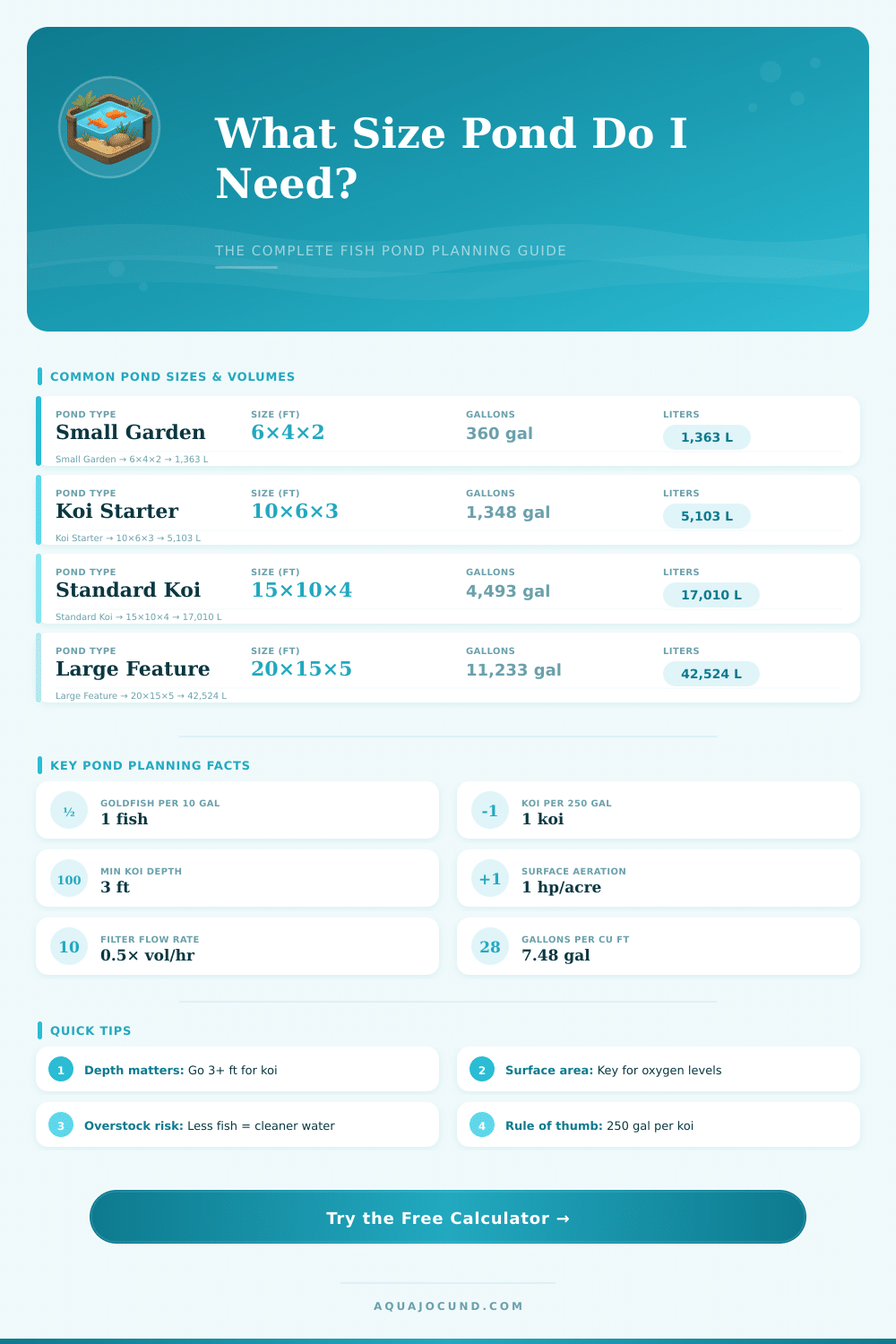
| Pond Type | Dimensions (ft) | Volume (gal) | Volume (L) | Max Koi | Max Goldfish |
|---|---|---|---|---|---|
| Half Barrel | 2 dia × 1.5 deep | ~35 | ~132 | 0 | 2–3 |
| Small Garden | 6 × 4 × 2 | ~360 | ~1,363 | 1 | 20–30 |
| Goldfish Pond | 8 × 5 × 2 | ~600 | ~2,271 | 2 | 40–50 |
| Koi Starter | 10 × 6 × 3 | ~1,348 | ~5,103 | 5 | 100+ |
| Standard Koi | 15 × 10 × 4 | ~4,493 | ~17,010 | 17 | 400+ |
| Large Koi | 20 × 12 × 4 | ~7,189 | ~27,215 | 28 | 600+ |
| Large Feature | 20 × 15 × 5 | ~11,233 | ~42,524 | 44 | 900+ |
| Round 10ft | 10 dia × 3 | ~1,763 | ~6,674 | 7 | 150+ |
| Material | Lifespan | Thickness | Fish Safe | Best For |
|---|---|---|---|---|
| Butyl Rubber | 20–50 yrs | 0.75–1mm | Yes | Koi & feature ponds |
| EPDM Rubber | 20–40 yrs | 0.75–1.14mm | Yes (fish-grade) | Large ponds, cold climates |
| PVC Liner | 10–20 yrs | 0.5–0.8mm | Yes | Budget installs |
| HDPE Liner | 30+ yrs | 1–2mm | Yes | Large commercial ponds |
| Preformed Fiberglass | 25+ yrs | Rigid | Yes | Small–medium ponds |
| Concrete / Block | 30–50 yrs | 4–6 in | With sealant | Formal / raised ponds |
| Geo + Liner | 20–35 yrs | Layered | Yes | Rocky/rooted ground |
| Pond Volume | Recommended Pump (GPH) | Filter Turnover Rate | UV Clarifier |
|---|---|---|---|
| Up to 500 gal | 250–500 GPH | Every 2 hrs | 5–9 watt |
| 500–1,000 gal | 500–1,000 GPH | Every 2 hrs | 9–18 watt |
| 1,000–3,000 gal | 1,000–2,000 GPH | Every 2 hrs | 18–36 watt |
| 3,000–5,000 gal | 2,000–3,500 GPH | Every 2 hrs | 36–55 watt |
| 5,000–10,000 gal | 3,500–6,000 GPH | Every 2 hrs | 55–110 watt |
| 10,000+ gal | 6,000+ GPH | Every 2 hrs | 110+ watt |
The Size of a Fish Pond matters much more than many folks imagine. Whether you want to keep fish in good health or ensure that the water stays clean, correct measures of the space are very important. A Fish Pond is made up of water with area under half of acre or depth less than 20 feet.
One usually calls it a lake if it passes one acre, although the Size alone does not always help to tell them apart.
How Big and How Deep Should a Fish Pond Be
Because some that want to keep koi require a Fish Pond big enough. Ideal start is at least 1,000 gallons, with around 250 to 300 gallons for one fish. Like this a Fish Pond with 1,000 gallons comfortably will hold three koi.
For five koi, plan about 1,250 gallons. A Fish Pond of around 1,500 gallons would be enough for some koi at the bare minimum, but bigger is always bettre. Koi grow quickly and reach two feet of length in only two years.
Too small a Fish Pond can cause them to stunt, which you clearly do not want, especially because of the high cost of koi.
The depth is another part that one must think about carefully. For a big Fish Pond with koi, it should have at least three feet of depth, without areas under two feet. Shallow places easily attract herons and raccoons for eating fish.
In cold regions, a Fish Pond maybe requires four too six feet of depth, so that it does not freeze to the bottom. A general ecosystem Fish Pond requires minimal depth of 24 inches, with less deep shelves that one builds for plants.
Goldfish also require enough space. A practical rule says five gallons of water for every inch of fish. So four ten-inch goldfish require at least 200 gallons.
Comet fish especially require a long Fish Pond because of their length.
Knowing the surface area and depth helps to count proper filters, doses of chemicals and number of fish for stocking. At rectangular Fish Ponds, one multiplies length by width by depth, then multiplies by 7.48 to convert cubic feet into gallons. Also a calculator for Fish Ponds can quickly estimate those numbers.
A natural Fish Pond that intends to attract wildlife should have round, smooth edges and sloping banks. It mostly stays fairly shallow, around three feet at the most. When a Fish Pond wants to be self-sustaining with fish, every acre holds at most about 400 pounds of live fish, but 250 pounds are more realistic.
Regular feeding of a family from a Fish Pond would require many acres, unless one adds extra feed andbreeding setups.
When one orders a liner, add double total depth to the length and width, plus extra two feet at every side for overlap.