🌡️ Fish Tank Water Temperature Checker
Check your tank temperature, convert °F – °C, find ideal ranges & calculate heater wattage
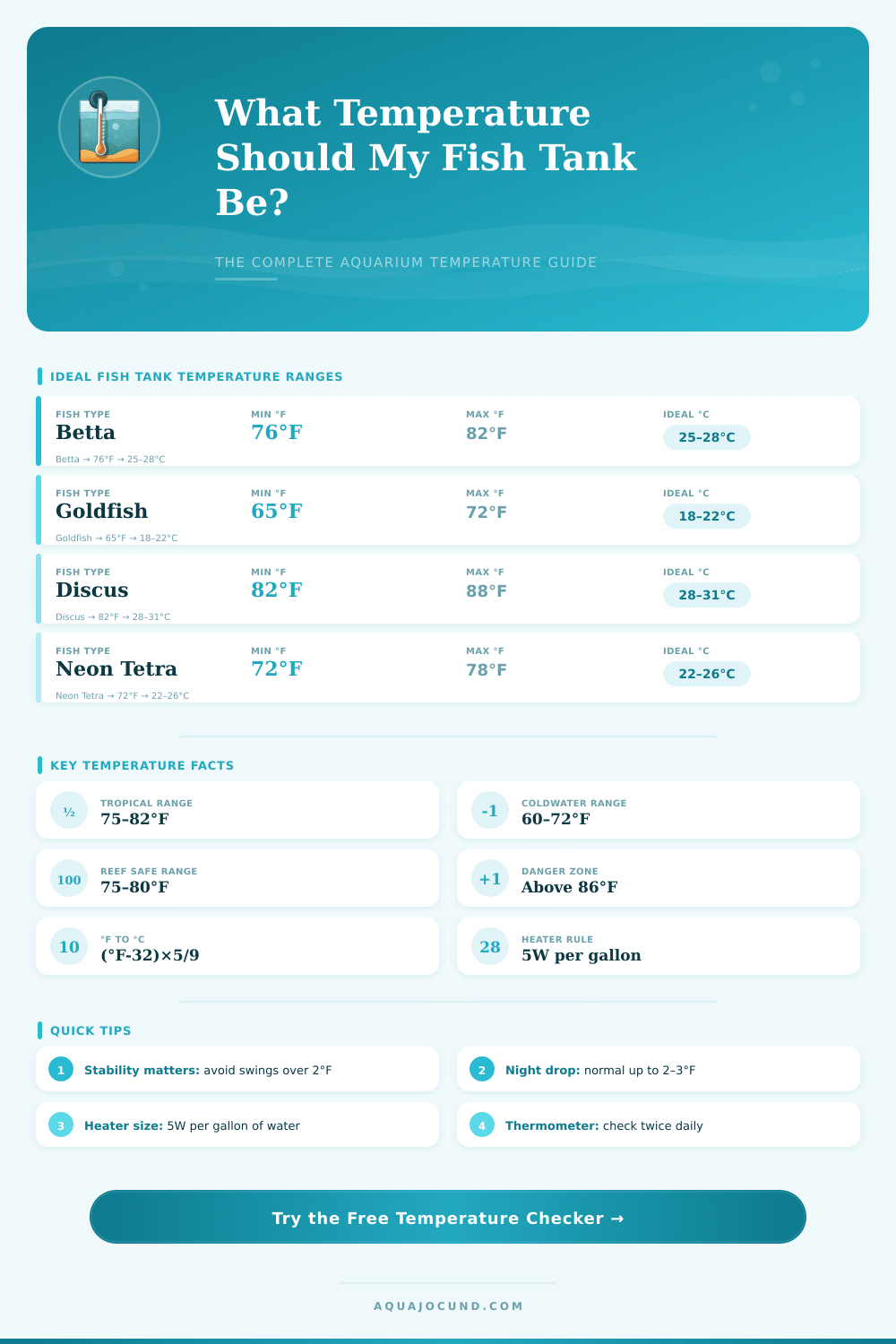
| Fish / Species Type | Min °F | Max °F | Ideal °F | Min °C | Max °C | Category |
|---|---|---|---|---|---|---|
| Betta Fish | 76 | 82 | 78–80 | 24.4 | 27.8 | Tropical |
| Neon Tetra | 72 | 78 | 74–76 | 22.2 | 25.6 | Tropical |
| Guppies | 72 | 82 | 76–78 | 22.2 | 27.8 | Tropical |
| Angelfish | 75 | 82 | 78–80 | 23.9 | 27.8 | Tropical |
| Goldfish (Fancy) | 65 | 72 | 68–70 | 18.3 | 22.2 | Coldwater |
| Goldfish (Common) | 60 | 70 | 65–68 | 15.6 | 21.1 | Coldwater |
| Discus | 82 | 88 | 84–86 | 27.8 | 31.1 | Tropical (Warm) |
| African Cichlid | 75 | 82 | 78–80 | 23.9 | 27.8 | Tropical |
| Oscar Fish | 74 | 81 | 77–79 | 23.3 | 27.2 | Tropical |
| Neocaridina Shrimp | 65 | 78 | 70–74 | 18.3 | 25.6 | Freshwater Shrimp |
| Caridina / Crystal Shrimp | 62 | 72 | 66–70 | 16.7 | 22.2 | Freshwater Shrimp |
| Reef Corals / FOWLR | 75 | 80 | 76–78 | 23.9 | 26.7 | Marine |
| Clownfish | 73 | 80 | 76–78 | 22.8 | 26.7 | Marine |
| Planted Tropical Tank | 72 | 80 | 75–77 | 22.2 | 26.7 | Planted |
| Axolotl | 60 | 68 | 62–65 | 15.6 | 20.0 | Coldwater |
| Koi (Pond) | 50 | 75 | 65–70 | 10.0 | 23.9 | Pond |
| Tank Size | Volume (Gal) | Volume (L) | Recommended Watts | +10°F Rise | +20°F Rise |
|---|---|---|---|---|---|
| Nano / Pico | 5 | 19 | 25W | 25W | 50W |
| 10 Gallon | 10 | 38 | 50W | 50W | 100W |
| 20 Gallon Long | 20 | 76 | 100W | 100W | 150W |
| 29 Gallon | 29 | 110 | 150W | 150W | 250W |
| 40 Gallon Breeder | 40 | 151 | 200W | 200W | 300W |
| 55 Gallon | 55 | 208 | 200W | 200W | 2x200W |
| 75 Gallon | 75 | 284 | 300W | 300W | 2x250W |
| 125 Gallon | 125 | 473 | 500W | 2x250W | 2x300W |
| °F | °C | °F | °C | °F | °C |
|---|---|---|---|---|---|
| 60°F | 15.6°C | 72°F | 22.2°C | 84°F | 28.9°C |
| 62°F | 16.7°C | 74°F | 23.3°C | 86°F | 30.0°C |
| 64°F | 17.8°C | 76°F | 24.4°C | 88°F | 31.1°C |
| 66°F | 18.9°C | 78°F | 25.6°C | 90°F | 32.2°C |
| 68°F | 20.0°C | 80°F | 26.7°C | 92°F | 33.3°C |
| 70°F | 21.1°C | 82°F | 27.8°C | 95°F | 35.0°C |
Fish are cold-blooded, which means they do not make heat in their body. Rather, the temperature of their bodies adjusts to what happens in the water around them. Because of that having stable Water Temperature in the Fish Tank is not only nice; it truly is key for their health.
Most Fish Tank fish feel good in the range of 75 to 80 degrees Fahrenheit, give or take. For those that use metric, that matches around 24 to 26.5 degrees Celsius. Tropical fish like that warmer zone, while freshwater species prefer to stay between 60 and 75 degrees.
Keep Fish Tank Water Temperature Steady
Fish Tanks with salt water usually keep around 26 degrees Celsius as standard. Even so, every species can have its own ideal spot. For instance, betta fish, in my experience, live best between 78 and 80 degrees.
Mollies seem to benefit when the water is between 74 and 80. Mark fish? They love the heat and want it quite warm.
Goldifsh are oddly tough about all that, they do well in normal room temperature between 60 and 75 degrees and do not even need a heater.
Here is the cause: staying steady is perfect every time. If the Water Temperature shifts too much or too quickly, problems show up soon. Seaweed can quickly spread or plants start to rot, which throws off all chemical levels in the Fish Tank.
Sudden temperature changes create ideal conditions for bacteria to grow, which makes the fish sick or even kills them. In nature, temperatures shift slowly, giving fish time to adapt or swim to another place if needed. In a Fish Tank?
The water is the same, so there is know escape route.
High temperatures boost the metabolism of fish and their aging. Their heart beats more quickly, they eat food sooner and warm water holds less oxygen, all of that is bad news. On the other hand, cold temperatures slow everything.
Fish grow more slowly, which helps to control the growth of plants and spread of seaweed. Water Temperature also affects the pH balance (cold water raises it), while warm water lowers it.
Winter sometimes forces you to use a heater to keep the right warm levels. The same, but the other way, happens during summer. If the cooling fails, Fish Tanks can reach 82 or even 84 degrees without much effort.
Floating frozen water bottles helps, but do it so that the Water Temperature does not fall too sharply. Truly, slowly warming a Fish Tank is less harsh thansuddenly changing either direction.
When you do water changes, match the temperature of the new water close to what is already in the Fish Tank, only a few degrees difference. Add it slowly, in small amounts, and pause between each. That step truly is worth the effort.