🪸 Live Rock Calculator
Calculate how much live rock your saltwater or reef aquarium needs by weight and displacement
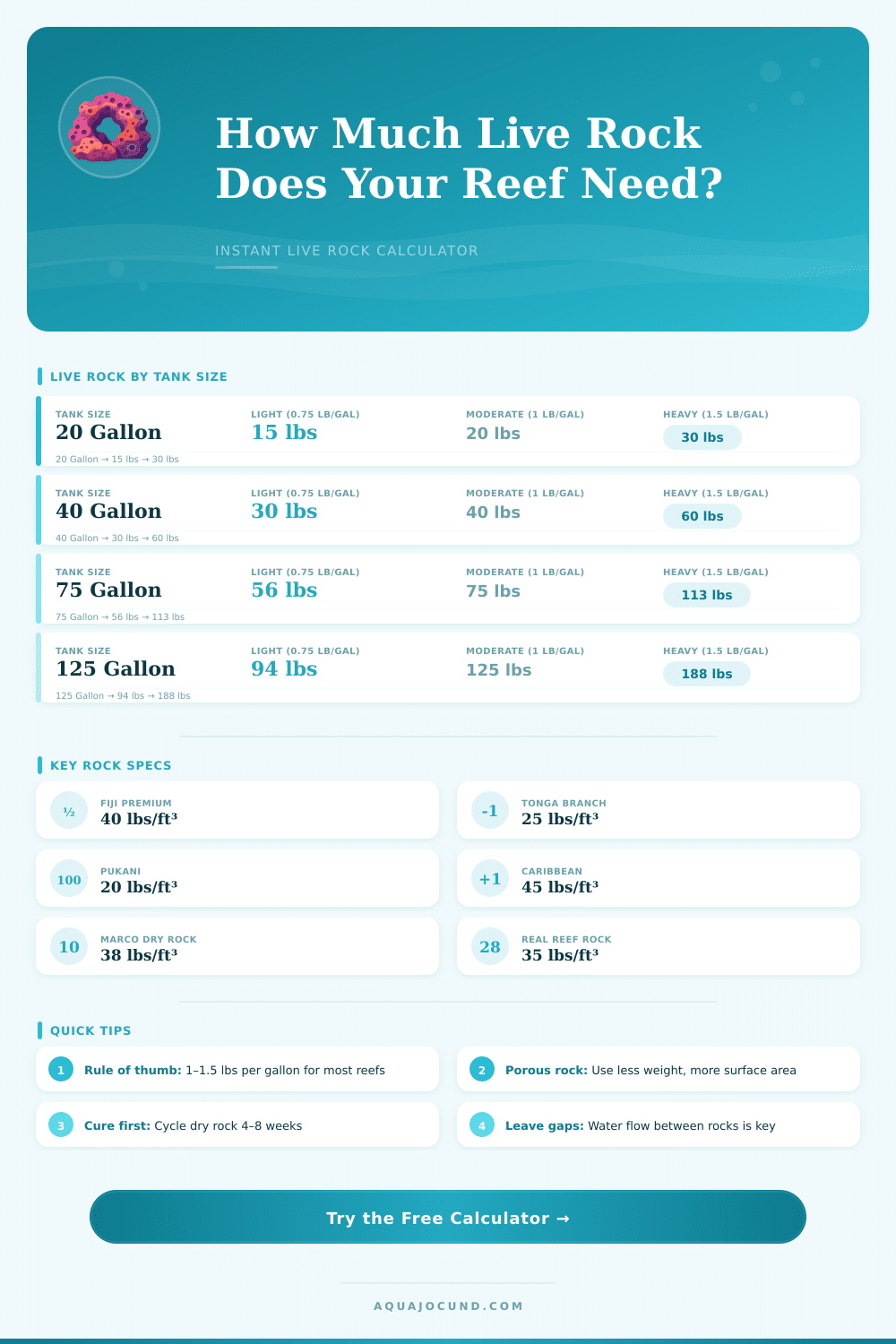
| Tank Size | Light (0.75 lb/gal) | Moderate (1.0 lb/gal) | Heavy (1.5 lb/gal) |
|---|---|---|---|
| 10 Gallon | 7.5 lbs (3.4 kg) | 10 lbs (4.5 kg) | 15 lbs (6.8 kg) |
| 20 Gallon | 15 lbs (6.8 kg) | 20 lbs (9.1 kg) | 30 lbs (13.6 kg) |
| 29 Gallon | 22 lbs (10.0 kg) | 29 lbs (13.2 kg) | 44 lbs (20.0 kg) |
| 40 Breeder | 30 lbs (13.6 kg) | 40 lbs (18.1 kg) | 60 lbs (27.2 kg) |
| 55 Gallon | 41 lbs (18.6 kg) | 55 lbs (24.9 kg) | 83 lbs (37.6 kg) |
| 75 Gallon | 56 lbs (25.4 kg) | 75 lbs (34.0 kg) | 113 lbs (51.3 kg) |
| 125 Gallon | 94 lbs (42.6 kg) | 125 lbs (56.7 kg) | 188 lbs (85.3 kg) |
| 180 Gallon | 135 lbs (61.2 kg) | 180 lbs (81.6 kg) | 270 lbs (122.5 kg) |
| Stocking Level | lbs per Gallon | kg per Liter | Best For |
|---|---|---|---|
| Light | 0.75 | 0.09 | Fish-only with live rock (FOWLR) |
| Moderate | 1.0 | 0.12 | Mixed reef, soft corals |
| Heavy | 1.5 | 0.18 | SPS-dominant reef, heavy bioload |
| Reef Wall | 2.0 | 0.24 | Full back wall aquascape |
| Rock Type | Curing Time | Method | Notes |
|---|---|---|---|
| Fiji Premium (wet) | 2–4 weeks | Saltwater bin with circulation | Monitor ammonia until zero |
| Tonga Branch (wet) | 2–3 weeks | Saltwater bin, gentle flow | Fragile branches, handle carefully |
| Pukani (wet) | 4–6 weeks | Saltwater bin, frequent water changes | Very porous, traps more die-off |
| Caribbean (wet) | 2–4 weeks | Saltwater bin with powerhead | Dense rock, shorter cure typical |
| Dry Rock / Marco | 4–8 weeks | Tank cycle or fishless cycle | No die-off but needs bacteria seeding |
| Real Reef Rock | 1–2 weeks | Brief rinse, light cycle | Man-made, minimal curing needed |
| Lava Rock | 2–4 weeks | Soak and scrub, then cycle | Rinse well to removeite dust |
| Man-made Ceramic | 1–2 weeks | Rinse, seed with bacteria | Inert material, quick startup |
| Rock Type | Density (lbs/ft³) | Porosity | Best For |
|---|---|---|---|
| Fiji Premium | 40 | Medium | General reef, good bacteria surface |
| Tonga Branch | 25 | High | Open aquascapes, branching look |
| Pukani | 20 | Very High | Maximum filtration per pound |
| Caribbean | 45 | Low–Medium | Dense reef walls, heavy structures |
| Dry Rock / Marco | 38 | Medium | Budget reef, no pest hitchhikers |
| Real Reef Rock | 35 | Medium–High | Pest-free, natural appearance |
| Lava Rock | 30 | High | Budget builds, high surface area |
| Man-made Ceramic | 28 | High | Custom shapes, consistent quality |
When deal about the rocky parts in saltwater aquariums, the Live Rock stays the most popular option for natural biological cleaning. It forms the basic structure of coral reefs in the natural ocean and does a similar role in home aquarium setups. Usually it is made up of calcium carbonate, but often one finds it made from man-made materials concrete or even aragonite skeletons of old stone corals, that died a long time ago.
The main appeal shows because of that, that Live Rock arrives already fully covered by tiny animals, invertebrates, coralline seaweed and many other creatures. Like this it becomes ideal for starting a fresh reef aquarium quickly and well, usually the rock already bears the useful nitrifying bacteria, that does the main work. If you choose fully matured Live Rock, you receive rich biodiversity directly from the box, what helps the cycle of the aquarium move more quickly.
Live Rock and Dead Rock for Saltwater Aquariums
There are genuinely documented cases, when one aquarium cycled in only one week after adding of rock, gathered in the morning directly from the reef, sent in the morning and installed in the aquarium in the evening.
Some farmed creatures follow another timetable. They exist first as dead rock, before one places them in ocean places like the Florida Keys. During years of sitting there, they slowly get covered by all kinds of useful life, that one would want in an active reef aquarium.
On the other hand, there exist also eco-friendly options, like products based on calcium carbonate, that arrive seeded with nitrifying bacteria, microalgae and coralline seaweed, without unwanted pests or unwanted seaweeds.
Even so not everything sells as Live Rock. Currently more many reef fans favour dead rock. Every method has its advantages and disadvantages, depending on your targets.
If you choose only dead rock, you escape issues with pests, and the coralline seaweed will cover it well, if one gives enough time. After you add a bit of Live Rock in the aquarium, the dead rock slowly gets covered with coralline seaweed, bacteria and invertebrates. Good middle ground tactics?
Combine dead rock with some bright bits of Live Rock to start the spreading. Because Live Rock has quite a high price each pound, many people choose this way too lower expenses.
When you plan the size of your aquarium landscape, count around one pound of rock each gallon for minimum visible effect. Want a denser look? Then use up to two pounds each gallon.
Some hobbyists consider that two-pound-rule as their usual start.
When you introduce Live Rock in an already running aquarium, the curing matter very much. Dying organic stuff on the rock can cause spikes of ammonia, nitrite and other values. Unwanted hitchhikers in uncured rock can spread through the whole system.
Aquariums without Live Rock commonly have trouble reaching stability and suffer because of problems like dinoflagellates and cyano-bacteria. Ignoring it extends thetime for settling causes. Even adding some bits of fresh Live Rock in a difficult aquarium can give clear improvements almost immediately.
Starting a reef setup with Live Rock and live sand can process everything in weeks instead of months.