🌿 Potassium Nitrate Aquarium Calculator
Calculate precise KNO3 dosing for planted aquariums using EI, Lean, or PPS-Pro methods
| Day | Macros | KNO3 Action | Notes |
|---|---|---|---|
| Monday | Macro Day | Dose KNO3 + KH2PO4 + K2SO4 | After lights on |
| Tuesday | Micro Day | No KNO3 | Trace elements only |
| Wednesday | Macro Day | Dose KNO3 + KH2PO4 + K2SO4 | After lights on |
| Thursday | Micro Day | No KNO3 | Trace elements only |
| Friday | Macro Day | Dose KNO3 + KH2PO4 + K2SO4 | After lights on |
| Saturday | Rest | No dosing | Day before water change |
| Sunday | Water Change | 50% water change | Reset nutrient levels |
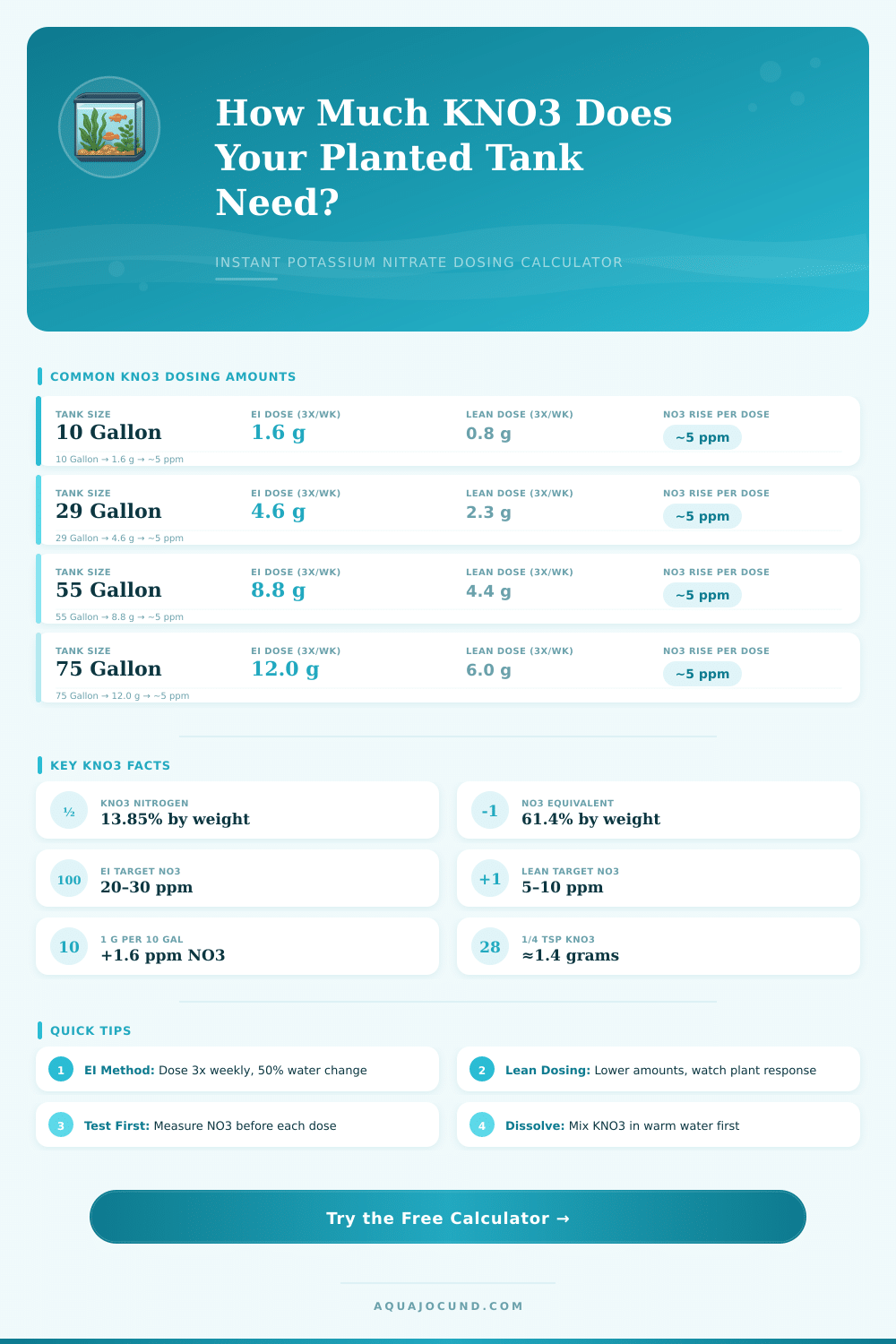
| Tank Size | Dimensions (L×W×H in) | EI Dose (3x/wk) | Lean Dose (3x/wk) |
|---|---|---|---|
| 5 Gallon | 16 × 8 × 10 | 0.8 g (1/8 tsp) | 0.4 g |
| 10 Gallon | 20 × 10 × 12 | 1.6 g (1/4 tsp) | 0.8 g |
| 20 Long | 30 × 12 × 12 | 3.2 g (1/2 tsp) | 1.6 g |
| 29 Gallon | 30 × 12 × 18 | 4.6 g (3/4 tsp) | 2.3 g |
| 40 Breeder | 36 × 18 × 16 | 6.4 g (1 tsp) | 3.2 g |
| 55 Gallon | 48 × 13 × 21 | 8.8 g (1.5 tsp) | 4.4 g |
| 75 Gallon | 48 × 18 × 21 | 12.0 g (2 tsp) | 6.0 g |
| 125 Gallon | 72 × 18 × 21 | 20.0 g (3.3 tsp) | 10.0 g |
| Compound | Formula | Role in Cycle | Safe Range (ppm) |
|---|---|---|---|
| Ammonia | NH3 / NH4+ | Fish waste, first stage | 0 ppm (toxic above 0.25) |
| Nitrite | NO2⁻ | Converted from ammonia | 0 ppm (toxic above 0.5) |
| Nitrate | NO3⁻ | End product, plant nutrient | 5–40 ppm (planted tanks) |
| Potassium Nitrate | KNO3 | Fertilizer source of NO3 | Dose to target NO3 level |
| Potassium | K+ | Essential macronutrient | 10–30 ppm |
| Nitrogen Gas | N2 | Denitrification end product | N/A (escapes to air) |
| Method | Target NO3 (ppm) | Frequency | Best For |
|---|---|---|---|
| Estimative Index (EI) | 20–30 | 3x weekly + 50% WC | High-tech, high-light planted |
| Lean Dosing | 5–10 | 3x weekly | Low-tech, low-light planted |
| PPS-Pro | 10–20 | Daily | Moderate light, no large WC |
| Custom | User-defined | User-defined | Experienced aquarists |
Potassium nitrate, known also as KNO₃, is a mineral that happens naturally and works as a source for nitrates. It ranks between the usual additions that one adds to planted aquariums. In water it splits into ions of potassium and ions of nitrate.
Those particles split from one another and do not stay bound. The nitrate part matches to that which appears naturally in aquariums.
Potassium Nitrate for Planted Aquariums
Nitrogen forms a base for chlorophyll and is needed for good growth of leaves and fast growth of plants. Potassium itself is one of the main foods for plants. It represents the K in the NPK label that one finds on every fertilizer packet.
Potassium nitrate together with potassium phosphate makes two of the basic additions for planted aquariums. They provide the main nutrients, while a mix of trace elements is also reuqired for full nutrition of plants.
One commonly prepares by settling 10 grams of potassium nitrate in a liter of pure water. One can adjust this strength more strongly or more weakly according to need. While dosing, one advises to add a quarter teaspoon three times per week in certain sizes of aquariums.
It helps too keep levels of nitrates between 5 and 10 ppm. When nitrates drop to nothing, plants can hardly grow and algae can easily install. In such conditions without nitrates, blue-green algae also can appear.
One commonly asks, does the usage of potassium nitrate alone remove the need to add potassium separately. That depends on the amount of potassium that the aquarium truly needs. Usually yes, one still must dose extra potassium.
Potassium sulfate commonly serves to give that extra potassium separately. KNO₃ targets mainly the nitrates, while potassium sulfate targets the potassium.
Folks commonly wonder, whether nitrate from additions like potassium nitrate differs from that which comes from the nitrogen cycle in the aquarium. The chemistry of aquariums is this complex, that figuring out what exactly happens is difficult. One study showed, that the LC50 for nitrate in zebra fish after four days falls between 982 and 1226 ppm at pH 7.2, which points to very low toxicity.
One finds potassium nitrate in stores for home repairs at a price under 10 dollars, in form of stump-remover products. Some aquarium fans use Spectracide Stump Remover, that contains potassium nitrate. It is also available at companies that provide aquarium supplies.
On Amazon, pure potassium nitrate costs around two dollars per pound. There are also liquid products specifically foraquariums, although many reckon them too costly because they consist mostly of water.