🏖 Aquarium Sand Calculator
Calculate the exact amount of sand your fish tank needs by weight and volume
| Sand Type | Density (g/cm³) | Grain Size | Best For |
|---|---|---|---|
| Play Sand | 1.55 | 0.1–0.5 mm | Budget freshwater tanks |
| Pool Filter Sand | 1.58 | 0.4–0.8 mm | Corydoras, planted tanks |
| Aragonite Sand | 1.50 | 0.5–1.5 mm | Saltwater, African cichlids |
| Black Diamond Blasting | 1.72 | 0.2–0.6 mm | Dark contrast planted tanks |
| Live Sand (Reef) | 1.45 | 0.5–2 mm | Marine reef tanks |
| Silica Sand | 1.60 | 0.1–0.5 mm | General freshwater |
| Coral Sand | 1.48 | 1–3 mm | Saltwater, high pH tanks |
| Aqua Soil Sand | 1.10 | 1–2 mm | High-tech planted tanks |
| Tank | Dimensions (L×W×H in) | Volume | Sand at 2 in Depth |
|---|---|---|---|
| 5 Gallon | 16 × 8 × 10 | 5 gal / 19 L | 11 lbs (5.1 kg) |
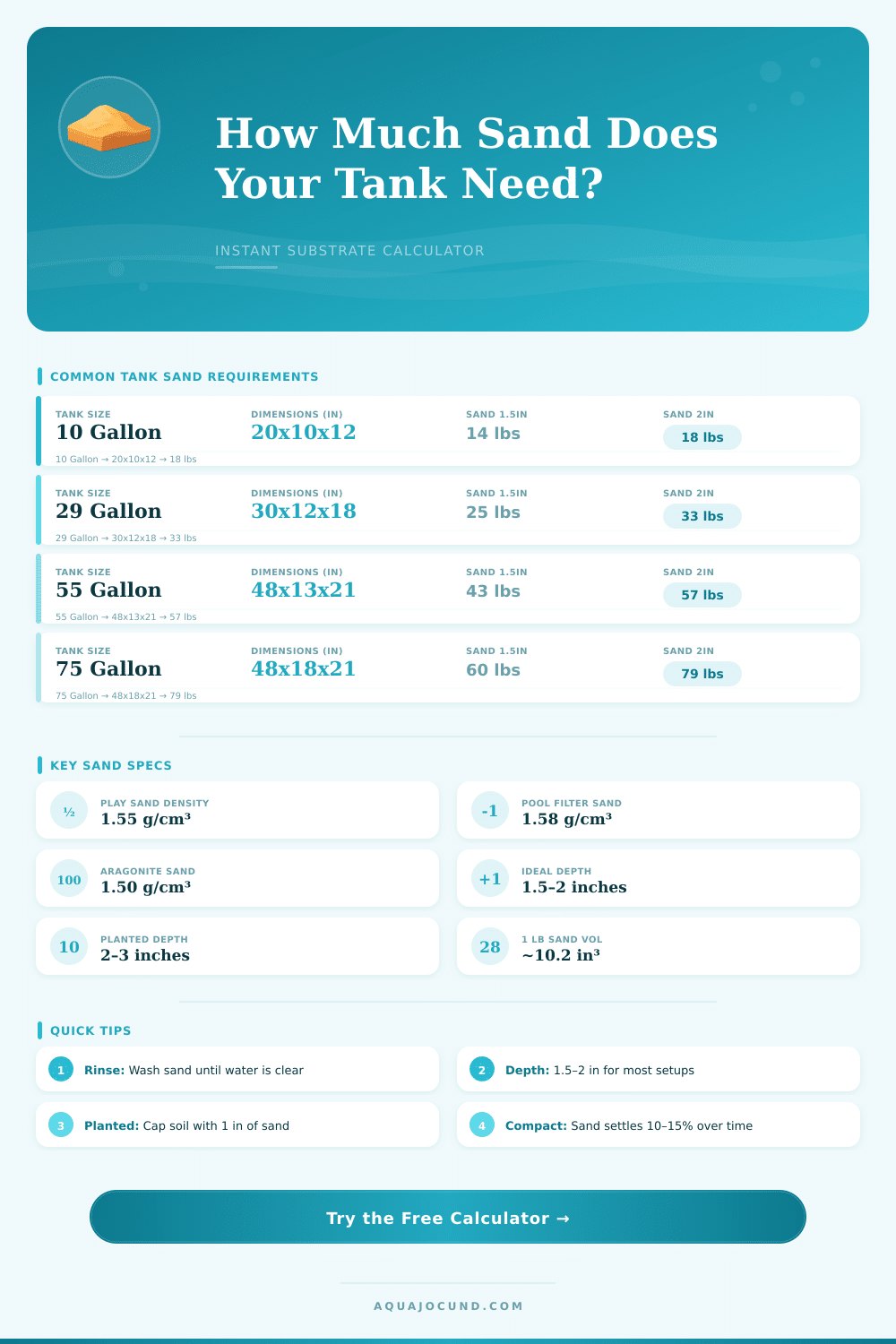
| 10 Gallon | 20 × 10 × 12 | 10 gal / 38 L | 18 lbs (8.2 kg) |
| 20 Long | 30 × 12 × 12 | 20 gal / 76 L | 33 lbs (14.9 kg) |
| 29 Gallon | 30 × 12 × 18 | 29 gal / 110 L | 33 lbs (14.9 kg) |
| 40 Breeder | 36 × 18 × 16 | 40 gal / 151 L | 59 lbs (26.8 kg) |
| 55 Gallon | 48 × 13 × 21 | 55 gal / 208 L | 57 lbs (25.7 kg) |
| 75 Gallon | 48 × 18 × 21 | 75 gal / 284 L | 79 lbs (35.7 kg) |
| 125 Gallon | 72 × 18 × 21 | 125 gal / 473 L | 118 lbs (53.5 kg) |
| Purpose | Depth (in) | Depth (cm) | Notes |
|---|---|---|---|
| Fish-only freshwater | 1 – 1.5 | 2.5 – 3.8 | Thin layer, easy to clean |
| Corydoras / loaches | 1.5 – 2 | 3.8 – 5.1 | Smooth sand protects barbels |
| Low-tech planted | 2 – 2.5 | 5.1 – 6.4 | Cap over root tabs or soil |
| High-tech planted | 2.5 – 3 | 6.4 – 7.6 | Over nutrient-rich base layer |
| Saltwater / reef DSB | 4 – 6 | 10.2 – 15.2 | Deep sand bed for denitrification |
| Saltwater shallow bed | 1 – 2 | 2.5 – 5.1 | Aesthetic only, easy maintenance |
| Sand Type | 1 in Depth (lbs/100 in²) | 2 in Depth (lbs/100 in²) | 3 in Depth (lbs/100 in²) |
|---|---|---|---|
| Play Sand | 5.60 | 11.20 | 16.80 |
| Pool Filter Sand | 5.71 | 11.42 | 17.12 |
| Aragonite Sand | 5.42 | 10.84 | 16.26 |
| Black Diamond | 6.21 | 12.43 | 18.64 |
| Live Sand | 5.24 | 10.48 | 15.72 |
| Silica Sand | 5.78 | 11.56 | 17.34 |
| Coral Sand | 5.35 | 10.69 | 16.04 |
| Aqua Soil Sand | 3.97 | 7.95 | 11.92 |
Aquarium Sand forms a soft, natural base that works well in freshwater and saltwater setups. Besides its nice look, it helps plant growth and gives a comfortable surface for fish that live near the bottom. Certain species like corydoras and plecos clearly truly favor Sand instead of gravel so many owners of Aquariums think about the change.
A nice feature of Sand is that it quite well stops organic particles from laying deeply in the bottom of the Aquarium. Sand with natural color also helps to hide seaweed and algae, making them less noticeable. Some types of Sand come in plastic tins instead of bags, which eases carrying and pouring in the Aquarium without spilling everywhere.
Using Sand in Your Aquarium
Aquarium Sand commonly costs a lot. For a 55-gallon Aquarium a good amount of proper Aquarium Sand could spend around 120 dollars, while the same amount of play Sand costs only around 20 dollars. Pool filter Sand, play Sand and Sand for mix concrete all can serve as a base and are much cheaper than products made specially for Aquariums.
One finds pool filter Sand selling for only 3 dollars each 50-pound bag. Play Sand costs around 6 dollars for 50 pounds. On the other hand, between the cheap options, pool filter Sand is considered the safest for Aquariums.
Sand needs to be washed before it enters the Aquarium. Average Sand of average type usually requires only one fast rinse. Even so, colored quartz Sand can be very dusty, depending on the brand.
One way is to wash it in a plastic bucket, one portion at a time, then pour the clean Sand in a tin.
There are some downsides that are worth knowing. Some types of Sand can thicken over time, which reduces the flow of water and can form bad spaces below. Algae and garbage builds up inside of the Sand, which makes cleaning difficult.
Loose Sand in the water can also damage filters, so make sure to keep it away from there parts. Getting clear Sand without losing a big part of it can be truly annoying.
For planted Aquariums Sand alone does not provide nutrients. Commonly one uses root tablets together with Sand. Some folks lay rich soil below and cover it with Sand.
Aragonite Sand is popular for reef Aquariums. Caribsea sands are well known and found in pet stores. Sand from beaches or riverbeds that does not work for Aquariums could badly affect the water quality and injure tropical fish.
Adding Sand to an Aquarium that already has fish, one can use this: fill a cup at the half with wet Sand, add water from the Aquarium, lower it to the bottom and pour slowly while you gentle jiggle from side to side. Some prefer to leave the bottom bare to escape all that trouble, butSand however looks much more nice.