🐟 Aquarium Gravel Calculator
Calculate the exact amount of substrate your fish tank needs by weight and volume
| Substrate | Density (g/cm³) | Grain Size | Best For |
|---|---|---|---|
| Standard Gravel | 1.50 | 3–5 mm | General community tanks |
| Aquarium Sand | 1.60 | 0.5–2 mm | Bottom dwellers, Corydoras |
| Seachem Flourite | 1.30 | 2–7 mm | Planted tanks, root feeders |
| Eco-Complete | 1.20 | 1–5 mm | Planted tanks, no-rinse setup |
| ADA Amazonia Soil | 1.10 | 2–5 mm | High-tech planted, shrimp |
| Pea Gravel | 1.55 | 6–12 mm | Goldfish, large cichlids |
| Crushed Coral | 1.45 | 2–6 mm | African cichlids, high pH |
| Pool Filter Sand | 1.58 | 0.4–0.8 mm | Budget planted, Corydoras |
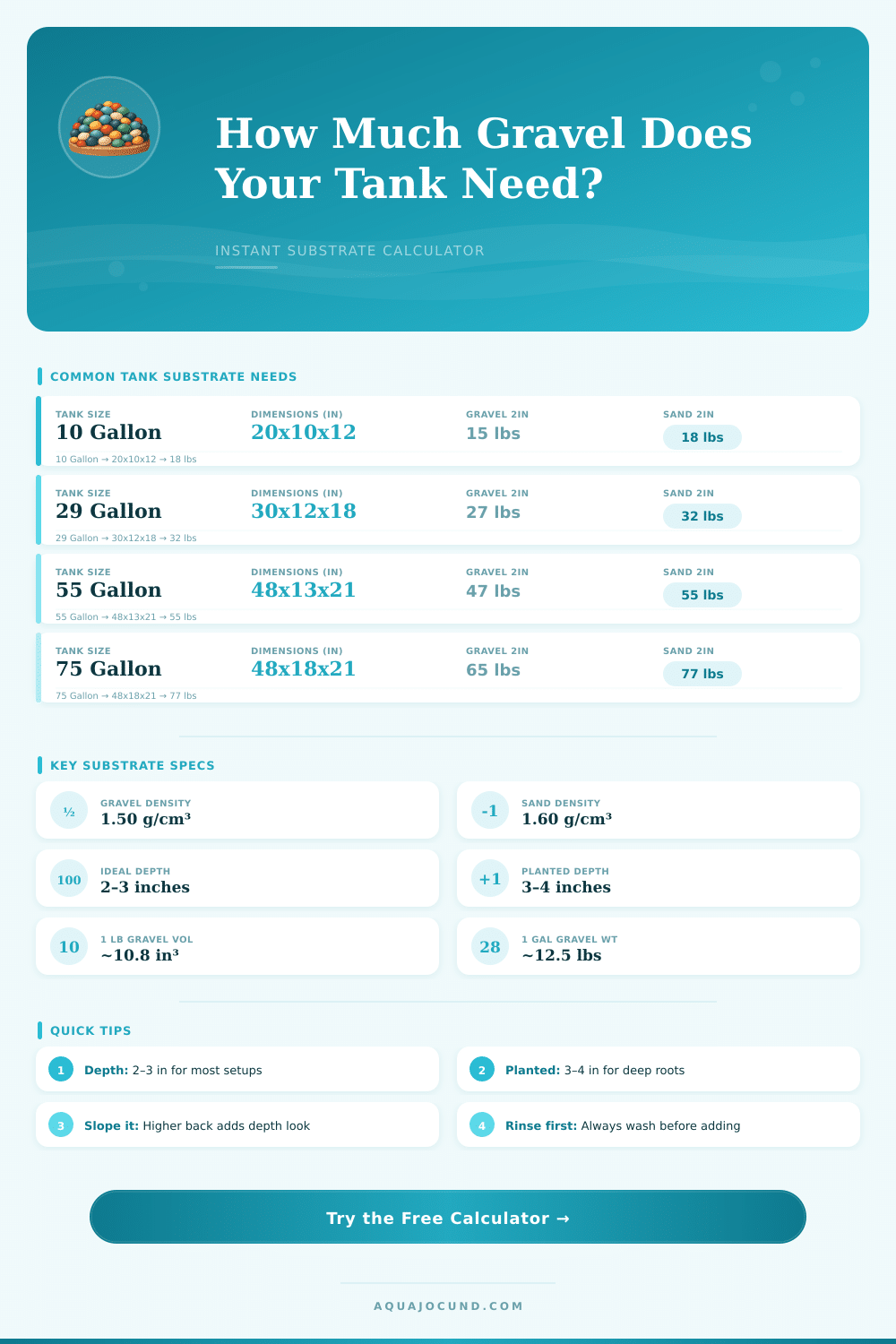
| Tank | Dimensions (L×W×H in) | Volume | Gravel at 2 in Depth |
|---|---|---|---|
| 5 Gallon | 16 × 8 × 10 | 5 gal / 19 L | 10 lbs (4.5 kg) |
| 10 Gallon | 20 × 10 × 12 | 10 gal / 38 L | 15 lbs (6.8 kg) |
| 20 Long | 30 × 12 × 12 | 20 gal / 76 L | 27 lbs (12.3 kg) |
| 29 Gallon | 30 × 12 × 18 | 29 gal / 110 L | 27 lbs (12.3 kg) |
| 40 Breeder | 36 × 18 × 16 | 40 gal / 151 L | 49 lbs (22.2 kg) |
| 55 Gallon | 48 × 13 × 21 | 55 gal / 208 L | 47 lbs (21.3 kg) |
| 75 Gallon | 48 × 18 × 21 | 75 gal / 284 L | 65 lbs (29.5 kg) |
| 125 Gallon | 72 × 18 × 21 | 125 gal / 473 L | 98 lbs (44.5 kg) |
| Purpose | Depth (in) | Depth (cm) | Notes |
|---|---|---|---|
| Fish-only community | 1.5 – 2 | 3.8 – 5.1 | Enough for biological filtration |
| Low-tech planted | 2 – 3 | 5.1 – 7.6 | Sufficient for easy root plants |
| High-tech planted | 3 – 4 | 7.6 – 10.2 | Deep roots, carpet plants |
| Under-gravel filter | 2.5 – 3 | 6.4 – 7.6 | Even depth is critical |
| Cichlid / digging fish | 2 – 3 | 5.1 – 7.6 | Heavier substrate resists digging |
| Shrimp breeding | 1.5 – 2.5 | 3.8 – 6.4 | Active buffering soil preferred |
| Substrate | Weight at 1 in Depth (lbs/gal floor) | Weight at 2 in Depth (lbs/gal floor) | Weight at 3 in Depth (lbs/gal floor) |
|---|---|---|---|
| Standard Gravel | 6.2 | 12.5 | 18.7 |
| Aquarium Sand | 6.7 | 13.3 | 20.0 |
| Flourite | 5.4 | 10.8 | 16.2 |
| Eco-Complete | 5.0 | 10.0 | 15.0 |
| ADA Amazonia | 4.6 | 9.1 | 13.7 |
| Pea Gravel | 6.5 | 12.9 | 19.4 |
| Crushed Coral | 6.0 | 12.1 | 18.1 |
| Pool Filter Sand | 6.6 | 13.1 | 19.7 |
aquarium gravel does much more than simply sit at the bottom of the tank. It breaks the solid waste and uneaten food that slowly sinks, thus stops the forming of thick buildup. Such buildup can hold useful bacteria that truly helps.
Those bacteria break down the fish waste and help to control the levels of nitrate and nitrite in low values. That helps with the health of the fish. A bed from little grains of gravel provides a large surface for the growth of those bacteria.
How to Choose and Care for Aquarium Gravel
gravel especially stops food, waste and other trash from floating freely through the whole tank. Because of that you need fewer water changes although one must regularly clean it.
The choice between sand and gravel depends mainly on the species of fish and plants in the tank. Some fish dig in the soil, and sharp bits of gravel can injure their mouths or whiskers. Sand is more smooth and tender, so it allows bottom fish, like the cory fish, to naturally dig and sift.
On the other hand, gravel is easier to take care of and it backs good bacterial growth. During cleaning, sand commonly clogs the vacuum tubes, what truly upsets.
Natural gravel works well for planted tanks, just like special species with rounded bits, designed for African cichlids, that helps to keep the water chemistry healthy. Gravel comes in various forms, sizes and colors, from natural shades to shining painted versions. Natural gravel with brown and gray tones gives a softer, calm look, that contrasts well with the plants.
By layering little natural grains below and bigger ones up you can copy a natural riverbed. Adding a black background in the tank does make everything look more alive.
Painted or colored gravel can lose its shade over time, becoming white or gray. The dye from such gravel can also come out and color the water, no matter how many times you wash it. Some cheap gravel from home stores works well, but it commonly has quite a lot of big grains.
Pea gravel from a garden store commonly costs very little, sometimes around five dollars for a fifty pound bag, however such big gravel does not work for aquariums, because the food simply sits stripped up.
For planted tanks, half inch or more gravel provides space for the roots to spread. The general rule is one to too pounds of gravel per gallon of water. Aquarium plants can grow in average gravel without separate soil, if they receive enough light.
Before adding fresh gravel, you must rinse it many times. Many folks rinse it over and over, because there is no such thing as too much rinsing. It is alsofine to run the tank without gravel, if the bare bottom looks good.