Hexagon Fish Tank Calculator
Model a regular hexagon aquarium from side length or flat span, then estimate water volume, setup weight, substrate displacement, and realistic stocking space before you buy or build.
How this works: the calculator treats the footprint as a regular hexagon, calculates area from either side length or flat-to-flat span, adjusts for fill level, subtracts decor displacement, and adds substrate and tank weight for a practical setup load.
Best for: upright community tanks, shrimp columns, centerpiece displays, and rooms where a six-panel shape gives you more viewing angles than a rectangle with the same stand footprint.
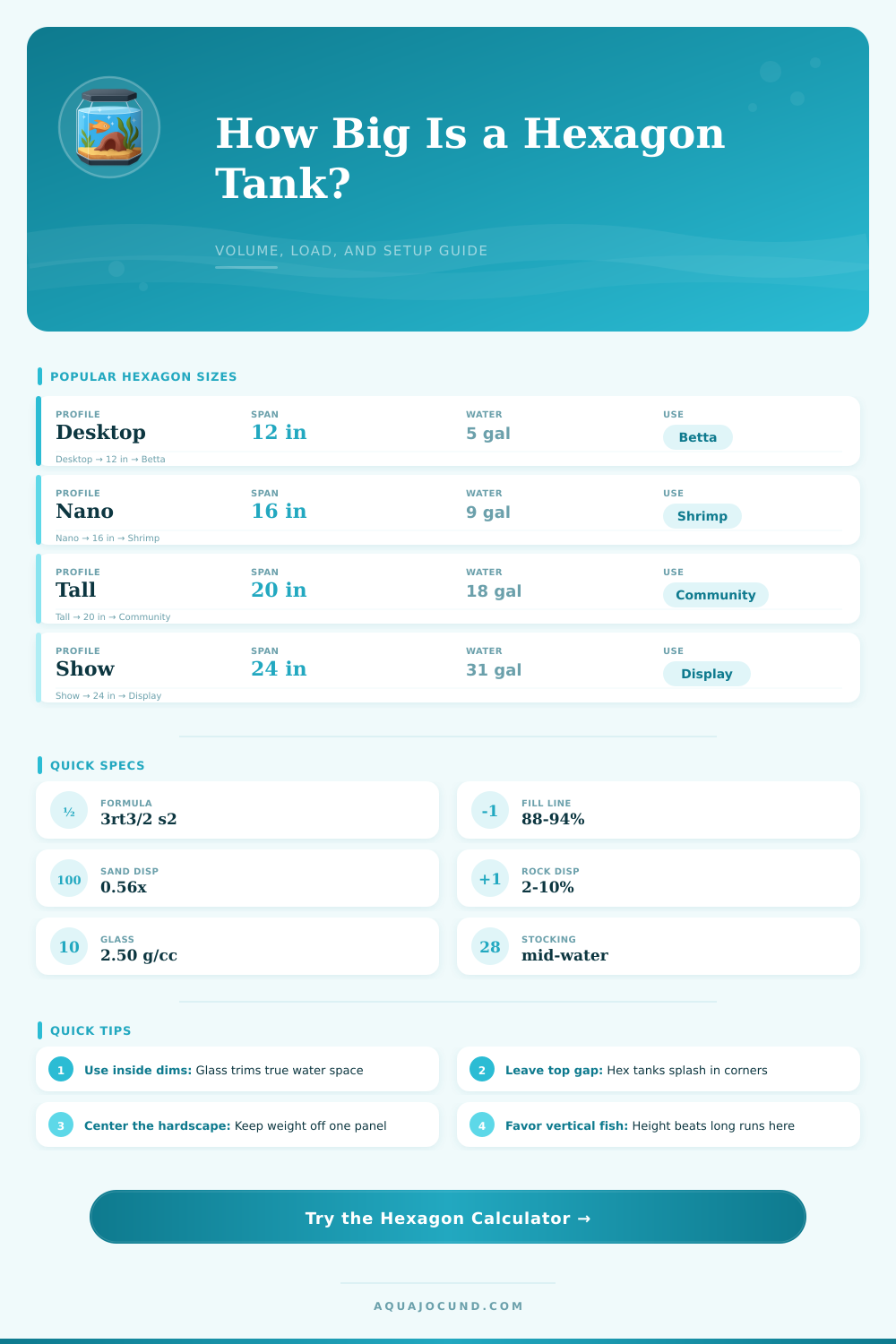
Low footprint, easy to light, but limited swim path. Best with shrimp, snails, or one centerpiece fish.
Good visual height and stand presence. Works best with calm fish that use vertical space instead of long runs.
Excellent for a room divider corner or lobby focal point. Plan stronger filtration because six panes reflect light and debris.
Rocks and tall wood look dramatic, but weight concentrates fast. Confirm stand loading and keep hardscape centered.
| Flat Span | Water Height | Approx Water | Typical Use |
|---|---|---|---|
| 12 in | 16 in | 5.2 gal | Betta display |
| 16 in | 18 in | 9.8 gal | Shrimp colony |
| 20 in | 20 in | 18.9 gal | Nano community |
| 24 in | 22 in | 30.7 gal | Show tank |
| 28 in | 24 in | 48.8 gal | Plant tower |
| Substrate | lb per gal | Displacement | Best Fit |
|---|---|---|---|
| Bare bottom | 0.0 | 0.00x | Hospital setups |
| Fine sand | 12.0 | 0.56x | Bottom dwellers |
| Coarse sand | 11.4 | 0.52x | General community |
| Gravel | 13.2 | 0.47x | Mixed decor |
| Planted soil | 9.5 | 0.40x | Rooted plants |
| Crushed coral | 14.5 | 0.44x | Buffering setups |
| Style | Capacity Factor | Works Well With | Watch For |
|---|---|---|---|
| Shrimp | 0.94x | Colonies, moss | Filter intake |
| Light nano | 0.82x | Small rasboras | Overfeeding |
| Moderate | 0.72x | Tetras, gouramis | Vertical crowding |
| Showcase | 0.62x | One centerpiece | Territory overlap |
| Vertical | 0.68x | Angels, hatchets | Surface access |
| Water Height | Typical Glass | Notes | Build Caution |
|---|---|---|---|
| Up to 14 in | 0.20 in | Small display hex | Check trim fit |
| 14 to 20 in | 0.25 in | Most retail hex tanks | Watch corner seams |
| 20 to 24 in | 0.31 in | Mid-size tall builds | Use rigid stand |
| 24 to 28 in | 0.39 in | Showpiece columns | Brace top opening |
| Over 28 in | Engineer spec | Custom only | Do not guess |
Retail hexagon tanks often have thick trim and molded corners. If you measure outside dimensions, volume can look larger than reality by a meaningful margin.
Tall hexagon builds reward centered wood and rock stacks. A dramatic side pile can look great, but it also shifts panel stress and stand loading.
A hexagon aquarium has six equal sides to the tank, and it offer a different visual appearance to the aquarium. Because a hexagon aquarium has six sides that capture the light from multiple angle, it will create a different shape for the room. However, it is more difficult to calculate the volume of a hexagon aquarium correctly because you need to take into account the geometry of the aquarium so that you dont provide too much fish for the aquarium.
If you provide too many fish to a hexagon aquarium, then the stability of that aquarium may be an issue. One of the factor to consider for a hexagon aquarium is the height of the aquarium. A tall and narrow aquarium may allow the aquarium to fit into tight spaces within the home, such as a desk or corner of the room.
How to plan a six-sided aquarium
However, tall aquariums will increase the amount of water pressure on the slanted sides of the aquarium. You should measure the inside dimension of the aquarium, not the outside trim of the aquarium. This is due to the thickness of the aquariums glass.
Another decision is the substrate to use inside the aquarium. The substrate will impact the volume of water that the aquarium will have. Fine sand is likely to even settle within the aquarium, but it will displace more water than gravel.
The shape of the aquarium will impact the kind of fish that are best within it. Because of the shape of the aquarium, you should not place fish that require long distances to swim within the aquarium into the aquarium. Instead, fish that swim in the middle of the aquarium are best suited for a hexagon aquarium.
Fish like hatchetfish or gouramis are two that is likely to enjoy living within such an aquarium. Territorial fish should also be avoided for a hexagon aquarium. If you would like to keep one territorial fish within the aquarium, then that is an option, but it is not recommended.
For the filtration system for the aquarium, a sponge filter is likely best to keep small fish in the aquarium safely. A powerhead filter can create a whirlpool in the aquarium that may endanger the fins of the fish. Finally, the weight of the aquarium is another topic to discuss.
You will increase the weight of the aquarium if you add decor into the aquarium. If the aquarium is small, it may only hold five gallon of water. However, its weight will increase with the addition of items like soil, driftwood, or rocks to the aquarium.
A hexagon aquarium filled with many decoration can weigh as much as fifty pounds, and that weight is distributed onto six points of contact with the stand. You must place the hexagon aquarium on a level floor with a stand that has some padding to avoid placing any tilting of the aquarium onto one of the panels of the aquarium. The thickness of the glass panels should also be appropriate for the height of the aquarium, as taller aquariums have thicker glass to handle the weight of the water within.
The hardscape within the aquarium should be centered within the tank. If there are some heavy rock within the aquarium, they should not be placed off of the center to avoid placing stress onto the frame of the aquarium over time. There are various aquarium presets that can be utilized to plan the aquarium.
For example, a tank that is to be used to display a betta fish can have a bare bottom within the tank, while a display tank for a shrimp colony may feature planted soil within the tank. When adding decor to the tank, some of the water within the tank will be displaced. Because of this, it is important to account for the amount of water that will be within the aquarium when the decor is added, a margin of ten to fifteen percent can be added to account for this displacement.
Mistakes are frequentlly made in the planning of a hexagon aquarium. Many people focus on the excitement of creating their dream tank, but they ignore the mathematics involved in creating a healthy and stable aquarium. For instance, an individual may believe that they have created a thirty gallon hexagon aquarium, but the rocks and other decor may reduce that capacity to only eighteen gallons of water.
In addition to the water within the aquarium, there must be some headroom for the tank. Headroom is the portion of the tank that remains between the water and the lid of the aquarium. Some species of aquatic plant may need headroom for water changes, so that the owner is not continuously splashing the aquariums contents outside of the tank itself.
Additionally, you should not add too many fish to the aquarium, as they will require breathing room. In addition to the height of the aquarium, the other design element that must be considered for a hexagon aquarium are the lights that are placed within the tank. Rather than utilizing lights that shine downward into the tank, the lighting should come from above the aquarium.
The light that shines into the tank will reflect off of each of the facet of the tank. In addition to adding some plants in the centered portions of the tank, it is also possible to create paths through the tank that allow the plants to simulate natural streams within the aquarium itself. While a hexagon aquarium is not the ideal aquarium for every individual, it is possible to create a beautiful centerpiece within the home using a well-planned hexagon aquarium.
Regardless of the design elements that are included within the aquarium, it is essential that the individual accurately measure the dimensions of their aquarium and ensures that the weight of the aquarium is evenly distributed to prevent any negative impact upon the aquariums stability or the health of its inhabitants.