💧 Pond Evaporation Calculator
Estimate daily, weekly, and monthly water loss from your pond based on size, climate, and exposure
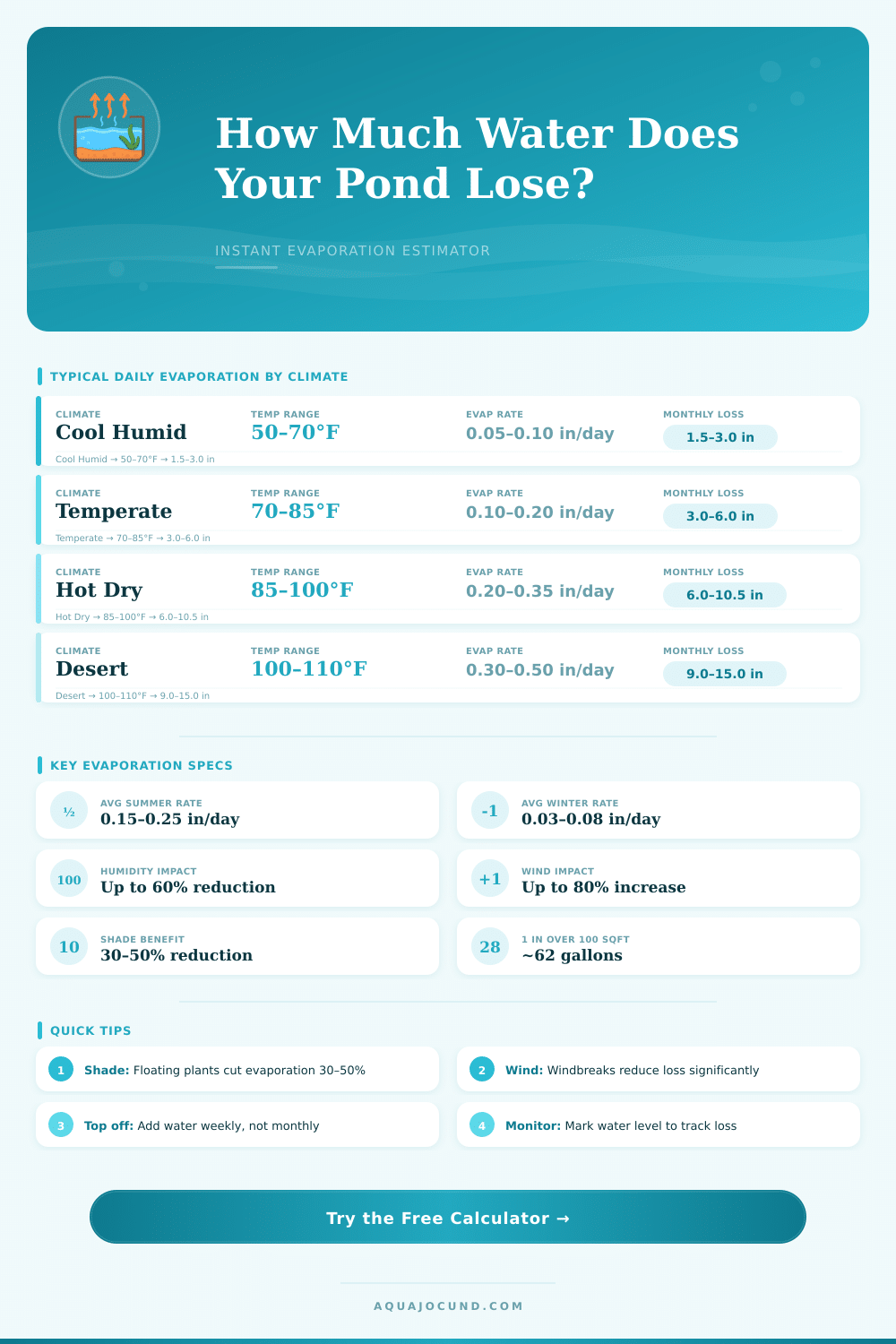
| Climate Zone | Summer Rate | Winter Rate | Annual Avg |
|---|---|---|---|
| Cool Temperate (PNW, UK) | 0.08–0.15 in/day | 0.02–0.05 in/day | 0.05 in/day |
| Moderate (Midwest, NE US) | 0.12–0.22 in/day | 0.03–0.08 in/day | 0.10 in/day |
| Subtropical (SE US, FL) | 0.15–0.25 in/day | 0.06–0.12 in/day | 0.14 in/day |
| Hot Arid (SW US, AZ) | 0.25–0.40 in/day | 0.08–0.15 in/day | 0.22 in/day |
| Desert (Sahara, Mojave) | 0.35–0.50 in/day | 0.10–0.20 in/day | 0.30 in/day |
| Tropical Humid (Hawaii, SE Asia) | 0.10–0.18 in/day | 0.08–0.14 in/day | 0.12 in/day |
| Pond Type | Surface Area | Mild Day Loss | Hot Day Loss |
|---|---|---|---|
| Small Garden (6×4 ft) | 24 sq ft | ~1.0 gal | ~3.0 gal |
| Koi Pond (10×8 ft) | 80 sq ft | ~3.3 gal | ~10.0 gal |
| Goldfish (8×6 ft) | 48 sq ft | ~2.0 gal | ~6.0 gal |
| Round Lily (8 ft dia) | 50 sq ft | ~2.1 gal | ~6.3 gal |
| Large Natural (20×15 ft) | 300 sq ft | ~12.5 gal | ~37 gal |
| Farm Pond (30×20 ft) | 600 sq ft | ~25 gal | ~75 gal |
| Season | Temp Range | Relative Rate | Notes |
|---|---|---|---|
| Spring | 55–75°F | 70–90% | Rising temps, moderate humidity |
| Summer | 75–100°F | 100–150% | Peak evaporation season |
| Autumn | 50–75°F | 60–80% | Declining temps, less sun |
| Winter | 30–55°F | 20–40% | Minimal evaporation, possible ice |
The Evaporation of Pond is the main and most natural cause because of that they lose water. Usually, when one does not add fresh water, the level drops in around one inch each week due to Evaporation. Neither the most little Pond, that measures only three feet wide, neither the big, that has twenty twenty-five feet, escapes toll of one until three inches per week.
It do not seem a lot, even so it adds up very soon.
Why Ponds Lose Water and How to Slow the Loss
Various things affect how quickly Pond empties. Temperature plays big part. Hot days strengthen the Evaporation compared to cold days.
The humidity also matters. In dry and low humidity conditions, water dries more quickly than in wet areas. In some regions of the globe, the relative humidity changes greatly between summer and winter, so that the Evaporation speeds range according to seasons.
Wind helps also. If one mixes it in the calculation, the water loss can become uncontrolled. Even cool spells sometimes cause bigger toll than summer heat in certain situations.
Big but shallow Pond dries more fast then little and deep. Because bigger surface together with less depth strengthens the Evaporation speed. Deeper Pond help to reduce the toll, because the water then are more distant from the face.
Falls and fountains expand the surface, what results in bigger water loss. Fountains so strengthen Evaporation, hence matter to watch the water level.
In very warm weather, the situation can become wild. When temperatures pass ninety degrees and some days reach the hundred, Pond drops in four until five inches during only two days. In such warm conditions, the average tends to be three until four inches per week.
In a big Pond, losing around twenty-five gallons each week are normal, when the thermometer marks around ninety degrees.
Fully stopping the Evaporation it is possible not, because it is natural thing. Even so, reduce it in eighty percent or more create clearly visible impact. Shade is useful a lot.
One can install tiny shady shield, plant trees for shade around the Pond or use water plants as lilies for cover one third until half of the surface, everything that helps. Freely floating plants, for instance water lilies or water clover, that covers forty until sixty percent of the area, shade the water bottom. Even so, shade does not block Evaporation because of wind or water moving.
Rocks and holey stuff as wood around the Pond also soak up water. Partly underwater rocks do the water shallower beside them, what makes fast Evaporation. When Pond empties much more fast than one hopes, maybe deal about leak instead of Evaporation.
Simple way tohelp are simply add water, when the level sinks.