🐟 Koi Fish Water Temperature Checker
Check if your pond temperature is safe, get feeding guidance & activity status in °F and °C
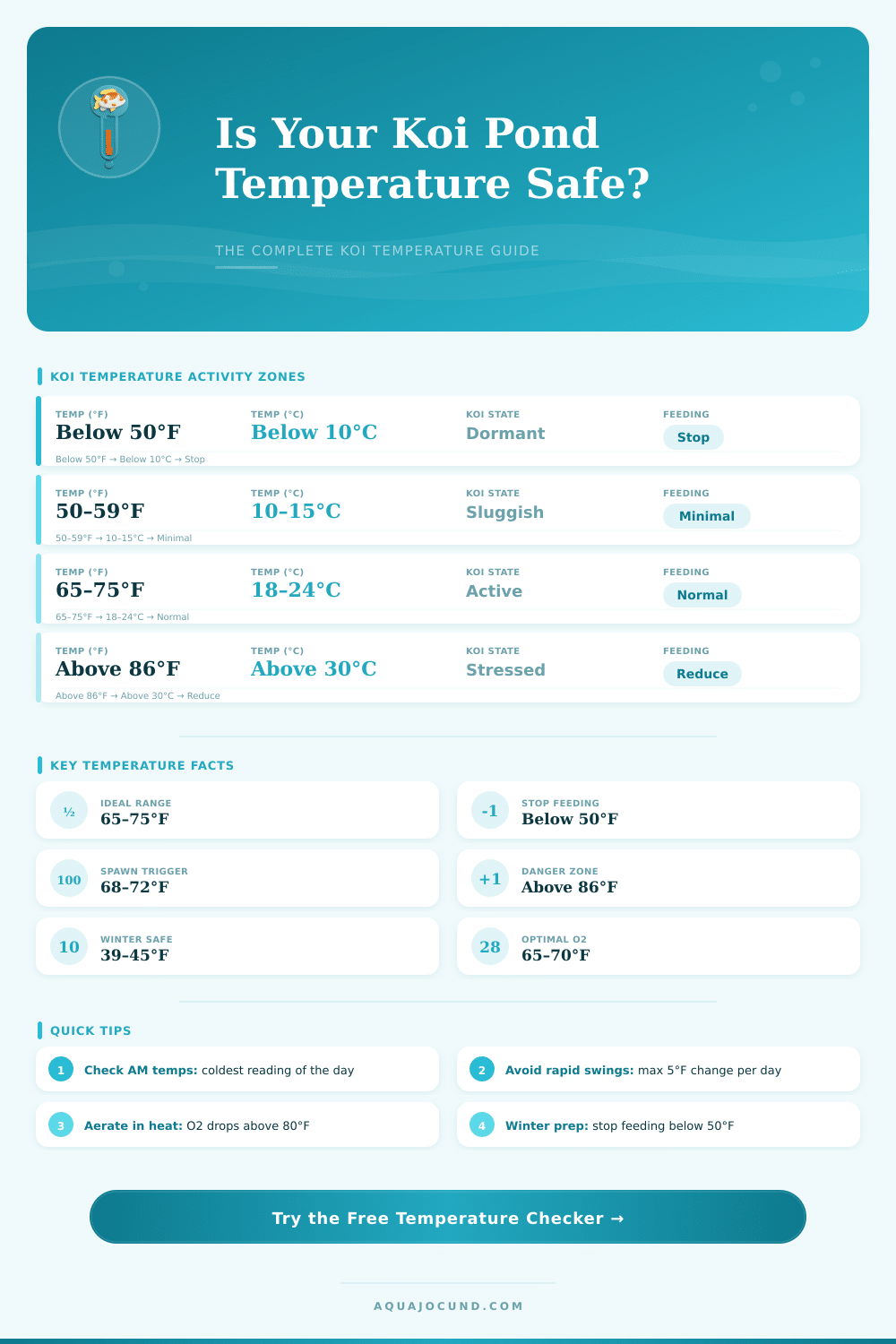
| Temp Range (°F) | Temp Range (°C) | Koi Activity State | Feeding Recommendation | O2 Level Note |
|---|---|---|---|---|
| Below 39°F | Below 4°C | Frozen risk / torpor | No feeding — cease all activity | Risk of ice-over; use de-icer |
| 39–49°F | 4–9°C | Dormant / hibernating | No feeding | O2 adequate; check ammonia |
| 50–59°F | 10–15°C | Very sluggish | Wheat germ only, 1–2x/week | O2 good; digestion very slow |
| 60–64°F | 16–18°C | Slowly active | Wheat germ, 2–3x/week | O2 good; light feeding |
| 65–75°F | 18–24°C | Optimal — fully active | Regular diet 2–3x/day | O2 optimal; ideal growth |
| 76–80°F | 24–27°C | Active; monitor closely | Reduce protein; 2x/day | O2 starts declining; aerate |
| 81–85°F | 27–30°C | Stressed; watch behavior | Minimize feeding; 1x/day | O2 low; heavy aeration needed |
| Above 86°F | Above 30°C | Danger zone | Stop feeding immediately | O2 critically low; emergency aerate |
| Pond Volume | Volume (Liters) | Recommended Wattage | Heater Type | Temp Rise Capacity |
|---|---|---|---|---|
| Up to 500 gal | Up to 1,893 L | 300–500W | Pond de-icer / immersion | +5–10°F above ambient |
| 500–1,000 gal | 1,893–3,785 L | 1,000–1,500W | Inline titanium heater | +10–15°F above ambient |
| 1,000–2,000 gal | 3,785–7,571 L | 2,000–3,000W | Inline titanium heater | +10–20°F above ambient |
| 2,000–5,000 gal | 7,571–18,927 L | 4,000–6,000W | Heat pump recommended | +15–25°F above ambient |
| 5,000+ gal | 18,927+ L | Heat pump 5–15 ton | Commercial heat pump | Stable year-round control |
| Temperature (°F) | Temperature (°C) | Max Dissolved O2 (mg/L) | Koi Safe Minimum (mg/L) | Action Required |
|---|---|---|---|---|
| 50°F | 10°C | 11.3 | 5.0 | Normal operation |
| 60°F | 16°C | 9.9 | 5.0 | Standard aeration |
| 70°F | 21°C | 9.0 | 5.0 | Standard aeration |
| 75°F | 24°C | 8.6 | 6.0 | Ensure good aeration |
| 80°F | 27°C | 8.2 | 6.0 | Increase aeration |
| 86°F | 30°C | 7.6 | 7.0 | Max aeration + chiller |
| 90°F | 32°C | 7.2 | 7.0+ | Emergency intervention |
Koi live in fresh water, and from what I’ve seen they do best somewhere between around 65 and 77 degrees Fahrenheit. In Celsius, that comes to about 18 to 25 degrees, the ideal conditions for koi fish to grow most healthy and avoid the most common health troubles. In that range, small changes don’t usually bother their activities.
Some owners of indoor koi keep the water temperature at 68 to 78 degrees, but many fish keepers notice that their fish like it a bit cool, in the range of 65 to 75 degrees.
Koi Water Temperature and Care
Here’s the key point, koi are surprisingly tough. They can actually survive water as cold as around 34 degrees or as warm as 90 degrees. Even so, simply surviving and truly doing well are two diferent things.
Just because they can handle those extremes does not mean that they should stay there. When the temperatures always fall under 50 degrees or climb past 90 degrees for long times, things become difficult. In such cases, a deep pool helps the most.
When the water cools under around 50 degrees, koi almost stop everything. Their body processes slow, and there immune systems start to fail. Under 41 degrees or so, their body enters a weird state called torpor, something close to hibernation, but not as deep.
They save energy and pass most of the time sitting near the bottom of the pool. The good part? Koi last through winter, if only the whole pool does not freeze solid.
Other point: protect them against predators during those slow times matters, because they then become easy targets, when they cannot flee.
Match the feeding to the seasons. Do not feed until the water temperature always reaches 50 degrees. Here their metabolism slows a lot, so they almost don’t need food.
At 55 to 70 degrees, daily feeding works well. Above 70 degrees, you can feed twice a day. For smaller koi, you can even feed four times a day, although everything has limits.
Here’s what gets interesting: when the water warms to about 82 degrees, koi eat eagerly, but their digestion slows. Feeding after sunset instead of in the day can help their bodies handle it more effectively.
There is a learned trick for winter pond care. Too much water flow can hurt, it really can turn your pool into an icy mess that creates dangerously cold conditions at the bottom. Match the flow to your pond setup and local climate.
During warmer periods, use falls and fountains freely. They mix the water, spread the warmth and boost the oxygen. The evaporation from those features makes a natural cooling effect that koi like.
Pumps with flow during warm waves help your fish stay healthier overall. Key point: overnight, water plants compete with the fish for oxygen, sogood airflow becomes even more important then.