Wood Buoyancy Weight Needed Calculator
Estimate the slate, stone, or ceramic anchor weight needed to hold aquarium wood down from volume, wood density, water displacement, soak reduction, and safety factor.
| Wood Type | Typical Dry Density | Default Soak Reduction | Buoyancy Behavior |
|---|---|---|---|
| Cholla skeleton | 18 lb/ft³ / 0.29 kg/L | 45% | Very open and buoyant until saturated |
| Cork bark | 15 lb/ft³ / 0.24 kg/L | 45% | Usually needs a strong hidden anchor |
| Spider wood | 33 lb/ft³ / 0.53 kg/L | 35% | Branches trap air and often float at first |
| Manzanita branch | 40 lb/ft³ / 0.64 kg/L | 30% | Moderate lift, variable by dryness |
| Malaysian driftwood | 47 lb/ft³ / 0.75 kg/L | 25% | Often sinks sooner than branch wood |
| Mopani | 55 lb/ft³ / 0.88 kg/L | 20% | Dense pieces may only need light help |
| Anchor Material | Density Used | Net In-Water Weight | Best Use |
|---|---|---|---|
| Slate plate | 168 lb/ft³ / 2.69 kg/L | 63% of dry weight | Flat hidden base |
| Granite stone | 165 lb/ft³ / 2.64 kg/L | 62% of dry weight | Visible rock anchor |
| River stone | 155 lb/ft³ / 2.48 kg/L | 60% of dry weight | Natural exposed weight |
| Basalt / lava stone | 120 lb/ft³ / 1.92 kg/L | 48% of dry weight | Bulkier porous anchor |
| Ceramic tile | 135 lb/ft³ / 2.16 kg/L | 54% of dry weight | Flat plate attachment |
| Stainless weight | 490 lb/ft³ / 7.85 kg/L | 87% of dry weight | Small dense ballast |
| Scenario | Approx Wood Size | Wood Volume | Typical Anchor Need |
|---|---|---|---|
| 5 gal nano branch | 8 x 3 x 3 in / 20 x 8 x 8 cm | 0.02 ft³ / 0.6 L | 0.4-0.8 lb / 0.2-0.4 kg |
| 10 gal cholla cluster | 12 x 4 x 3 in / 30 x 10 x 8 cm | 0.04 ft³ / 1.1 L | 0.8-1.6 lb / 0.4-0.7 kg |
| 20 long branch | 18 x 5 x 4 in / 46 x 13 x 10 cm | 0.09 ft³ / 2.5 L | 1.5-3 lb / 0.7-1.4 kg |
| 40 breeder cork | 24 x 8 x 6 in / 61 x 20 x 15 cm | 0.33 ft³ / 9.3 L | 8-14 lb / 3.6-6.4 kg |
| 75 gal root mass | 30 x 10 x 8 in / 76 x 25 x 20 cm | 0.42 ft³ / 11.9 L | 8-16 lb / 3.6-7.3 kg |
| 125 gal stump | 38 x 14 x 12 in / 97 x 36 x 30 cm | 1.18 ft³ / 33 L | 18-35 lb / 8-16 kg |
| Step | Formula | Purpose | Unit Basis |
|---|---|---|---|
| Wood volume | shape volume x fullness | Approximates irregular wood | ft³ or L |
| Displaced water | volume x water density | Gross upward force | 62.4 lb/ft³ |
| Dry wood weight | volume x wood density | Natural downward force | wood density |
| Net lift | displacement - wood weight | Lift before soaking | force weight |
| Soaked lift | net lift x remaining lift % | Waterlogging reduction | percent |
| Anchor weight | soaked lift x safety x flow | Required dry anchor weight | lb or kg |
To anchor aquascape driftwood effectively, you can use a calculator to estimate required weight based off displacement and density. If you’ve ever spent hours arranging branches, pruning leaves, planting moss, and then come back a couple days later only to find your carefully arranged driftwood has floated to the surface, you’re not alone and I’m sure you were frustrated.
The reason: Wood is full of trapped air and therefore porous. Until it displaces that air with water, it’s going to fight with gravity and float like a cork in bathtub. So what gives? Well, it’s actualy pretty simple math (tedious math). It involves material densities and displacement forces. You also has to factor in a safety margin for the currents in the tank. To be clear, you don’t have to become a naval architect to fix this, but knowing how it works can save you from having to re-arrange and get frustrated.
How To Keep Driftwood From Floating
So, how do we solve the problem? Water is heavy. A cubic foot of water weighs about 62lbs. Dry wood is lighter then wet wood. In fact, it is so light per cubic foot that it may want to float upwards by almost thirty pounds. Yep, Archimedes discovered that millennia ago and guess what, it still applies today.
So will your hardscape sink or become a floating raft? Every cubic foot of submerged wood displaces roughly sixty-two pounds of water. If that piece of spiderwood weigh only 33 lbs/cu ft, because it’s so light, then it has nearly 30 lbs of net upward lift trying to push against it. This explains why gluing rocks on doesn’t work so well. It sticks for a time, but then it fails. As the wood moves just barely enough that the glue can’t hold it, it either breaks surface apart or gradually gives way from the constant upward pressure.
There’s no guessing involved here either since we can use a calculator to figure out how much weight an object must have in order to sink. You put in the dimensions of the particular object, and it calculates the weight by subtracting the weight of the object from the weight of the water it displaces. Then it deducts a reduction value called “soak loss.” This means that as the wood gets wet over time (weeks or months), it soaks up water. As a result, it becomes less buoyant and weighs more.
Why is this important? Soaked wood behave very differently from new wood. That new branch might require 5 lbs of slate to weigh it down when first added, but a month later after being submerged it may only require 2 lbs. This adjustment is built into the calculator to make sure you aren’t over-anchoring your tank unnecessarily and clouding the water or crushing those delicate plant.
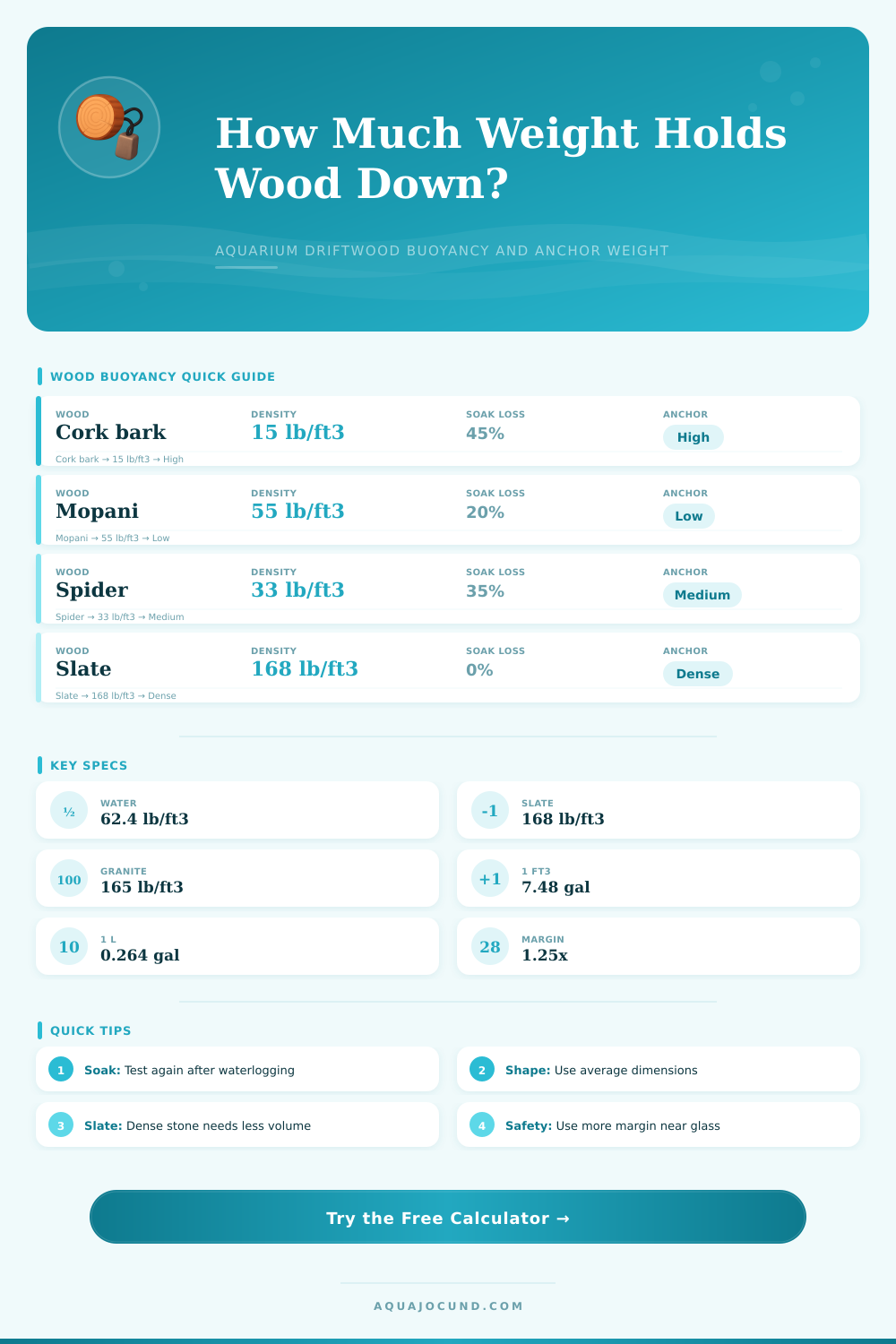
Woods also vary. For example, cork bark is notorious for being very buoyant and needs a lot of anchoring power no matter how long it’s been soaking up water. On the opposite end of the spectrum, mopani is so dense that most will sink on their own or only need a small stone to keep them from tipping over. If you don’t have access to a scale to weigh your wood prior to putting it into the tank, the typical densities of these popular woods is provided in the reference tables that come with the calculator. That way, you can at least have a starting point about which direction you’ll be applying safety factor, towards the low end for mediums vs. The high end for high-lift materials.
Aquariums are dynamic systems and a little extra weight goes a long way. You poke stuff around during maintenance, fish swim all over the place, even filters cause current, and decorations gets swished around. If you size your anchor to match the buoyant force exactly, any movement will lift the wood off the bottom. Adding 25% additional weight (a conservative safety margin of 1.25) ensures it stays in place. Active bottom-dwellers like plecos that dig, along with strong currents, can both increase this margin to 1.5 or more so the hardscape doesn’t move. Better to have slightly too much weight buried in the substrate than not enough.
Most aquascapers prefer slate because it’s dense yet thin, which makes hiding it underneath sand and soil easy. It’s also their favorite anchor material. If you’d like some rocks in your design that show, then granite is a good choice as well. Porous lava rock has a similar appearance but is much less dense. That’s why more volume is needed with lava rock to get an equivalent amount of holding power. The calculator gives you exact volumes (in different anchor materials) needed to reach desired weight, so you’ll know exactly what size slate tile or what size stone to buy.
It’s always a good idea to test your set up out of the tank before putting it all together. Before you put the wood in the tank, fill a bucket with water and place the wood and its anchor inside. Is the wood floating? Try adding more weight until it holds fast. Use aquarium safe silicone if necessary.
After you figure out displacement, density, and volume, knowing how to anchor driftwood becomes less of a guessing game. It allows you to guess how much stone you will require before ever filling the tank. This saves you time and ensures that your aquascape is positioned just as you designed it.