🌊 Wavemaker Flow Rate Calculator
Compare recommended turnover with effective wavemaker flow after pulse duty, obstruction loss, and pump placement.
| Pattern | Calculator Factor | Best Use | Watch Point |
|---|---|---|---|
| Wide propeller stream | 1.00 | General reef circulation | Broad but shorter reach |
| Gyre / crossflow | 1.10 | Long tanks and SPS reefs | Needs open rock lanes |
| Narrow direct stream | 0.88 | Spot flow behind rockwork | Can irritate coral tissue |
| Random alternating mode | 0.96 | Mixed reef variability | Average flow is below peak |
| Tank | Typical Size | Mixed Reef 35x | SPS 60x |
|---|---|---|---|
| 10 gallon | 20 x 10 x 12 in | 350 gph | 600 gph |
| 20 long | 30 x 12 x 12 in | 700 gph | 1,200 gph |
| 40 breeder | 36 x 18 x 16 in | 1,400 gph | 2,400 gph |
| 55 gallon | 48 x 13 x 21 in | 1,925 gph | 3,300 gph |
| 75 gallon | 48 x 18 x 21 in | 2,625 gph | 4,500 gph |
| 90 gallon | 48 x 18 x 24 in | 3,150 gph | 5,400 gph |
| 125 gallon | 72 x 18 x 22 in | 4,375 gph | 7,500 gph |
| 180 gallon | 72 x 24 x 24 in | 6,300 gph | 10,800 gph |
| Placement | Efficiency | What It Means | Typical Adjustment |
|---|---|---|---|
| Opposing ends, alternating | 1.05 | Best whole-tank exchange | Use two matched pumps |
| Same end, aimed across | 0.96 | Good reach, one dominant lane | Angle one pump upward |
| Back wall, angled forward | 0.92 | Good for open aquascapes | Avoid direct coral blast |
| Low behind rockwork | 0.82 | Detritus suspension helper | Needs extra open flow |
| High surface agitation | 0.88 | Great oxygen exchange | Less deep-tank turnover |
Achieving the correct water flow in your reef tank is necessary to prevent detritus from sitting on the rocks in your reef tank, as well as to prevent the tissue of your corals from becoming sluggishly. If the water flow is too low, the detritus that accumulate on the rocks can contribute to the development of anaerobic zones that will damage your corals. However, if the water flow in your reef tank is too high, the sand in your reef tank will continually move across the bottom of the tank, and the polyp of your corals will remain in a retracted state.
The wavemaker flow rate calculator allows you to calculate how much usable circulation will reach your display tank. You can use the wavemaker flow rate calculator by entering the dimensions of your tank, the type of livestock that you will keep in the tank, and the specifications of the pump that you plan to purchase for your tank. Many individual make the mistake of using only the rated flow number of the pump that they are considering purchasing.
Find the Right Water Flow for Your Reef Tank
The rated flow of the pump is the amount of water that the impeller can push through a straight pipe, but the tank that is being constructed has numerous obstacle to the movement of water through it. As a result, the water flow in the tank will be less than the rated flow of the pump. The wavemaker flow rate calculator accounts for these obstacles to the water flow in the tank.
Each of the variable that can be adjusted in the flow rate calculator will alter the effective flow number of the pump that is being calculated. One of the variable to consider is the pulse duty cycle of the controller that will be used to control the pump. The rated flow of the pump will be different than the flow of the water that is circulated through the display tank when the pump is running at a specific duty cycle.
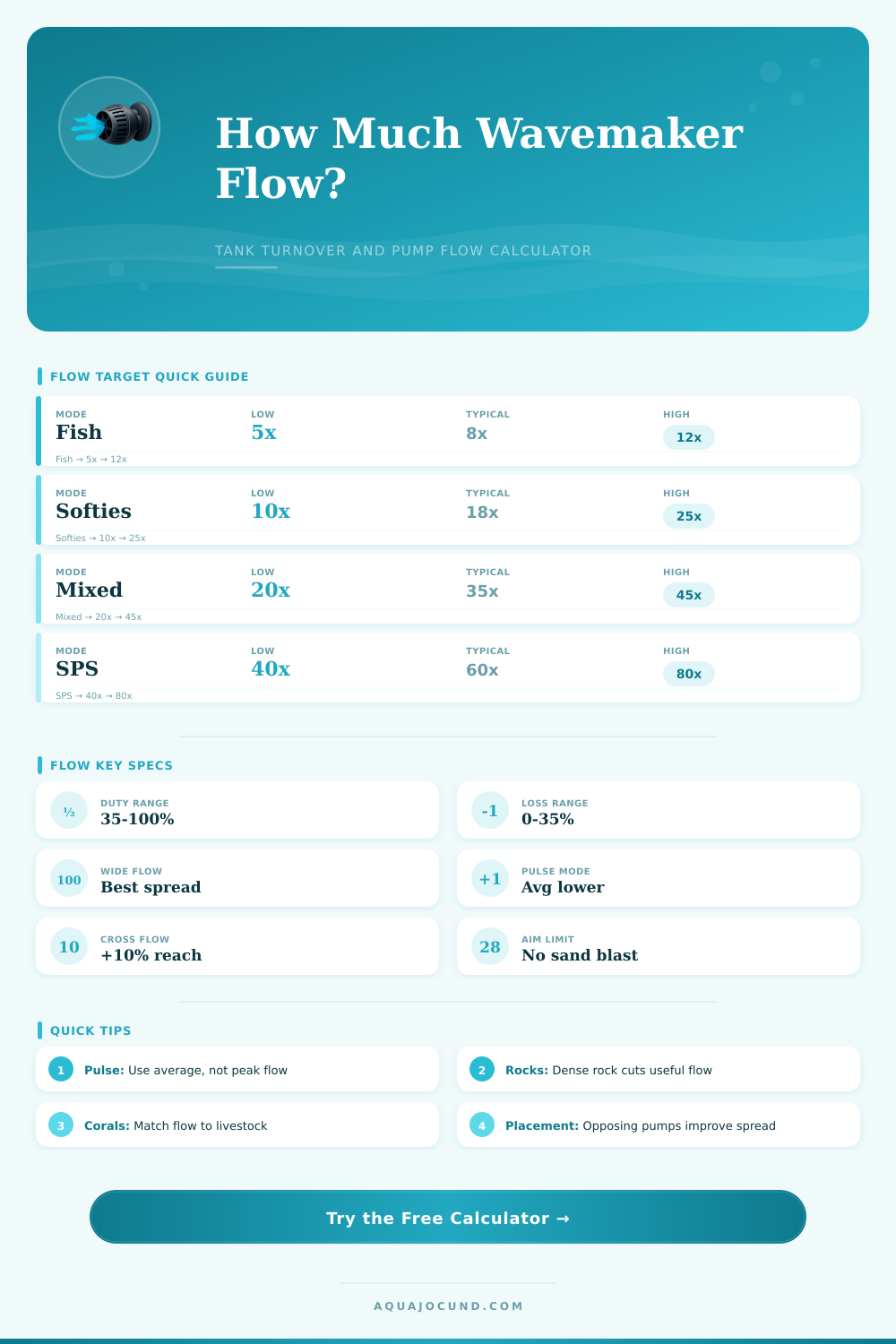
For instance, if the pump is set to run at 70% duty cycle, the display tank will not receive 70% of the rated flow of the pump. This is due to the fact that the impeller will ramp up in duty cycle at part of the cycle, and coast to a standstill at another part of the cycle. If the pump is set to a 50% duty cycle, the effective flow will be half of the rated flow of the pump prior to any losses due to the obstacles in the tank.
Another variable to consider is the obstruction loss of the tank. Obstruction loss is the resistance in the water column that occur due to the rockwork and corals in the display tank. An estimated percentage of the obstruction loss can be entered into the wavemaker flow rate calculator.
For instance, a moderately stocked mixed reef tank may have an obstruction loss of 15%, but a tank that contains dense branching SPS or LPS corals may have an obstruction loss of 25% or 30%. The higher the obstruction loss of the tank, the higher pump specification that the tank will require. The placement of the pumps in the display tank will also affect the water flow that is created by the pumps.
For instance, two pumps that are placed at opposing end of the tank will circulate the water differently than if you mount the two pumps on one end of the tank. The wavemaker flow rate calculator accounts for these different placement option, as each placement option has an efficiency factor associate with it that the user can enter. The mode selector on the wavemaker flow rate calculator will allow you to select the target number of tank turnovers per hour according to the requirement of the livestock that will inhabit the tank.
For instance, fish-only tank may require eight turnovers of the tank volume per hour, while mixed reef tanks require 35 turnovers of the tank volume per hour. SPS tanks may require 60 turnovers of the tank volume per hour. These targets are pre-set on the wavemaker flow rate calculator, but you can change them to meet the requirements of specific coral in the display tank.
An additional variable that can be accounted for in the wavemaker flow rate calculator is the flow rate of the return pump. The water that exit the sump and passes through the return pump is already in motion, so its contribution to the total circulation in the display tank is not at its full flow rate. The return pump flow is not at 100% of its return pump’s rated value, but accounting for this in the wavemaker flow rate calculator will help ensure that the total circulation in the display tank will meet the target that is set according to the requirements of the corals in the tank.
The wavemaker flow rate calculator will provide you with a mathematical estimate of the water flow that will reach your display tank. However, the calculator cannot measure how the water flow feels to the animals in the tank. The only way to determine whether the water flow in your tank is correct is to actually observe the sand in your tank and the corals in your tank.
If the sand in your tank does not move and the corals remain expanded, the flow of water through the tank is likely sufficient. If the sand moves in place but the corals are retracted, or if detritus begins to accumulate on the rocks in your reef tank, the effective flow is too low for the requirements of the corals in your tank. In this case, you may need to adjust the placement or the settings of the pumps.
The wavemaker flow rate calculator is a tool that will help to avoid simply purchasing the largest pump available for your display tank.