🌊 Water Density Calculator Salinity
Estimate aquarium water density, specific gravity, total water weight, and salinity-driven density change.
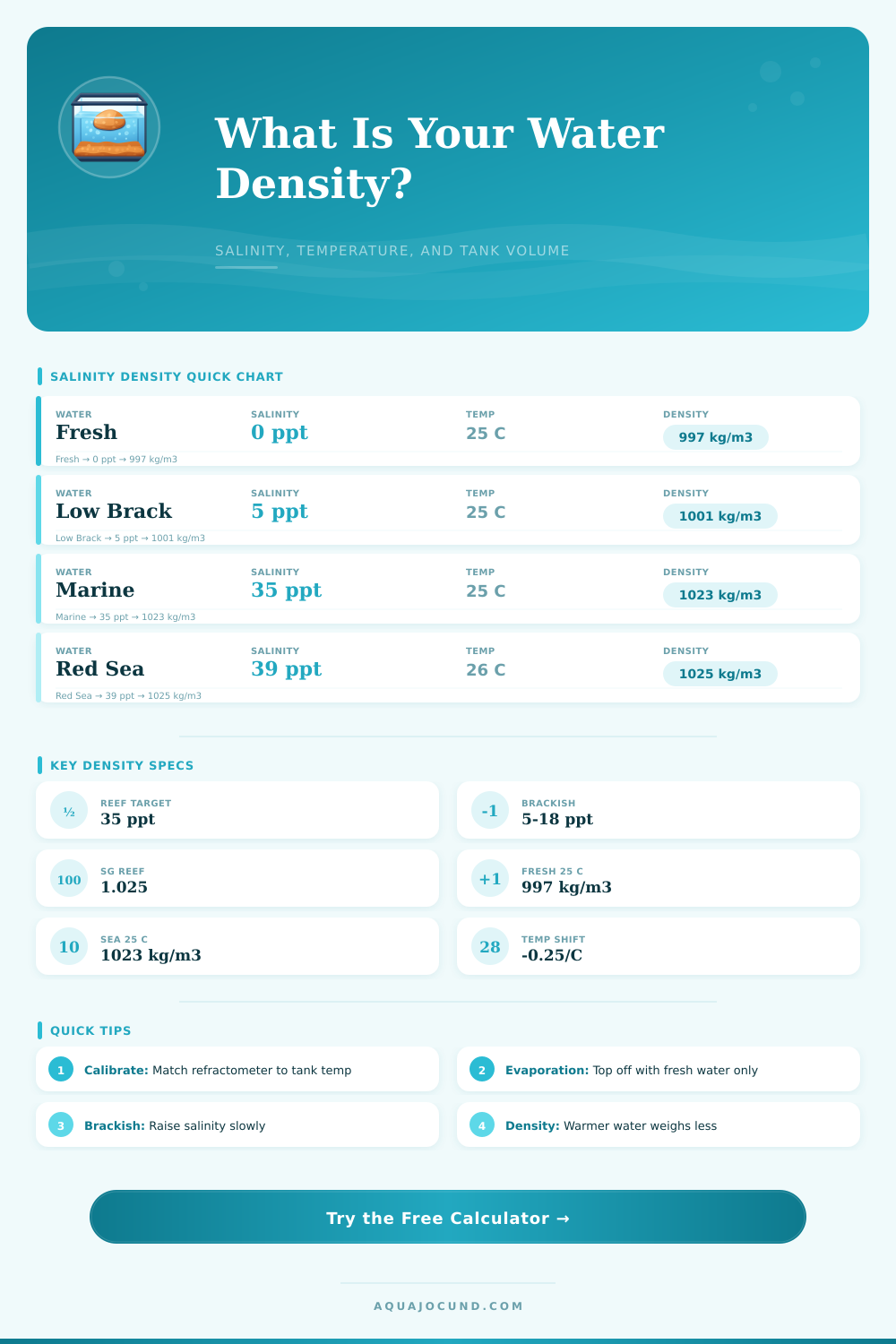
| Water Type | Salinity | Density at 20°C | Density at 25°C | Approx SG 25°C |
|---|---|---|---|---|
| Fresh | 0 ppt | 998.2 kg/m³ | 997.0 kg/m³ | 1.000 |
| Light Brackish | 5 ppt | 1002.0 kg/m³ | 1000.7 kg/m³ | 1.004 |
| Mid Brackish | 15 ppt | 1009.4 kg/m³ | 1008.0 kg/m³ | 1.011 |
| Marine | 32 ppt | 1022.0 kg/m³ | 1020.4 kg/m³ | 1.024 |
| Reef | 35 ppt | 1024.3 kg/m³ | 1022.7 kg/m³ | 1.026 |
| Red Sea | 39 ppt | 1027.3 kg/m³ | 1025.6 kg/m³ | 1.029 |
| System or Livestock | Typical Salinity | Specific Gravity | Density Clue | Notes |
|---|---|---|---|---|
| RO top-off water | 0 ppt | 1.000 | Lightest | Use for evaporation replacement, not saltwater changes. |
| Planted freshwater | 0-0.5 ppt | 1.000-1.001 | Near fresh | Salt additions barely change total tank weight. |
| Molly / guppy brackish | 3-8 ppt | 1.002-1.006 | Slightly heavier | Acclimate slowly across several water changes. |
| Figure 8 puffer | 6-12 ppt | 1.004-1.009 | Moderate | Targets vary by keeper and source water chemistry. |
| Mudskipper / scats | 12-22 ppt | 1.009-1.016 | Heavy brackish | Large evaporative changes can swing density quickly. |
| Fish-only marine | 30-35 ppt | 1.022-1.026 | Marine | Lower end is common for fish-only systems. |
| Mixed reef | 34-36 ppt | 1.025-1.027 | Ocean-like | Stability matters more than chasing a single number. |
| Hyposalinity QT | 12-14 ppt | 1.009-1.010 | Controlled | Use a calibrated refractometer for treatment work. |
| Temperature | Freshwater Density | 35 ppt Density | Change from 25°C Reef | Aquarium Meaning |
|---|---|---|---|---|
| 68°F / 20°C | 998.2 kg/m³ | 1024.3 kg/m³ | About +1.6 kg/m³ | Cool mixing water reads denser. |
| 75°F / 23.9°C | 997.3 kg/m³ | 1023.0 kg/m³ | About +0.3 kg/m³ | Close to many tropical tanks. |
| 77°F / 25°C | 997.0 kg/m³ | 1022.7 kg/m³ | Baseline | Common refractometer reference point. |
| 80°F / 26.7°C | 996.6 kg/m³ | 1022.2 kg/m³ | About -0.5 kg/m³ | Warm reef water is slightly lighter. |
| 84°F / 28.9°C | 996.0 kg/m³ | 1021.5 kg/m³ | About -1.2 kg/m³ | Heat and evaporation can pull in opposite directions. |
| Tank Size | Typical Dimensions | Freshwater Weight | 35 ppt Weight | Added Marine Weight |
|---|---|---|---|---|
| 10 gallon | 20 × 10 × 12 in | 83.1 lb | 85.3 lb | +2.2 lb |
| 20 long | 30 × 12 × 12 in | 166 lb | 171 lb | +4.5 lb |
| 40 breeder | 36 × 18 × 16 in | 333 lb | 341 lb | +9 lb |
| 55 gallon | 48 × 13 × 21 in | 458 lb | 470 lb | +12 lb |
| 75 gallon | 48 × 18 × 21 in | 624 lb | 640 lb | +17 lb |
| 125 gallon | 72 × 18 × 22 in | 1040 lb | 1068 lb | +28 lb |
Rock, sand, evaporation, and salt mix hydration all change the final reading. Measure the water after it is fully mixed, then use the calculator to estimate density and water mass.
Warm water expands and becomes less dense. A reef at 80°F can weigh slightly less per gallon than the same salinity sample at 68°F.
Adding salt to water increases the masses of the water. The increased mass of the salt waters means that saltwater will be more heavier then freshwater. Additionally, the salt ions that is added to the water have more mass than the water molecules in the amount of water that is displace by the salt ions.
Therefore, the density of the saltwater will be higher then the density of the freshwater. As a result, an saltwater aquarium will weigh more than a freshwater aquarium of the same volume. Furthermore, these factor make it necessary to account for the weight of the saltwater if you’re going to place that aquarium upon a floor.
Salt Makes Water Heavier and Affects Aquariums
If the weight of the saltwater are not accounted for, the floor may sag or even fail with the weight of the aquarium. The density of water is a measurement of the amount of mass that is contain within a specific volume of water. Furthermore, the density of water does change.
For instance, the salinity of water will increase the density of the water. Additionally, the temperature of the water will also affect the density of water. Warm water molecule will move faster than cold water molecules.
Therefore, the warm water will have a more higher rate of expansion. Because warm water expand more than cold water, warm water will be less dense than cold water. Thus, warm saltwater will be less dense than cold saltwater, and cold saltwater will be more dense than warm saltwater.
To determine the density of the water in you aquarium, it is necessary to utilize a calculator. The calculator will account for the salinity and temperature of the water in determining the density of the water. Brackish water is water that has a salinity level that is higher than freshwater yet lower than saltwater.
Furthermore, many people keeps brackish water in tanks in which specific animals are kept. The salinity of brackish water can change quick. For instance, the water evaporate from the tank yet the salt remains in the tank.
As the salinity of the water increase due to the evaporated water, the density of that brackish water also increases. A reference table exist that illustrates the differences between light brackish and mid-brackish water. Furthermore, this reference table can tell you the density requirement of the animals that are kept in those tanks.
The density of the water in the tank can be measured with a tool call a refractometer or a tool called a hydrometer. Each of these tool will tell you the density of the water in the tanks. However, a refractometer and a hydrometer will not tell you the total weight of the water in the tank.
In order to calculate the total weight of the water in the tank, you must know the dimension of the tank and the density of the water. Furthermore, it is necessary to calculate the total weight of the water in the tank to ensure that the aquarium rest upon a stable surface. Another common mistake with aquariums is adding saltwater to the tank to replace the water that have evaporated.
However, you should not add saltwater to replace the evaporated water. The reason that saltwater should not be added is that the salinity of the water will increase. The increase in salinity will increase the density of the water.
Instead, use fresh RO (reverse osmosis) water to replace the water in the tank that evaporated. Stability in the water is important to the health of the fish in the tank. Fish can handle constant density in the water yet cannot handle rapid changes to that density.
Rapid changes in density cause osmotic shock in the fish, which can harm them. By maintaining the salinity of the water in the tank, the density will remain the same. A stable density will keep the fish healthy.