Water Change Volume To Hit Target Calculator
Calculate the water change needed to move nitrate, phosphate, GH, KH, TDS, salinity, or any mixable aquarium reading toward a target value.
🎯Quick Presets
📏Tank And Target Inputs
⚙Parameter Reference Grid
📊Common Target Ranges
| Parameter | Common goal | Typical new water | Calculator note |
|---|---|---|---|
| Nitrate | Below 20 ppm for many community tanks | 0 to 10 ppm | Best modeled by dilution when no dosing occurs. |
| Phosphate | 0.05 to 1 ppm depending on plants or reef | 0 to source value | Rock, food, and soil can rebound after the change. |
| GH | Species specific hardness target | RO mix or tap blend | Linear blend works when using the same test scale. |
| KH | Stable buffer for tank style | Prepared alkalinity | Change slowly when pH stability matters. |
| TDS | Livestock or remineralizer target | RO, tap, or mixed water | TDS is broad, so confirm key minerals separately. |
| Salinity | Brackish or marine target | Freshwater or salt mix | Match temperature and measure with calibrated gear. |
💧Common Tank Volumes
| Tank | Inside dimensions | Nominal volume | 35% change |
|---|---|---|---|
| 5 gal nano | 16 x 8 x 10 in / 41 x 20 x 25 cm | 5 gal / 19 L | 1.8 gal / 6.6 L |
| 10 gal | 20 x 10 x 12 in / 51 x 25 x 30 cm | 10 gal / 38 L | 3.5 gal / 13 L |
| 20 long | 30 x 12 x 12 in / 76 x 30 x 30 cm | 20 gal / 76 L | 7 gal / 26 L |
| 29 gal | 30 x 12 x 18 in / 76 x 30 x 46 cm | 29 gal / 110 L | 10 gal / 38 L |
| 40 breeder | 36 x 18 x 16 in / 91 x 46 x 41 cm | 40 gal / 151 L | 14 gal / 53 L |
| 55 gal | 48 x 13 x 21 in / 122 x 33 x 53 cm | 55 gal / 208 L | 19 gal / 73 L |
| 75 gal | 48 x 18 x 21 in / 122 x 46 x 53 cm | 75 gal / 284 L | 26 gal / 99 L |
| 125 gal | 72 x 18 x 21 in / 183 x 46 x 53 cm | 125 gal / 473 L | 44 gal / 166 L |
🔬Formula Behavior Examples
| Situation | Current | New water | Change to target |
|---|---|---|---|
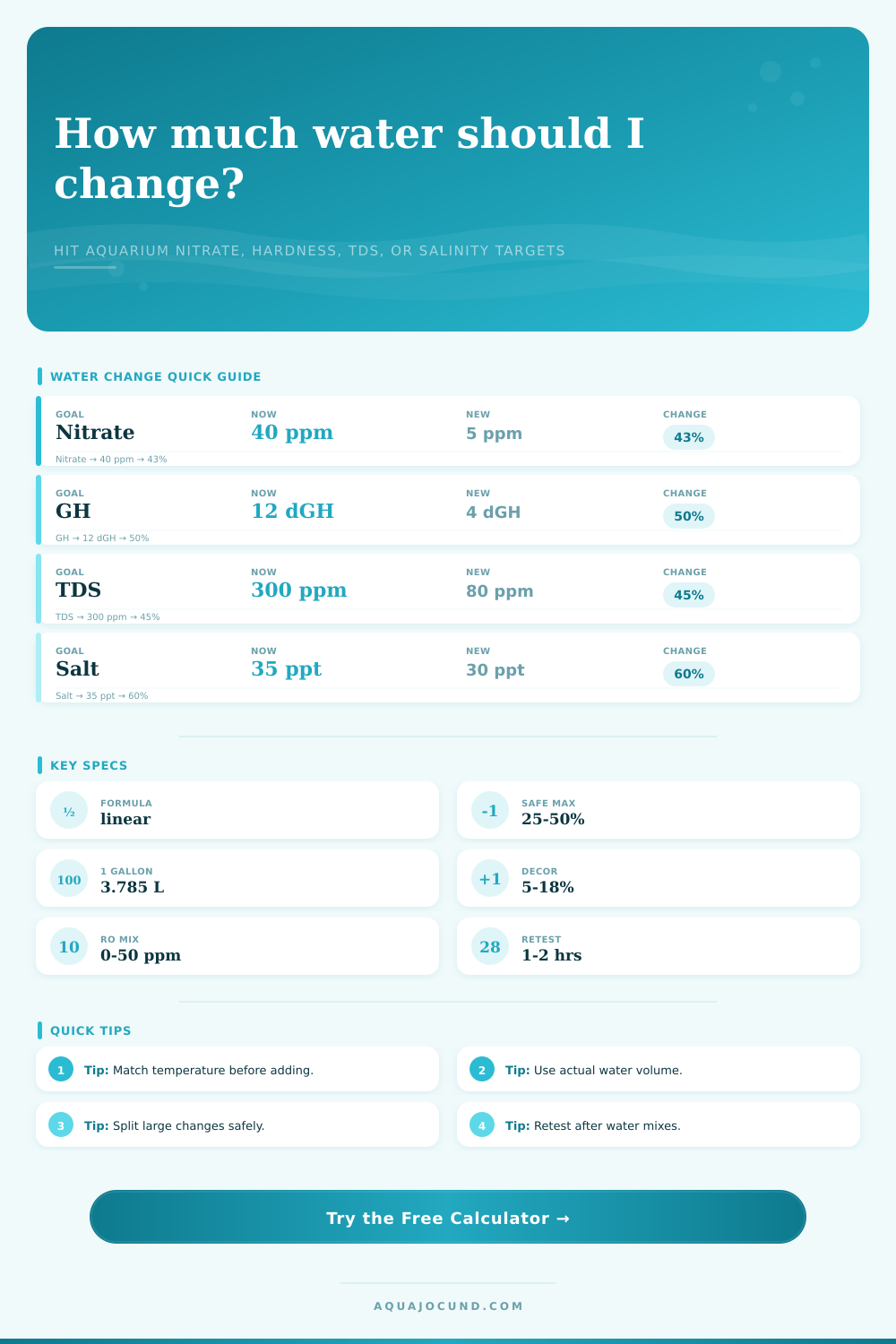
| Lower nitrate from 40 to 20 ppm | 40 ppm | 5 ppm | 57% if done once, or split over changes |
| Lower TDS from 300 to 200 ppm | 300 ppm | 80 ppm | 45% with mixed RO water |
| Raise KH from 2 to 4 dKH | 2 dKH | 8 dKH | 33% if new water is prepared higher |
| Lower salinity from 35 to 33 ppt | 35 ppt | 30 ppt | 40% with lower salinity water |
| Target equals source water | Any | Target | Mathematically trends close, not exact at 100% |
| Target beyond source water | 40 ppm | 20 ppm | Cannot reach 10 ppm by water change alone |
🧪Planning Tips
The calculator will tell you exactly how much water to change. Why do you want that? Because it’s dangerous to guess. If you don’t change enough, your parameters rises. If you change too much, you shock livestock. The calculator converts vague observations into clear volumes. It’s very basic dilution stuff.
But here’s where it gets sticky: Your tank isn’t a box full of water. There are rocks and substrates and other things in there. Those things occupies space. That 50g tank that may have held 50 gallons of water now doesn’t because of all that stuff. So what? Well, how much does all that stuff occupy? The calculator allows you to input a percent of occupied space by tank decorations.
Why Water Change Calculators Are Important
Why? Because if you don’t factor this in, you’re going to remove more then you think. However, keep in mind the quality of that new water as well. It’s not like you can dilute your tank down to nothing if tap water has minerals or nitrates. You can only reduce parameters down to what is found in the source water. So the tool asks for reading of the prepared new water.
With reverse osmosis water, you can drop the parameters further down. With untreated tap water, you have a ceiling on how far down you can go. This point is missed by many aquarists. They think a water change reset everything. What actualy happens is it blends two solutions.
Another consideration is temperature matching. Thermal shock kills fish. So if you’re replacing water and that new water is 10 degrees cooler than your tank then… yikes! The calculator assumes that you have prepared your replacement water. That means the water has been temperature matched AND dechlorinated. Don’t skimp here. Take your time pouring in the water so it can be mixed into existing water. Stressing out delicate species such as shrimp isn’t good.
Sometimes the math say make one big change. That’s not always best for biological balance. Rather, you might divide up that change into several changes. Those accomplishes your chemistry goal and maintain stability in the tank. They just take longer to do so. And they’re safer for your livestock.
For some parameters, there is many approaches as shown by the table of references. Methods for reducing nitrate levels differ from those for reducing salinity. Why? Because the physical properties of water changes much more with salinity. After a water change, numbers might bounce right back. That means your rocks is adding hardness or your substrate is releasing phosphate. Within hours, the numbers are drifting back towards their previous levels.
It is not because the water change failed, but because the problem isn’t in the water column at all; it’s inside the tank. Once the water has had time to circulate and come back up to temp, retest. That will tell you whether or not you nailed the target.
Chemical management is an exact science and water changes are a part of it. But they’re more than cleaning. They become a measure of how much you know about source water quality. They also show how much you know about volume and displacment. And then they’re no longer a guess but a way to begin controlling your environment. It’s no longer a random act with the bucket. It’s a measured intervention that you pour in and watch settle into place.
You know what’s going on. Control is what separates the hobbyist who keeps fish from the one whose tank thrive.