Water Change Percentage Calculator
Plan aquarium water-change size, nitrate reduction, refill volume, schedule pressure, and livestock-safe staging.
Recommended Plan
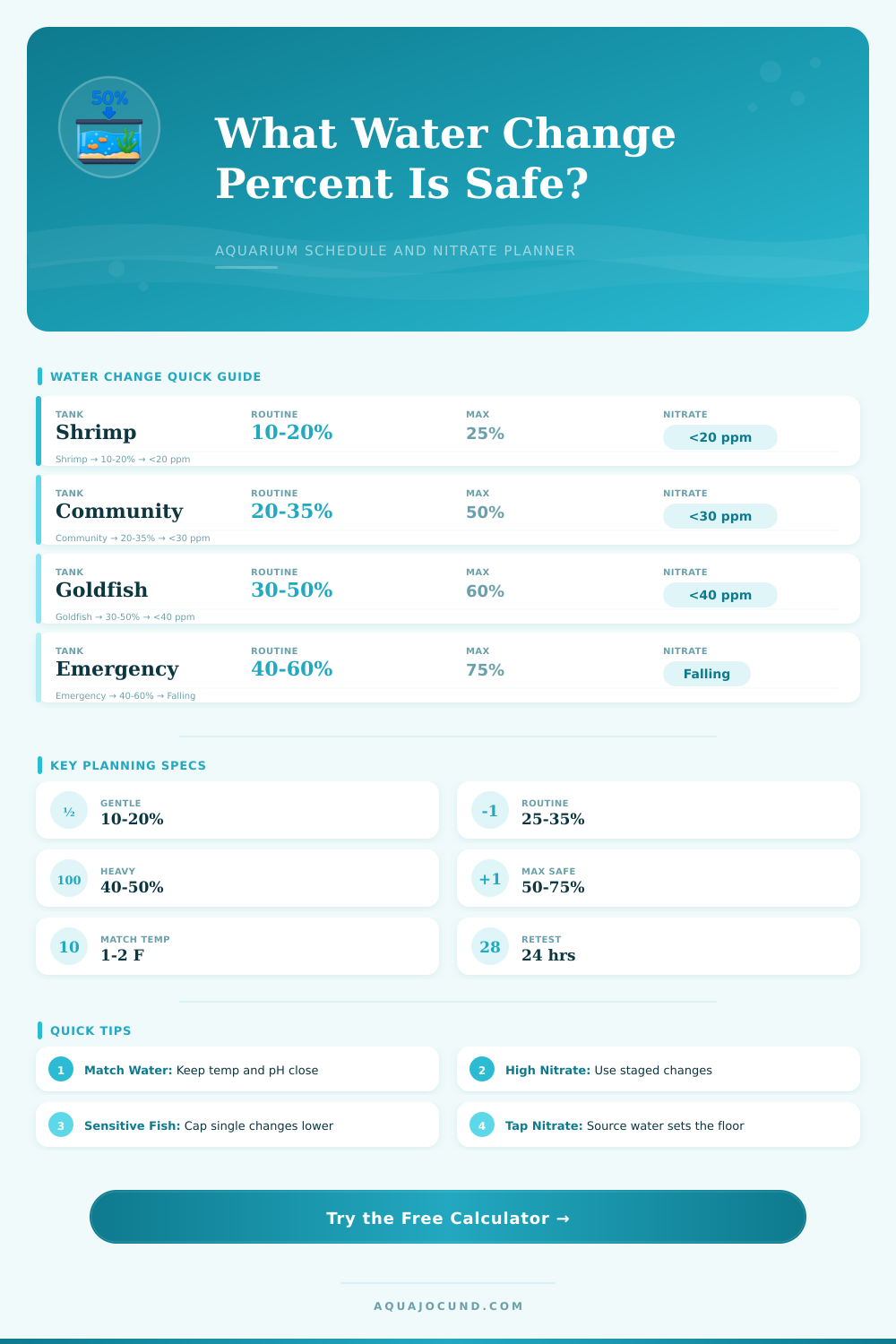
| Change Size | Best Use | Nitrate Removed | Main Caution |
|---|---|---|---|
| 10% | Very sensitive tanks, small top-up correction | 10% above source-water nitrate | Often too small for high nitrate |
| 25% | Routine planted and community maintenance | 25% above source-water nitrate | Repeat weekly if bioload is high |
| 40% | Heavy feeding, goldfish, cichlids, nitrate correction | 40% above source-water nitrate | Match temperature and hardness |
| 60% | Emergency correction or neglected tank recovery | 60% above source-water nitrate | Stage if livestock is sensitive |
| Setup | Common Target | Action Point | Planning Note |
|---|---|---|---|
| Shrimp or fry | 5-20 ppm | 20-30 ppm | Use smaller, more frequent changes |
| Planted community | 10-30 ppm | 35-45 ppm | Plants may consume part of the weekly rise |
| Goldfish or large cichlids | 20-40 ppm | 40-60 ppm | Large routine changes are common |
| Reef aquarium | 2-15 ppm | 15-25 ppm | Balance nitrate with phosphate and alkalinity |
| Tank | Display Volume | 25% Change | 40% Change |
|---|---|---|---|
| 10 gallon | 9-10 gal / 34-38 L | 2.5 gal / 9.5 L | 4 gal / 15 L |
| 29 gallon | 26-29 gal / 98-110 L | 7 gal / 26 L | 11.5 gal / 44 L |
| 55 gallon | 49-55 gal / 185-208 L | 14 gal / 52 L | 22 gal / 83 L |
| 125 gallon | 112-125 gal / 424-473 L | 31 gal / 118 L | 50 gal / 189 L |
| Refill Match | Suggested Cap | When to Stage | Check After |
|---|---|---|---|
| Excellent match | Profile cap | Only for very high nitrate | Normal behavior within 1 hour |
| Good match | 5% below profile cap | Above 50% or soft-water tanks | Temperature and breathing |
| Fair match | 10% below profile cap | Above 35-40% | pH, KH, and fish stress |
| Poor match | 20-30% first pass | Almost always | Retest before the next stage |
Maintaining an aquarium require that you manage the waste that accumulates in the tank. Managing the waste in your aquarium is necessary to avoid building up waste that may be harmful to your fish. One of the best method of managing the waste in your aquarium is to change the water in the tank.
Using the calculator, you can determine how much water to change and how often you will need to change the water in your aquarium. The amount of water to change within the aquarium will depend upon the contents of the tank, the rate at which the nitrate levels in the tank increases, and the match between the aquariums water and the water that you will use to refill the aquarium. Nitrate levels in the aquarium can be measured to determine if the levels is contributing to the health of the fish in the tank.
How to Use the Aquarium Water Change Calculator
The reason that nitrate levels are one of the most easily measure parameters in the aquarium is that nitrate reflects the amount of fish food, fish waste and the amount of uptake of these substances by the aquarium plants. Water changes will remove some of the existing nitrate levels from the aquarium, but the amount of nitrate that is added to the aquarium will be the amount that exists in the water that is used for the water change, whether from your tap water or a water mix. If your source water for the aquarium contains some nitrate, the amount of nitrate in the aquarium will only partialy change toward the target nitrate level.
The calculator accounts for the math behind this calculation, asking you for the current nitrate level in the aquarium, the target nitrate level, and the nitrate level in your source water. The calculator also takes into account how quickly the nitrate levels in your tank will rise before the next schedule water change. This helps you to ensure that the water change calculations remains effective between water changes.
The sensitivity of the fish in your aquarium will help to determine the maximum amount of water that you can change at one time. Many aquarium inhabitants, such as shrimp, fry, and fish that were caught in their native habitat, are much more sensitive to changes in water chemistry than more hardy fish species. Therefore, you will need to change the water for shrimp, fry, and native fish at a higher rate than for community fish.
Other fish, such as goldfish and cichlids, has a higher tolerance for water changes because they produce more waste and benefit from more water in their tanks. You can select the sensitivity level of your fish with the tool. By selecting a sensitivity level for your fish, you ensure that the percentage of the water in your tank that you will change takes into account the tolerance that your fish have for water changes.
The chemistry of the water that is used to refill your aquarium is another factor to consider. For example, a 50% change in the water in the tank may expose your fish to stressful changes in water chemistry if the replacement water differ from the aquarium water in temperature by five degrees or in hardness. This calculation is build into the aquarium water change calculator.
The calculator will account for the chemistry of your water change with regard to the chemistry of the aquarium water. This adjustment will help to account for the buffering power of your aquariums water. This adjustment may require that you change the water in stage rather than all at once.
Changing the water in stages rather than performing a large water change at once is likely to reduce the chance of shocking your fish. The amount of cleaning that you perform of the aquarium gravel as well as the amount of uptake of the water by aquarium plants will also affect the amount of water that you need to change. Deep vacuuming of the gravel will remove more nitrate from the tank than light vacuuming.
Aquatic plants that perform heavy growth will contribute less to the rate at which the nitrate levels rises in the tank. Therefore, with a tank that features heavy growth of aquarium plants, you may not need to change the water in the tank as often or as much. These factors will change how much water you have to change to ensure that you dont have to test the nitrate levels in your tank too often.
Enter these details in the calculator to ensure that the percentage of water to change is based off your aquarium. The reference tables below feature target nitrate levels for the different types of aquariums. These reference tables show the levels that most aquarium keepers use for different types of livestock.
These tables are provided for quick reference, though they are not rules to be followed in all cases. Your test results will be a more reliable indicator of the nitrate levels that your fish should have in there tanks than these reference tables. It is common for people to change too little water too often in their aquariums or to change to much water at one time.
The aquarium water change calculator accounts for these issue. With these calculations, you can develop a water change plan that will work for your aquarium while minimizing the risk of shocking your fish. Once you have a plan that works with the math and the requirements of your fish, maintaining the aquarium becomes a routine task.