Water Change Drain Time Calculator
Estimate aquarium drain time from real water volume, change target, hose or pump flow, lift/drop, tubing length, and flow restrictions.
Drain Time Estimate
| Method | Typical Flow | Best For | Timing Notes |
|---|---|---|---|
| Micro airline drip tube | 4-12 gph / 15-45 L/h | Acclimation, tiny fry tanks | Very slow, stable, easy to stop precisely |
| Small siphon hose | 30-70 gph / 115-265 L/h | Nano and desktop aquariums | Good control; debris can cut flow quickly |
| Standard gravel vacuum | 55-120 gph / 210-455 L/h | Routine substrate cleaning | Flow falls while digging into gravel |
| Large siphon hose | 90-180 gph / 340-680 L/h | Medium and large tanks | Fast enough to need a visible stop mark |
| Sink water changer | 80-220 gph / 300-835 L/h | Long runs to a sink | Depends heavily on faucet suction and hose length |
| Utility pump | 180-450 gph / 680-1700 L/h | Large tanks, sumps, ponds | Rated flow drops with lift and narrow tubing |
| Aquarium | Nominal Dimensions | 30% Change | Likely Drain Time |
|---|---|---|---|
| 5 gal betta | 16 x 8 x 10 in / 41 x 20 x 25 cm | 1.5 gal / 5.7 L | 4-9 min with small tubing |
| 10 gal community | 20 x 10 x 12 in / 51 x 25 x 30 cm | 3 gal / 11 L | 5-11 min with small siphon |
| 20 long planted | 30 x 12 x 12 in / 76 x 30 x 30 cm | 6 gal / 23 L | 7-15 min with gravel vac |
| 29 gal tall | 30 x 12 x 18 in / 76 x 30 x 46 cm | 8.7 gal / 33 L | 8-16 min with standard siphon |
| 40 breeder | 36 x 18 x 16 in / 91 x 46 x 41 cm | 12 gal / 45 L | 10-20 min with large hose |
| 75 gal display | 48 x 18 x 21 in / 122 x 46 x 53 cm | 22.5 gal / 85 L | 12-26 min with large hose or pump |
| Condition | Multiplier | When To Use | Practical Effect |
|---|---|---|---|
| Open hose | 1.00 | Clean tubing, clear intake | Uses nearly the measured bucket-test rate |
| Intake screen | 0.90 | Fish guard or coarse strainer | Small flow loss with better livestock safety |
| Gravel vacuum | 0.78 | Vacuum bell buried in substrate | Slows during debris lifts and sand pockets |
| Fine sponge guard | 0.66 | Shrimp, fry, or delicate fish | Safer intake, longer drain window |
| Debris or narrow fittings | 0.54 | Plants, valves, adapters, clogged mesh | Can double real drain time versus open hose |
| Step | Imperial Formula | Metric Formula | Use In Calculator |
|---|---|---|---|
| Rectangular volume | L x W x H / 231 | L x W x H / 1000 | Current water volume before drain |
| Cylinder volume | 3.1416 x r² x H / 231 | 3.1416 x r² x H / 1000 | Column, bowl-style, or round tanks |
| Bow front allowance | Rect + L x bow x H x 0.67 / 231 | Rect + L x bow x H x 0.67 / 1000 | Curved front extra water |
| Drain time | Drain gal / adjusted gph x 60 | Drain L / adjusted L/h x 60 | Base minutes before extra margin |
When emptying a big tank into a bucket, there’s always that moment of dread when the bucket doesn’t fill up fast enough, wondering how long it’ll be until the last few gallon drain and you can finally go to bed…or eat dinner. The truth is, most people underestimate drain time. Flow rate isn’t constant. As your water drains, gravity must overcomes the length of your hose(s) and an obstructed intake. All this combined makes drain time appear longer then expected.
Knowing these factors will help you avoid draining too much water at once or leaving your fish in a dwindling tank while you run out to get supplies. I have a calculator that does it for you above. But understanding what they mean can save you from falling into some common traps. Most importantly, the tank size isn’t often the number one variable.
Why Draining Takes Longer Than You Think
What’s your actual flow rate? Pumps and siphons is rated at maximum head pressure and with clean, unobstructed piping in ideal conditions. In reality, you’ve got tubing all over the place, maybe some buried in the substrate trying to vacuum out that gravel, perhaps a screen to prevent shrimp from going down the tube. All these things will severely impede the amount of flow. Digging around in the gravel with a typical gravel vacuum could reduce your effective flow by almost a quarter. This is where people make mistakes. Instead of observing the rate at which a bucket gets filled they rely on the box label.
The height do matter as well (though maybe not as much as you think with smaller drops). Siphons work because of gravity. Raising the water above its level for drainage requires overcoming that resistance. So if your hose goes six inches vertically into the floor drain but ten feet horizontal from there, you’re battling friction more then height. That’s why the tool allows you to enter both vertical drop and hose length independently. And did you spot the restriction multiplier option? That’s where real-world physics comes in. A fine sponge guard placed over the intake will protect sensitive fry but will also reduce flow by half. It’s a balance of safety versus speed.
What you keep in your tank isn’t just about size, it’s about selecting the right balance. However, there’s another factor in timing: As the water level lowers, so does the flow rate. The pressure decreases on siphons. That massive 75-gallon tank will empty rapidly at first, but getting rid of the last ten gallons may take longer than the first thirty.
For this reason, I think it makes sense to tack on some additional time to your calculations. If you’re aiming for a 20% water change, budget an additional 15%. This way, you won’t panic or rush if it takes longer toward the end. You’ll still have enough time to stop and confirm the water level before going too far and changing more than intended.
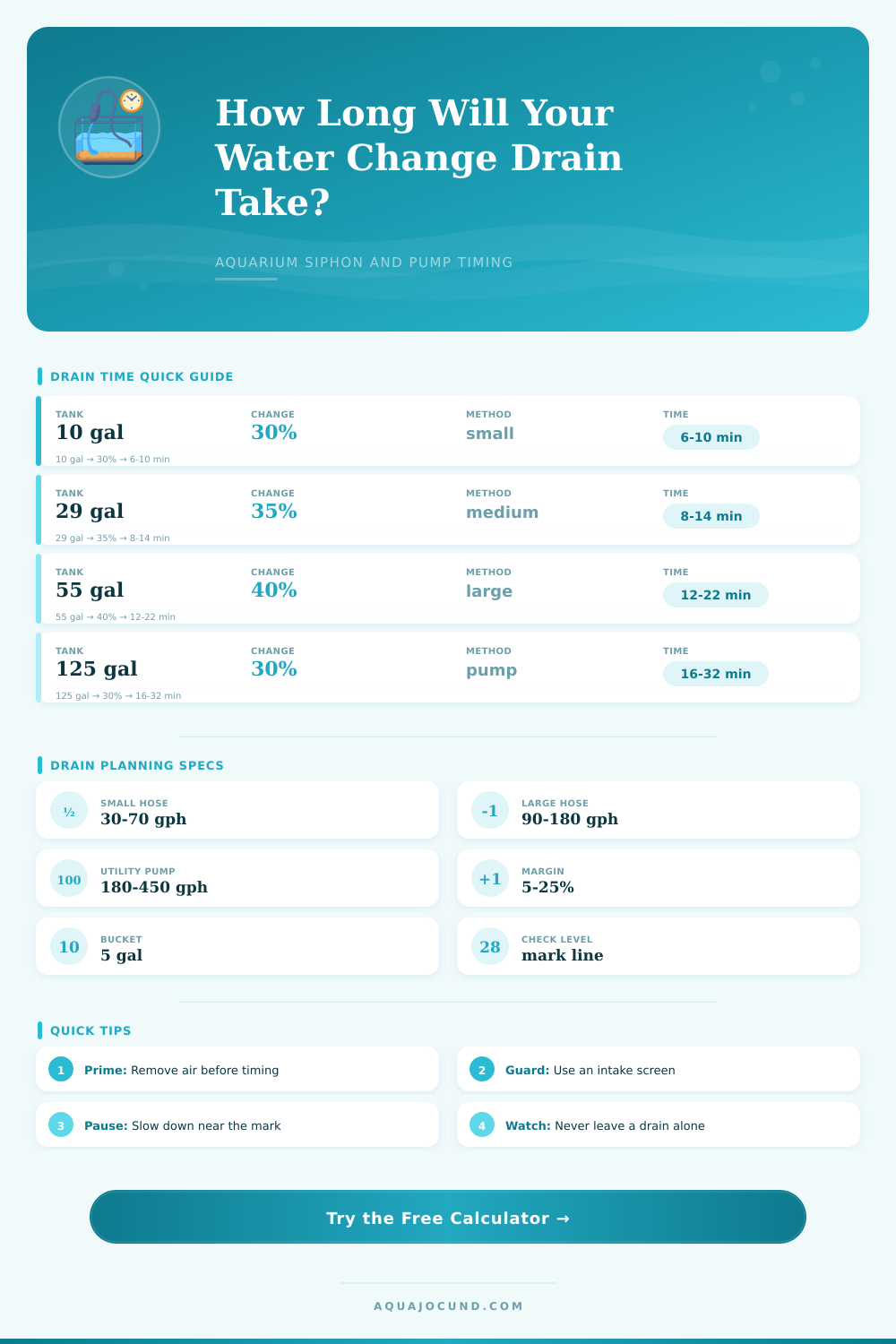
This is laid out on the page, through reference tables that compare various methods side by side. This way you can see how a micro airline tube is good for a small betta tank, but not a reef sump. Everything is scale. That large hose will empty a five gallon tank so quickly that you could of drained your whole tank before realizing what happened. Larger systems still need more robust tools, but they handles the lower drainage rate better because the change in any given minute is smaller relative to their size.
To conclude, predictable is better than perfect. How long will it take? That’s what you need to plan for, which means that you should of had your fresh water ready before starting. Running out at the last minute to buy some (or worse), cold shocking your fish by using tap water, isn’t going to help things.
Knowing how long it’ll take lets you put your buckets in place, get your siphon primed, and turn a frantic chore into a routine task. You won’t have to hover over the tank like a hawk anymore. It’s just another maintenance activity; something you plan to do routinely. What you want when you’re done is calm fish and clean water. What you don’t want is regret and exhaustion. Plan a little now to save yourself a lot later.