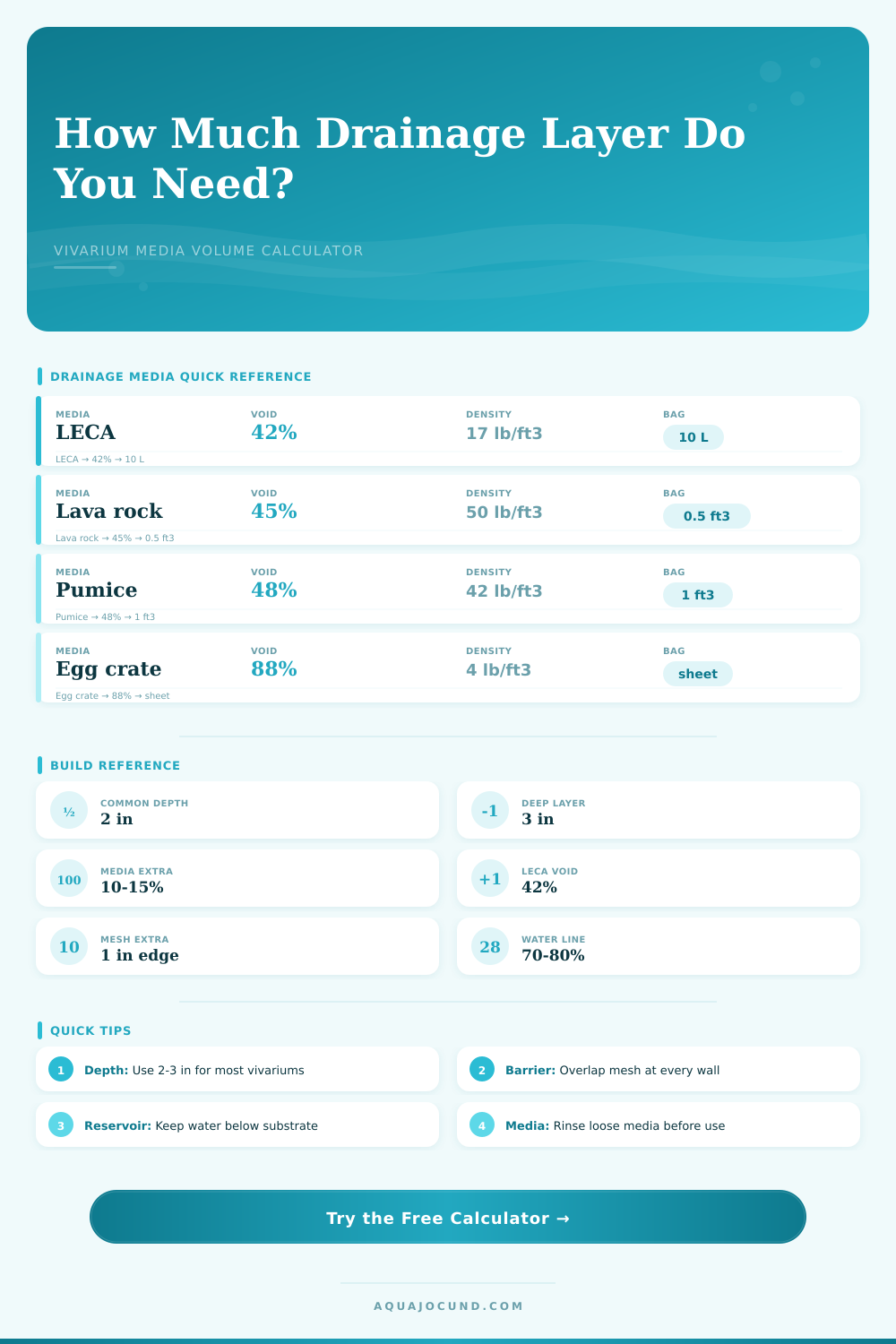
🐸 Vivarium Drainage Layer Volume Calculator
Size the drainage layer, media amount, water reservoir, separator mesh, and bag count for bioactive terrariums and planted vivariums.
| Material | Bulk Density | Void Space | Typical Bag | Best Use |
|---|---|---|---|---|
| LECA clay balls | 17 lb/ft³ | 42% | 10 L | Lightweight tropical builds |
| Hydroballs | 20 lb/ft³ | 40% | 10 L | Classic vivarium drainage |
| Lava rock | 50 lb/ft³ | 45% | 0.5 ft³ | Stable bases and slopes |
| Pumice stone | 42 lb/ft³ | 48% | 1 ft³ | High air space media |
| Coarse aquarium gravel | 95 lb/ft³ | 35% | 5 lb | Small shallow builds |
| Foam glass aggregate | 12 lb/ft³ | 55% | 10 L | Very light large enclosures |
| Egg crate false bottom | 4 lb/ft³ | 88% | 2×4 ft sheet | Deep reservoirs |
| Matala filter mat | 7 lb/ft³ | 70% | 24×39 in | Low profile drainage mat |
| Enclosure | Footprint | 2 in Layer | 3 in Layer | Typical Use |
|---|---|---|---|---|
| 12×12×18 in | 1.0 ft² | 0.62 gal | 0.94 gal | Nano dart frog |
| 18×18×24 in | 2.25 ft² | 1.40 gal | 2.10 gal | Crested gecko |
| 24×18×24 in | 3.0 ft² | 1.87 gal | 2.81 gal | Tropical display |
| 36×18×18 in | 4.5 ft² | 2.81 gal | 4.21 gal | Bioactive lizard |
| 48×24×24 in | 8.0 ft² | 4.99 gal | 7.48 gal | Large planted build |
| 60×24×24 in | 10.0 ft² | 6.23 gal | 9.35 gal | Display vivarium |
| Layer Depth | Use Case | Water Line Target | Notes |
|---|---|---|---|
| 1 in | Arid or temporary tub | 50-60% | Minimal buffer; monitor often |
| 1.5 in | Small tropical enclosure | 60-70% | Works with light misting |
| 2 in | Standard bioactive vivarium | 70-80% | Common depth for LECA |
| 3 in | Heavy planting or waterfall | 70-80% | More margin before substrate wicks |
| 4 in+ | Paludarium or false bottom | 80-90% | Use access tube or drain port |
| Tank Size | Footprint | 2 in Layer | 3 in Layer | Useful Reference |
|---|---|---|---|---|
| 10 gal | 20×10 in | 1.73 gal | 2.60 gal | Small conversion check |
| 20 high | 24×12 in | 2.49 gal | 3.74 gal | Tall tropical footprint |
| 40 breeder | 36×18 in | 5.61 gal | 8.42 gal | Common paludarium base |
| 55 gal | 48×13 in | 5.40 gal | 8.10 gal | Narrow display footprint |
| 75 gal | 48×18 in | 7.48 gal | 11.22 gal | Large planted conversion |
| 125 gal | 72×18 in | 11.22 gal | 16.83 gal | Long vivarium planning |
Add overlap on every side so substrate cannot slump into the drainage layer. The calculator adds twice the side overlap to both length and width.
The water reservoir estimate uses the material void space and your selected water line. Keep standing water below the substrate barrier to reduce wicking.
The drainage layer is a major part of your vivarium construction. Many vivarium constructor choose plants and plan their hardscape initially, only to have all their work fail because substrate remains soaked. In fact, I consider the drainage layer to be the lung of the vivarium, it keeps water off plant roots, permits air movement, and provides a safe environment for microorganisms.
Volume is important; you can use fancy-looking moss or something else as the top layer, but get the volume wrong and you’ll either lower the humidity too much or you’ll end up with a reservoir that’s too large which will cause the water line to creep upward until it starts rotting stems. Depending on your needs (water storage and weight limit), you may want a false bottom, lava rock, or LECA.
How to Build a Good Drainage Layer
Because lightweight expanded clay balls is light, easy to work with, and replaceable, they’re commonly used as a drainage layer. But each ball have roughly a forty percent void space, meaning only that percentage of water will rest between the balls. While lava rock increase the weight of the stand and gives stability to sloped designs, it adds a significant load to the stand. Use the calculator above to find the number of bags you need so you don’t run out or end up with too little. This ensures no trips to the hardware store and less time wasted.
The other factor is depth. Most people suggest two inches are the norm to allow for capillary action and some room to store water. However, three inches or more can be good if you have a paludarium or heavy-misting situation where you want to separate wet and dry areas. The deeper you go, the more water you can hold, but a higher substrate floor leave less room for plants to grow or climb.
This all depends on what’s important to your animals, how much do they value moisture versus how much volume do they use?
A barrier keeps the drainage media down and organic substrate up. When they gets mixed up the soil compacts and gets water-logged, water can’t drain out. Roots don’t grow well in this kind of environment. Isopods die from this too as their habitat turns oxygen-free (rots) due to lack of drainage. To calculate the mesh needed, include a bit more to allow for side-to-side tear or sag. Mesh sizes are shown in the reference table.
Note: Install the barrier so the drainage layer is clearly separated and work correctly.
The last step is water line management. The void space percentage matter. How much standing water can be held in the layer? Forty-two percent of the LECA volume consist of empty spaces that will hold water. If you set your water line to no higher than eighty percent of the layer depth, there’s a safe dry zone above the water that will allow oxygen to get into the bottom layer and prevent any bacterial bloom or mold growth.
Creating a vivarium involves a careful balance between living things, air, and water. That’s where the drainage layer comes in. It allow you to create the balance required for the whole thing to work. While it won’t make your tank look pretty, it’ll ensure enclosure lasts. Separate the layers, adhere to weight limits, and get the volume correct.