🪱 Vinegar Eel Culture Calculator
Plan how many fry a vinegar eel culture can support from harvest volume, density, bottle size, starter split, harvest interval, and culture age.
Calculation Breakdown
| Culture Stage | Typical Density | Age Factor | Planning Use |
|---|---|---|---|
| Fresh starter or recent restart | 50 to 150 eels per mL | 0.10 to 0.35 | Use for backup, not heavy fry demand. |
| Building culture with visible movement | 200 to 450 eels per mL | 0.35 to 0.65 | Good for small fry batches and daily testing. |
| Mature cloudy surface harvest | 500 to 900 eels per mL | 0.85 to 1.00 | Best default for routine first foods. |
| Peak dense culture | 900 to 1300 eels per mL | 0.90 to 1.00 | Useful for large spawns if harvested gently. |
| Old or slowing culture | 250 to 650 eels per mL | 0.55 to 0.85 | Split and restart before depending on it. |
| Bottle Setup | Culture Volume | Safe Harvest Range | Good Use |
|---|---|---|---|
| Small jar starter | 250 mL / 8.5 fl oz | 5 to 25 mL | Backup, test harvests, tiny fry groups. |
| Standard bottle | 500 mL / 16.9 fl oz | 10 to 75 mL | Small spawns and daily nursery feedings. |
| Large bottle | 750 mL / 25.4 fl oz | 15 to 110 mL | Medium fry batches with a starter reserve. |
| Quart jar | 950 mL / 32.1 fl oz | 20 to 140 mL | Shared fish-room starter and rotation work. |
| Half gallon culture | 1900 mL / 64.2 fl oz | 40 to 280 mL | Large spawns when multiple backups exist. |
| Fry Group | Typical Count | Eels Per Fry | Feedings Per Day |
|---|---|---|---|
| Betta or gourami first foods | 50 to 120 fry | 20 to 40 | 2 to 4 small feedings |
| Livebearer newborns | 30 to 100 fry | 30 to 60 | 1 to 3 feedings |
| Corydoras or tetra larvae | 80 to 180 fry | 20 to 45 | 2 to 4 feedings |
| Angelfish or cichlid spawn | 150 to 350 fry | 25 to 60 | 2 to 4 feedings |
| Fish-room mixed fry | 300 to 800 fry | 25 to 50 | 2 to 3 feedings |
| Interval | Culture Impact | Best Match | Calculator Adjustment |
|---|---|---|---|
| Daily | Small repeated pulls | High-density mature culture | Keep harvest under 5% to 10% of bottle. |
| Every 2 to 3 days | Balanced recovery | Most fry rooms | Works well with 10% to 20% reserve margin. |
| Every 4 to 7 days | Larger single harvest | Small spawns or backup bottles | Check the safe harvest limit before pulling. |
| Over 7 days | Less predictable density | Emergency backup only | Use extra reserve and refresh the culture. |
Vinegar eels are gold standard for feeding newly hatched betta fry. There is a specific kind of panic that sets in when your new betta fry decides to stop eating. Managing a vinegar eel culture require care to ensure there is always enough eels without overloading it.
This is where the challenge comes into play, how many are enough? How can you keep them fed while also maintaining health of the culture so it can continue regenerating itself? To do this, you need to balance current feeding requirements vs biological growth rate.
How to Manage Vinegar Eel Cultures
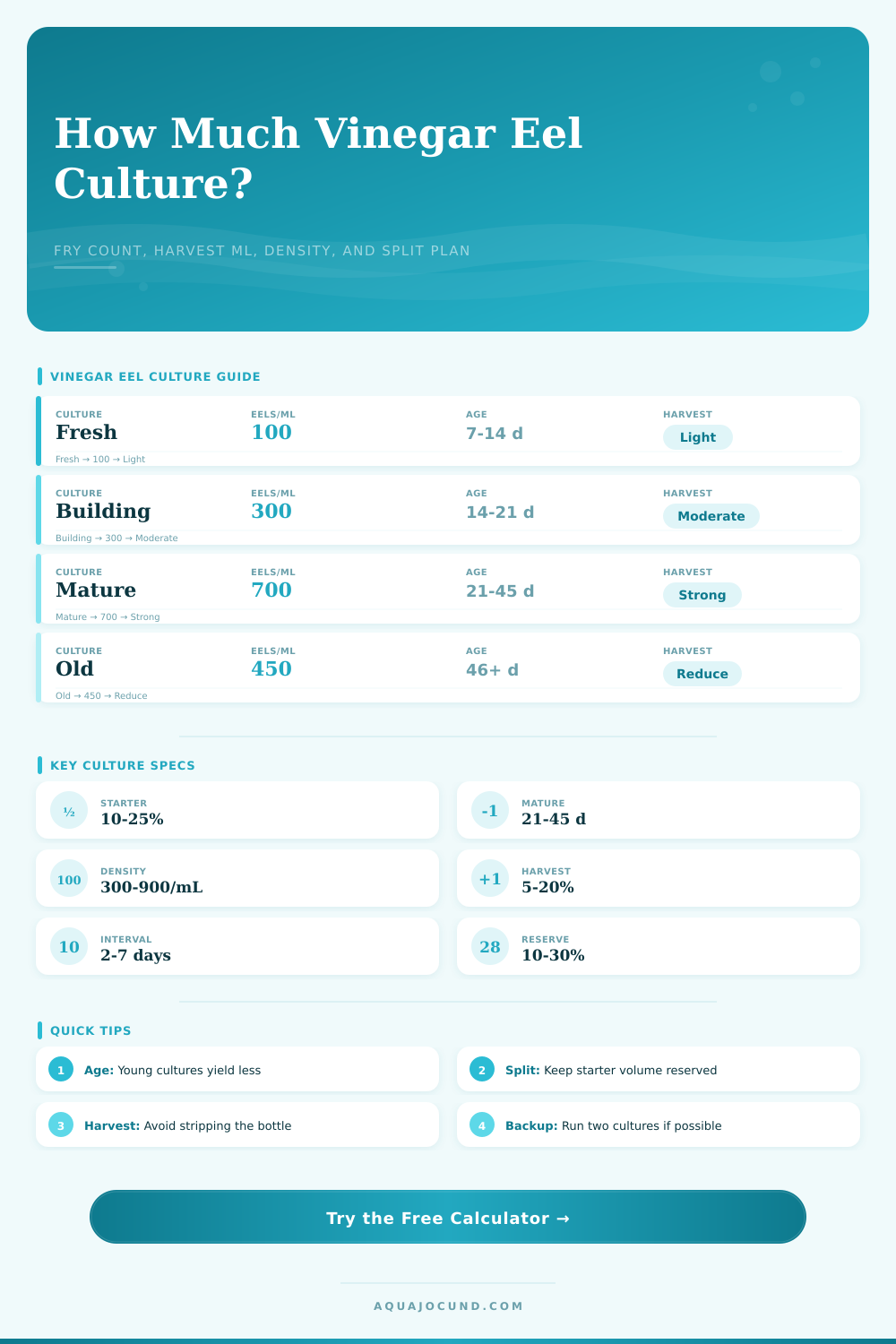
Age matter greatly for culture density. New cultures might look like they’re full of water but there isn’t many organisms in them. Older cultures can have up to a thousand eels per mL. Once you know how many fry you have and what stage your culture is at, a culture calculator will help estimate the eel density. That way, you won’t be guessing if your bottle is empty or not.
Over-harvesting is dangerous. Many hobbyists do not succeed with this because they takes out so much material! They want to make sure there’s enough for their fish to feed on. That’s why they’ll drain out half the bottle. The problem is that you’re depleting the biomass you need in order to regenerate.
A typical sustainable harvest will be a very small fraction of the total culture volume. Maintain a substantial amount of starter material as your reserve. This reserve is your insurance policy for continued growth of the colony. If you over-harvest, the population will crash. Below is an example of a reference table showing what kind of harvest size can be supported by each stage of the culture.
Will it work? How long has the culture been growing? Time matters. Initially (days 1-14), most of what is in that bottle are bacteria and a few stray eels trying to survive. As days pass (day 15), numbers will explode. Eels cover the surface, creating a cloudy, gelatinous mat. At this point (week 3), it’s prime pickin’ time. If you wait too long (45ish days), things can go bad (high acidity, food depletion) and the culture start to die out. Knowing how old your culture is will help you decide if you need to harvest/ split up your bottle as back-up.
It’s not how big the bottle is but how dense it is that counts. Using a big bottle with a poor culture won’t give you enough food for a lot of fry. But using a small jar with higher density will feed lots of fry. You should of adjusted the extractable volume to match the density of the eel.
If your larvae are delicate like angelfish or corydoras then you need to be careful how much you put in the tank. Putting a cup full of culture in the tank fouls the water. Use a syringe or pipette to apply small, precise dosages. To do this you need to accurately measure what you are extracting.
You can reduce risk by running several cultures in parallel. Because population of vinegar eels can go from a thriving mass to nothing overnight, it’s risky relying on only one bottle. Having another, less mature culture as backup will smooth out the supply chain. One might peak while the other is still coming along. By having more than one, you guarantee a continuous supply of live food.
The benefits of live food (which powdered substitutes lacks) include nutrition critical to fry growth and health. This establishes a self-sustaining loop. Let the fish feed off the culture, control your system with very little interaction. It’s not just eels, it’s a micro-ecosystem that you manage.
If you know your inputs (density, age, harvest rate) then it becomes a predictable process. That means that this changes you from having an anxious mindset into one of confidence. What are you measuring? Knowing what to measure is important. Look at the bottle like your production schedule. When you manage the system right the fry will eat and grow.
Actualy, its easier than it looks. You should be careful not to dissapear the whole colony by accident. It’s more differnt than you think if you want to maintain a luxurios amount of eels for your fish.