
Let’s face it; reef tanks take time to stabilize. Months go by as you build out the sand bed, place the frags, and wait for that crystal clear water. And then you hit it… The nitrates starts creeping up, the algae starts growing, and you realize that your filter isn’t keeping up.
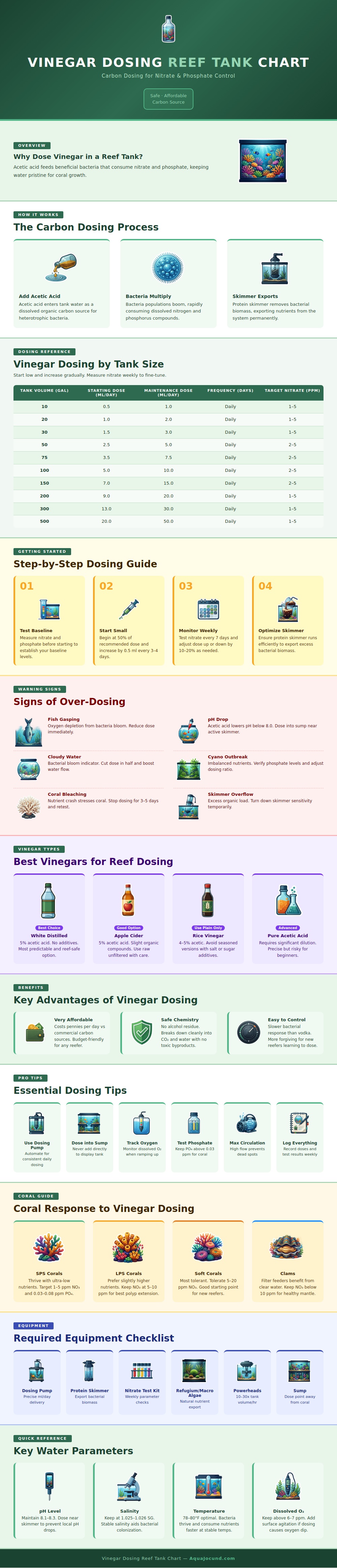
This sends many hobbyists into a tizzy and they purchase all sorts of overpriced additive products. Other hobbyists reach for the white distilled vinegar sitting in their kitchen pantry. Why? There is a logical explanation and, more importantly, a scientific way to do this. No guessing! See the infographic above.
How to Use Vinegar in Your Reef Tank Safely
Carbon dosing is actualy vinegar dosing. What happens is that you’re feeding heterotrophic bacteria acetic acid (vinegar). The heterotrophs multiplies by eating phosphate and nitrate while using the vinegar for food. Bacterial mass gets exported out of the tank via your protein skimmer. This establishes a clean cycle, a closed loop of clean.
Because you’re starting something new in your tank, you’ll want to be conservative. That means starting slowly. According to the chart, you’ll want to start with 1 ml/day if you have a 20g system. This slow start allows the bacteria time to grow up but doesn’t shock the livestock nor crash the O2 level.
It takes time to get it right, that’s how long? Observe and be patient. Don’t just pour the bottle in and go. Begin with half the volume as suggested for your tank size, gradually add a little more each week or so based off testing your water parameters. Nitrate is what you will want to test regularly and adjust accordingly.
If nitrates drop too low, it can lead to coral starvation. SPS corals (small polyp stony) prefers ultra-low nutrient environments (<1ppm, 5 ppm). Soft corals is less picky and can handle higher levels. Figure out what you have and then determine your goal range.
The dosage table clearly shows the volumes you’ll need so you don’t use too much or use amounts meant for small tanks in larger displays. Watch out for overdosing, There’s a very real risk of overdosing. Fish will start to gasp at the surface, indicating there isn’t much oxygen in the water due to bacterial blooms. When you see cloudy water, you know those bacteria is multiplying beyond the capacity of your skimmer to remove them. Time to cut back.
The other danger is that acetic acid is acidic, causing pH drops. To reduce the impact of this, dose in a sump close to an operating skimmer. This ensures any new water mixes quickly with existing water, allowing gas exchange before it returns to the display tank.
Because white distilled vinegar doesn’t have sugars or additives that fuel undesired algae strains, it’s the safest bet. Apple cider vinegar will work as well, but the presence of natural substances may skew results. Keep it simple. Get something like a dosing pump to make sure you are adding daily consistently rather than sporadically by hand.
Your protein skimmer needs to be large enough for the heavier workload of organics. Back off the dose if needed or increase the sensitivity to prevent overflow. Keeping records will show how things are progressing. Note your dosage, your test readings, and any odd coral behavior. You’ll start seeing trends that was invisible to the eye.
Circulation strength can play into this as well. Good water movement eliminates stagnant areas. These areas is prone to bacterial buildup, which leads to localized low oxygen levels.
Many reefers avoid carbon dosing because they fear losing control. I can tell you, however, that this is a much gentler entry different than things like vodka dosing. And it dissolves cleanly without any toxic byproducts, leaving only water and carbon dioxide. It’s also negligable in cost. Better water quality plus savings = a win-win.
Patience is the key. Begin with very small amounts, frequently check your parameters, and allow the bacterial action to occur. Healthy corals and clear water are your reward. Months later, when the light is on and the tank looks good, you’ll see what all that patient starting should of been for.
