🌊 Venturi Flow Calculator Aquarium
Estimate pump water flow, venturi suction, air draw, depth loss, and air tubing limits.
| Venturi Type | Typical Use | Suction Strength | Flow Recovery | Air Character |
|---|---|---|---|---|
| Drilled tee air port | Simple DIY aeration | Low | High | Coarser bubbles |
| Barbed inline venturi | Small pumps and HOB skimmers | Low-medium | Medium-high | Moderate air draw |
| Tapered cone venturi | Reef skimmer feed pumps | Medium | Medium | Steady air draw |
| Injector-style venturi | Large skimmers and ponds | High | Medium-low | Strong suction |
| Needle valve fine mix | Controlled skimmer tuning | Medium | Medium | Adjustable air |
| Recirculating intake | Recirc protein skimmers | High | Medium | High air ratio |
| Low-air CO2 reactor | Planted tank CO2 intake | Low | High | Small controlled draw |
| Nozzle | Metric | Best Flow Range | Typical Use | Watch For |
|---|---|---|---|---|
| 1/8 in | 3.2 mm | 80-180 gph / 303-681 lph | Nano injector | Clogs easily |
| 3/16 in | 4.8 mm | 150-350 gph / 568-1325 lph | Small skimmer | Needs clean prefilter |
| 1/4 in | 6.4 mm | 300-650 gph / 1136-2461 lph | Common reef venturi | Depth reduces draw |
| 5/16 in | 7.9 mm | 500-900 gph / 1893-3407 lph | Larger skimmer | Requires stronger pump |
| 3/8 in | 9.5 mm | 750-1400 gph / 2839-5299 lph | Pond or large injector | May lower velocity |
| 1/2 in | 12.7 mm | 1200+ gph / 4542+ lph | High-flow pond | Poor suction on small pumps |
| Tubing ID | Metric ID | Good Length | Air Draw Range | Typical Fit |
|---|---|---|---|---|
| 1/8 in | 3.2 mm | 1-2 ft / 0.3-0.6 m | 1-5 lpm | Small CO2 or ozone line |
| 3/16 in | 4.8 mm | 2-5 ft / 0.6-1.5 m | 3-15 lpm | Standard airline |
| 1/4 in | 6.4 mm | 3-8 ft / 0.9-2.4 m | 8-25 lpm | Skimmer intake |
| 5/16 in | 7.9 mm | 4-10 ft / 1.2-3.0 m | 15-40 lpm | Large skimmer silencer |
| 3/8 in | 9.5 mm | 5-12 ft / 1.5-3.7 m | 25+ lpm | Pond injector air feed |
| Application | Water Flow | Air Draw | Air:Water Ratio | Practical Note |
|---|---|---|---|---|
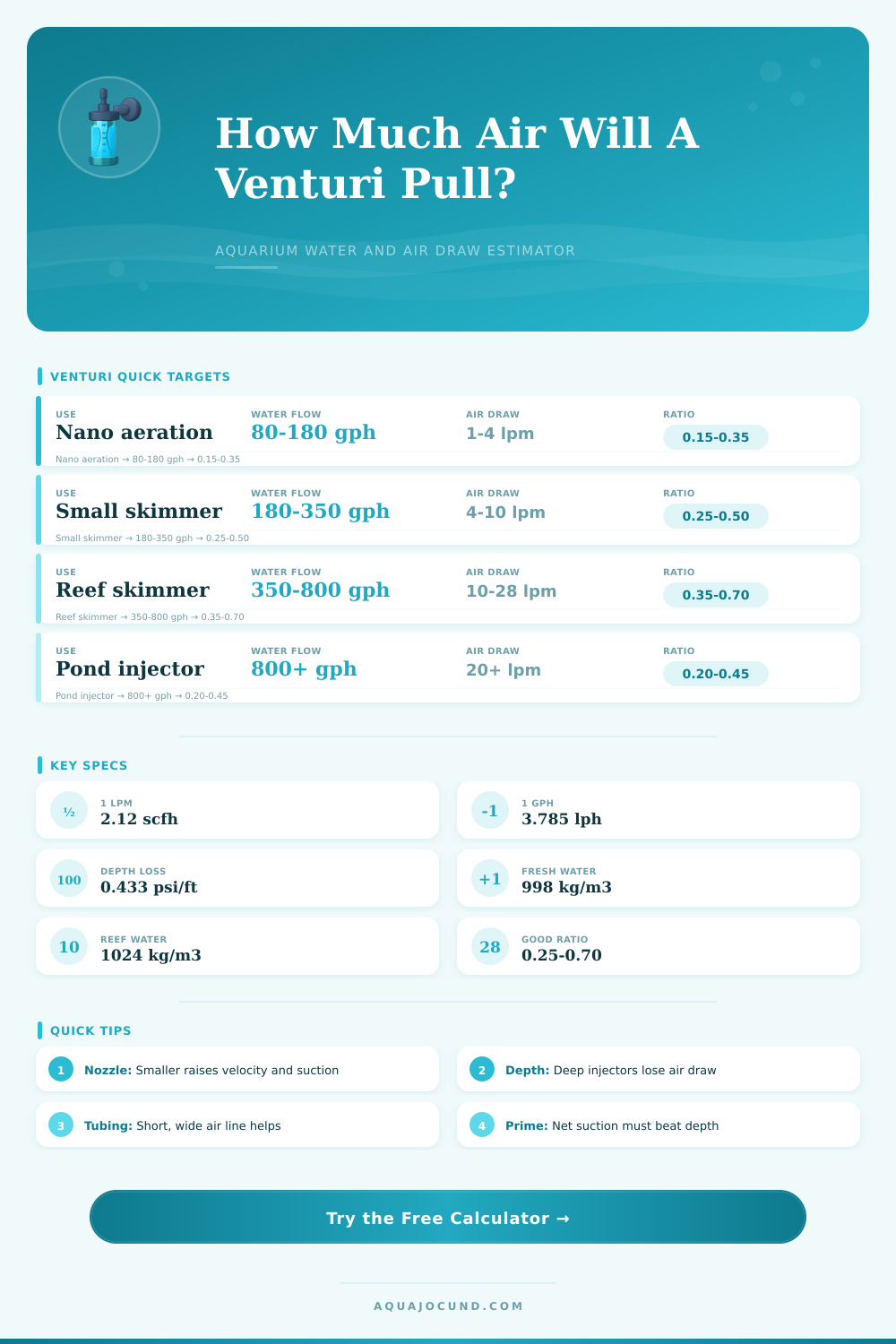
| Nano aeration | 80-180 gph / 303-681 lph | 1-4 lpm / 2-8 scfh | 0.15-0.35 | Quiet tubing matters |
| Small HOB skimmer | 180-350 gph / 681-1325 lph | 4-10 lpm / 8-21 scfh | 0.25-0.50 | Keep injector shallow |
| Medium reef skimmer | 350-800 gph / 1325-3028 lph | 10-28 lpm / 21-59 scfh | 0.35-0.70 | Needle wheel may add more air |
| Recirculating skimmer | 300-700 gph / 1136-2650 lph | 12-35 lpm / 25-74 scfh | 0.50-0.90 | Outlet backpressure changes draw |
| Pond injector | 800+ gph / 3028+ lph | 20+ lpm / 42+ scfh | 0.20-0.45 | Use larger air line |
A venturi takes fast moving water and turns it into suction to pull air into the water. The air that a venturi pulls into the sump is used for protein skimming, oxygenation, or for ozone dosing in ozonators. If a venturi isnt drawing enough air, it is important to understand that there is many variables that affect how much air the venturi can pull.
Each of these variables can interact with each other, yet all of them play a role in determining how much air the venturi can pull. One of the first variable to consider is the flow of the pump. This isnt the only variable to consider, however.
Why Your Venturi Is Not Pulling Enough Air
The flow of the pump can vary according to the amount of pressure it must fight and the shape of the venturi. Another important variable is the size of the nozzle. The velocity of the water through the narrowest part of the nozzle create the vacuum that pulls the air into the sump.
If the throat of the venturi is too close in size then the nozzle, the venturi will lose it’s suction. Alternatively, if the throat of the venturi is significantly larger than the size of the nozzle, the water will slow to a halt in the venturi and no longer create a vacuum. The depth of the water in the sump is another variable that can impact the performance of a venturi.
Every inch of water create pressure on the venturi. By moving the air port of the system upward within the sump, you will reduce the water pressure that the venturi must fight, allowing for better performance from the venturi. In order to manage the mathematics involved in understanding the venturi, you can use a calculator.
In order to use the calculator to determine the performance of the venturi, you will have to enter specific information about the system into the calculator. The calculator will take into consideration the density of the water in the sump, the length of the air line, the diameter of the air line, and the number of check valve or silencers that are present in the system. The calculator is capable of determining how much water passes through the venturi after the restriction of the nozzle.
Too much restriction in the system will result in starving the pump of the water it needs and reducing the performance of the pump. The calculator will also display the ratio of the amount of air that the venturi pulls in relation to the amount of water that passes through the system. Too low of a ratio will result in sparse bubble in the sump.
Too high of a ratio will make the pump surge or the water level in the skimmer become unstable. Another factor in the performance of the system that the calculator cannot account for is the cleanliness of the system. For example, a venturi with a very small nozzle will calculate to pull a great deal of air through the system.
A small bit of debris in the venturi can prevent the system from creating the vacuum necessary to allow air to pass through the system. In this instance, many aquarium system owner will include a prefilter or ensure that the venturi is easy to clean. In addition to the cleanliness of the system, the tubing that is used for the air line can impact the performance of the system.
If the air line is too long or narrow in diameter, it can create resistance for the movement of the air through the line. A short and wide air line will allow air to move more easily through the system. The calculator will account for the length and diameter of the air line.
Another factor that will impact the performance of the system is the environment of the sump itself. Any back pressure that the skimmer body, water level in the sump, or the height of the air intake creates will impact the vacuum that is created by the venturi. Reference tables will include target figures for the air line for a variety of different applications within the aquarium industry.
These targets will provide a starting point for the pump and the venturi. However, the variables in each sump may prevent a pump from functioning in the same way in another sump. A variety of different changes can be made to the system.
If the venturi creates suction but there is a low draw of air, the air path is the issue. You can increase the air draw by shortening the air line or increasing the inside diameter of the air line. If the suction that the venturi creates is marginal, the depth of the venturi can be reduced or you can use a venturi with a higher coefficient.
Both of these solution are presented in the calculator, separate from the suction that is created at the nozzle. Overall, the goal is to draw the correct amount of air through the system. It is not necessary for the venturi to create the maximum amount of air for the aquarium.
Rather, an air draw that is stable and does not require constant adjustment is required for the tank. By understanding each of the variables that impact the performance of a venturi, it is possible to tune the system to achieve the desired result.