UV Sterilizer Calculator
Estimate UV dose, safe flow, wattage and dwell time for aquariums, quarantine tanks and ponds.
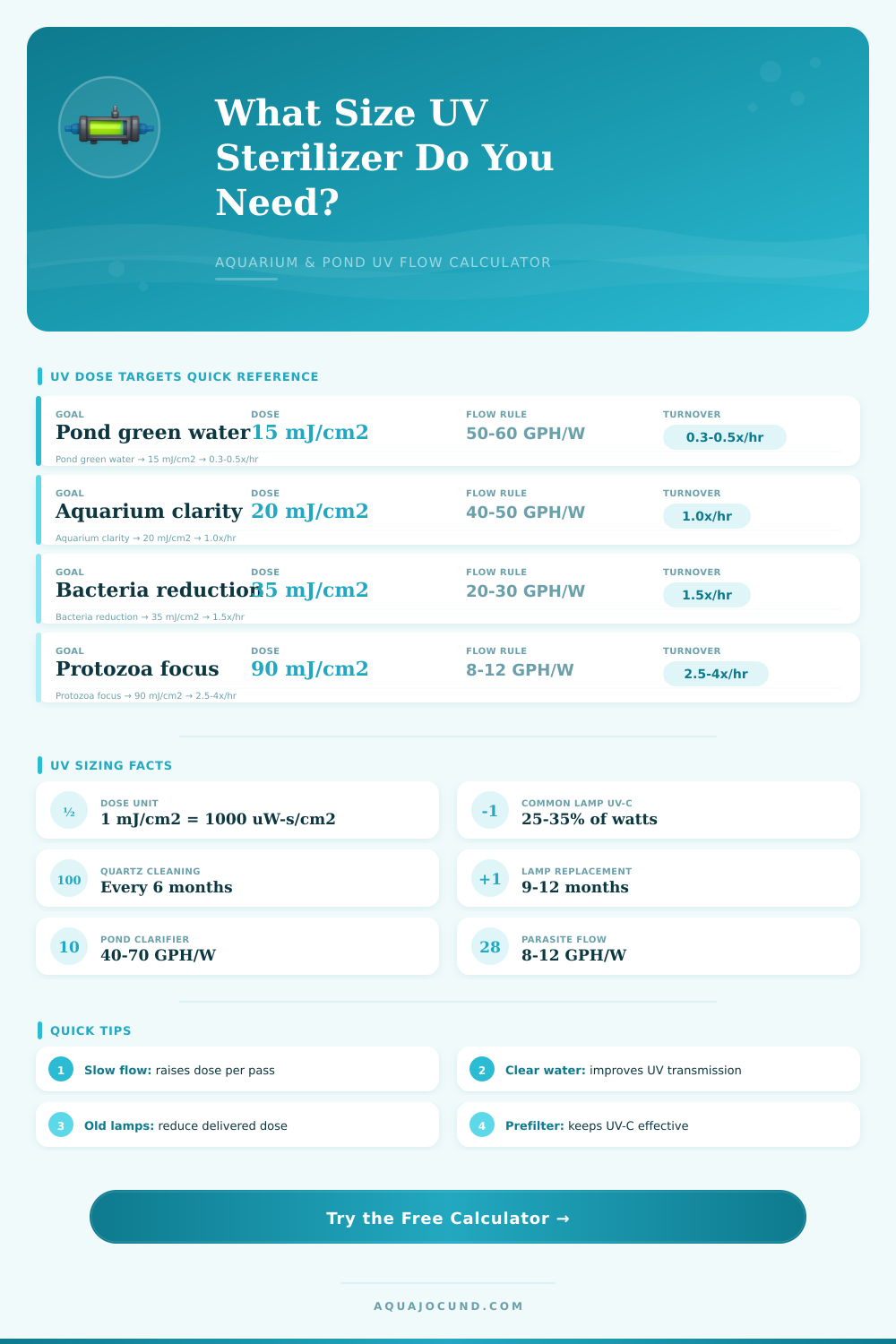
| UV goal | Target dose | Typical flow rule | Useful turnover | Best use |
|---|---|---|---|---|
| Pond green water clarity | 10-20 mJ/cm2 | 40-70 GPH per watt | Once per 2-3 hr | Suspended algae control |
| Aquarium clarity | 20 mJ/cm2 | 40-50 GPH per watt | 1x per hr | Cloudiness and algae spores |
| Bacteria reduction | 30-45 mJ/cm2 | 20-30 GPH per watt | 1-2x per hr | Water-column bacteria load |
| Level 1 sterilization | 45-60 mJ/cm2 | 20-25 GPH per watt | 1.5x per hr | General aquarium UV sizing |
| Protozoa / parasite focus | 75-90 mJ/cm2 | 8-12 GPH per watt | 2.5-4x per hr | Higher dose quarantine passes |
| Unit style | Typical UV-C output | Path depth | Geometry factor | Flow adjustment |
|---|---|---|---|---|
| Compact aquarium sterilizer | 28% | 1.1 in / 2.8 cm | 0.62 | 0.90x |
| Straight-through inline UV | 30% | 0.9 in / 2.3 cm | 0.70 | 1.00x |
| High-dwell straight tube | 32% | 0.8 in / 2.0 cm | 0.78 | 1.20x |
| Pond clarifier chamber | 28% | 1.4 in / 3.6 cm | 0.58 | 1.10x clarity |
| Pressurized filter UV | 25% | 1.8 in / 4.6 cm | 0.48 | 0.70x |
| High-output amalgam pond UV | 35% | 1.2 in / 3.0 cm | 0.72 | 1.30x |
| Submersible UV lamp | 25% | 2.0 in / 5.1 cm | 0.40 | 0.55x |
| Validated commercial reactor | 33% | 0.7 in / 1.8 cm | 0.85 | 1.35x |
| System | Volume | Clarity flow | Sterilizer flow | Typical UV range |
|---|---|---|---|---|
| 20 gal quarantine | 20 gal / 76 L | 40-80 GPH | 50-80 GPH | 9-15 W |
| 40 gal reef | 40 gal / 151 L | 80-160 GPH | 100-160 GPH | 15-25 W |
| 75 gal aquarium | 75 gal / 284 L | 150-300 GPH | 110-180 GPH | 18-30 W |
| 125 gal cichlid tank | 125 gal / 473 L | 250-500 GPH | 190-310 GPH | 25-40 W |
| 180 gal reef | 180 gal / 681 L | 360-720 GPH | 270-450 GPH | 40-65 W |
| 1,000 gal pond | 1,000 gal / 3,785 L | 350-500 GPH | Not typical | 18-40 W clarity |
| 3,000 gal pond | 3,000 gal / 11,356 L | 1,000-1,500 GPH | Not typical | 40-80 W clarity |
| Reference point | UV dose | Equivalent | Calculator use |
|---|---|---|---|
| Unit conversion | 1 mJ/cm2 | 1,000 uW-s/cm2 | Converts aquarium UV dose language |
| EPA 4-log Cryptosporidium | 22 mJ/cm2 | 22,000 uW-s/cm2 | Drinking-water benchmark, not aquarium guarantee |
| EPA 4-log Giardia | 22 mJ/cm2 | 22,000 uW-s/cm2 | Validated reactor benchmark |
| EPA 4-log virus table value | 186 mJ/cm2 | 186,000 uW-s/cm2 | Shows why virus claims need validation |
| Aquarium parasite convention | 90 mJ/cm2 | 90,000 uW-s/cm2 | Conservative hobby sizing target |
UV sterilizer work by directing the water past an UV-C lamp that emits a wavelength of 254 nanometers. This 254 nanometer wavelength will damage the DNA of the algae, bacteria, and parasite that it encounters. The calculator that is provided above will make the mathematical calculation for you after you enter your volume, flow rate, wattage, and various water quality factor.
Using the calculator is beneficial for removing the need to manually calculate these factor yourself. The UV dose that reach the organism in your water depends on several variable. Flow rate is one of those variable, and many people do not understand how important flow rate is to the effectiveness of your UV sterilizer.
How the UV Sterilizer Calculator Works
High flow rate will mean that the water passes the UV lamp at a high speed. High speeds will result in the water receiving a lower dose of UV light with each pass through the sterilizer. Therefore, slowing the flow will increase the dose that the water receive, but will reduce the number of times the volume of your system passes by the UV lamp each hour.
The calculator display both the UV dose and the turnover rate for you to review. Water clarity is another variable. Particle in the water will absorb the UV light, preventing it from reaching the organisms.
You must enter the percentage of transmittance of your water in the calculator. Water with tannin or water that has not been filtered will have a lower transmittance than water that is clear. Furthermore, the cleanliness of the sleeve in which the lamp is installed and the age of the lamp will also reduce the UV output of the lamp over time.
These variable are also asked of you in the calculator. Different application require different target dose. For instance, a pond owner may only wish to control the growth of free-floating algae, which require only a modest dose of UV light.
An aquarist who wishes to sterilize quarantine water for fish may need a higher UV dose to ensure the survival of the fish. Your specific goal for your UV sterilizers function is one of the choices within the calculator, and selecting your goal will automatically ensure that the flow and wattage recommendation for your system include the correct UV dose for your desired goal. The chamber in which the UV lamp is installed has a specific geometry.
A chamber with a wide opening and shallow depth may cause some of the water in your system to pass by the lamp at a greater distance from the lamp than other water in your system. Water at a greater distance will receive a lower UV dose than water that is closer to the lamp. The calculator include preset design for aquarium and pond sterilizers, so that if you select your system type, the calculator will automatically account for the geometry of the system in its calculation.
Another necessary variable is turnover rate. High dose of UV light are provided to the water in your system, but unless your systems water pass through the sterilizer at a sufficient rate, the dose will not have a beneficial effect on your system. Therefore, the calculator will compare the flow rate of your system to the target turnover rate for the selected goal.
If the entered flow rate is too low relative to the target turnover, the calculator will alert you to the fact that your pump may be undersized for your systems size. Finally, there are some variable that will change over time. Your prefilter may clog over time.
The growth of calcium scale on the quartz sleeve will reduce the amount of UV light that exit the lamp. Finally, the UV lamp will decrease in effectiveness over time. For these reason, the safety margin for your systems recommended UV parameter can be increased.
The recommended increase is between 15 and 25%, ensuring that your system will still provide an adequate dose of UV light despite the change in water quality over time. The reference table included on the calculator are for providing context to the variables that you enter into the form. However, you dont need to memorize the reference table.
The tables include the flow rate target for different system type. For instance, the tables can be used to understand why a clarifier for ponds will have a higher ratio of gallons passed per watt of UV lamp installed than a sterilizer for quarantine tank. Therefore, the three factor that must be matched together to create the correct UV sterilizer are the dose, flow, and turnover rate.
Additionally, regular maintenance of the system will be required to ensure that the UV sterilizer continue to operate at its recommended level.