Turtle Filtration Turnover Calculator
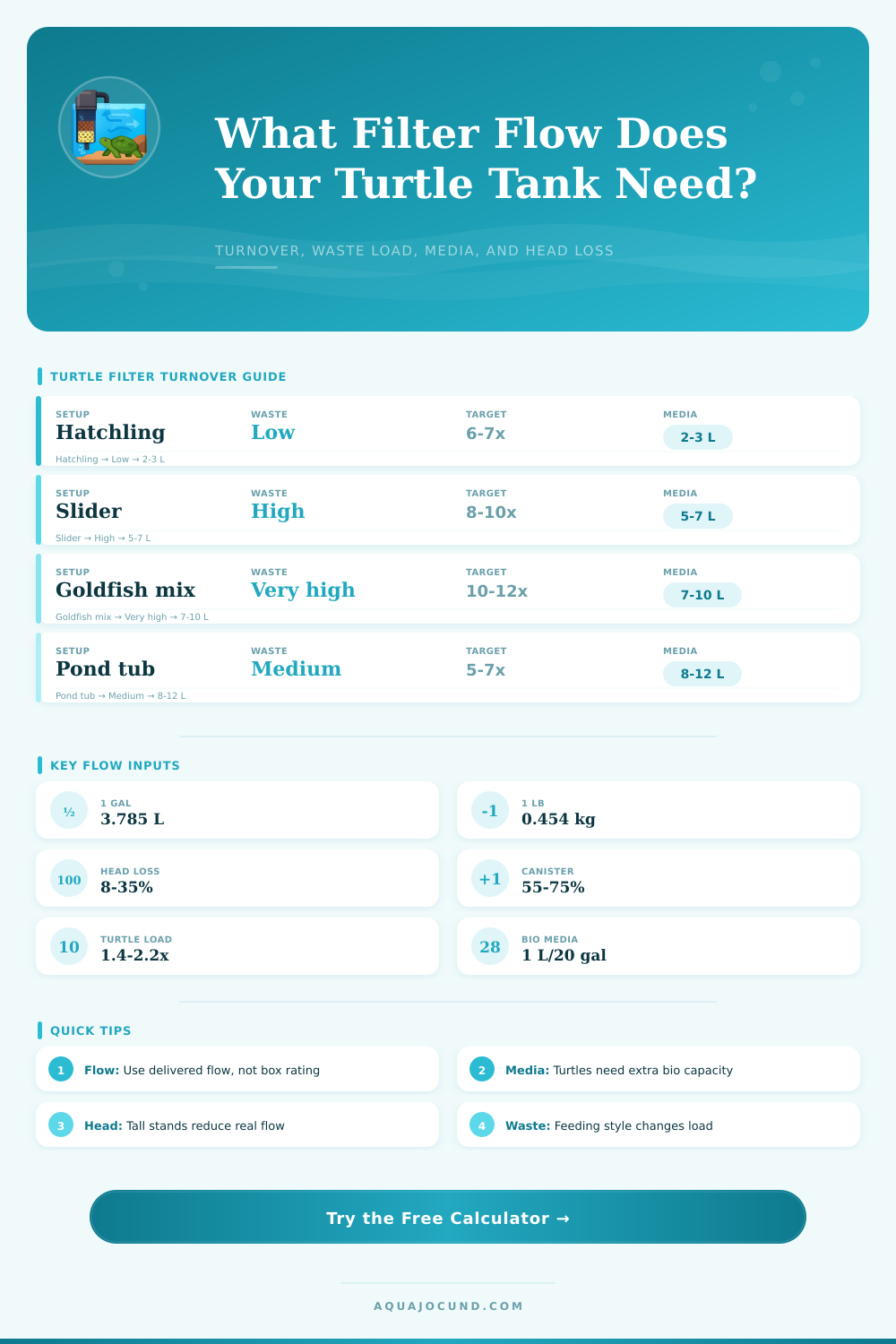
Estimate target turnover, delivered flow after head loss, canister derating, turtle waste load, and biological media capacity.
Volume is based on actual filled water, not the tank label. For shallow turtle tanks, lower water height can change turnover math more than the nominal aquarium size.
Filtration sizing result
| Setup | Base turnover | Waste multiplier | Planning note |
|---|---|---|---|
| Small musk or mud turtle | 5-7x per hour | 1.20-1.45x | Lower biomass but still benefits from strong mechanical capture. |
| Single juvenile slider | 6-8x per hour | 1.45-1.65x | Growth and feeding volume usually increase filter demand quickly. |
| Adult slider, cooter, painted turtle | 7-10x per hour | 1.65-1.90x | Use delivered flow and extra media, not only the aquarium rating. |
| Turtle with fish or messy feeding | 9-12x per hour | 1.90-2.20x | Plan for faster clogging and a larger mechanical prefilter. |
| Filter condition | Useful flow | Head loss effect | Best use |
|---|---|---|---|
| Sump or open pump | About 80-85% | Moderate, depends on return height | Large tubs, ponds, and high media volume systems. |
| Clean canister | About 65-75% | Noticeable with tall stands and long hoses | Common turtle tanks when media baskets are not packed tight. |
| Mature canister | About 55-65% | Higher as sponges and floss load with solids | Realistic planning value between cleanings. |
| Loaded HOB filter | About 45-55% | Low head but fast clogging | Supplemental polishing, not sole adult turtle filtration. |
| Tank / tub | Typical water | Delivered flow target | Bio media target |
|---|---|---|---|
| 29 gal low-fill musk tank | 18-24 gal | 130-220 GPH | 2-3 L |
| 40 breeder juvenile slider | 30-38 gal | 260-450 GPH | 3-5 L |
| 75 gal adult turtle | 55-70 gal | 520-800 GPH | 5-8 L |
| 125 gal stock tank | 95-120 gal | 800-1300 GPH | 8-12 L |
| Approach | Strength | Weak point | Calculator setting |
|---|---|---|---|
| Oversized canister | Compact, quiet, high media capacity | Rated flow drops as media loads | Canister mature, 10-18% clogging |
| Canister plus prefilter | Protects biomedia from heavy solids | Prefilter needs frequent rinsing | Canister clean, 8-15% clogging |
| Sump / moving bed | High oxygen and easy media scaling | Needs overflow planning | Sump pump, actual head height |
| HOB supplement | Good polishing and surface movement | Low biological reserve for turtles | HOB loaded, supplemental flow |
If you notice cloudiness in your turtle tank shortly after a clean, don’t panic! Rinse out those sponges and scrub down that glass. Within hours, you see it, the water has turned gray once more because the turtle stir up debris and eats food. Why? You relied on the box flow number rather then real-world flow-through-the-pipes numbers.
Turtles tanks is dirty places and need to be filtered harder than normal fish tank. What size filter do most folks get? They buy one sized for the number of gallons in their tank. If your tank is a 40g, you buy a 40g filter. That’s fine if you have small and docile fish. But that does not work for turtles.
How to Choose the Right Filter for Your Turtle Tank
Turtles are messy (a lot of waste) and they stir up silt with each swimming stroke. You need a filter that will handles all that volume fast enough to stay ahead of the game and catch all the solids. Then there’s the issue of how it naturaly clears away an ammonia spike before it reaches the eyes as the muck swirls through the water.
You put in what size tank you have and some data on your turtles, and the calculator does the rest of math for you. No more guesswork on converting.
Rated flow vs. Delivered flow: That’s the kicker. Pumps are tested by manufacturers in perfect scenarios, meaning wide open pipes. Resistance comes from long input hoses, bends in tubing, and prefilters that gets clogged up. Maybe a canister filter will say it pushes three hundred fifty gallons an hour on paper. Put some media in there and you’re lucky if you see half that amount. People makes the mistake of buying for the label and not the plumbing.
The second thing is head loss. What is head loss? It’s the height difference between the pump and the water surface. For every foot of head loss (i.e., pump sitting higher), the impeller lose some of its power. This means if your sump is below the tank (maybe it’s on a high stand) you’ll be losing a bunch of flow. The tool accounts for this as well. Simply choose your filter type and enter how much head you have, and it automatically adjusts. It uses common derating factors which represent reality, friction exist in the real world.
Finally, it factors the turtle’s biomass into the equation. An adult slider alone produces far more waste then multiple small fish. To ensure we don’t undersize biological media, the calculator takes the baseline biological requirement and multiplies it by a waste factor depending on shell length and number of turtles.
Biological capacity is often neglected when setting up tank. It’s easy to throw fine sponges and floss into the canister to trap as many particles as possible. If you don’t have enough biological capacity, those particles will get trapped inside your media, rot, and crash your cycle. Use open-pore media (such as sintered glass or ceramic rings) that let water flow freely through it. That media support huge colonies of nitrite-eating bacteria. How much do you need? Check the reference table on the page. It’s based off gallons of active water.
Changing filter socks every day doesn’t matter nearly as much. Consider what you are actualy getting in terms of turnover in the results. With adult sliders/cooters, you’ll usually want eight to ten turns per hour. So if you’re delivering four or five turns you have a filter that’s technically working but not sufficient from an ecological standpoint. Between feedings it’ll appear clear, but you won’t get the good clarity and the water may even start to smell off.
Sometimes you just need a bigger canister; sometimes you need a second prefilter; sometimes you need more regular partial water changes. You should of wanted a bigger one. That’s the point: maintainable. Not perfect. If you size it properly, every component will have work to do without any of them failing catastrophically.
Learn about what slows down your flow, such as head height and resistant media. Learn why you shouldn’t buy a filter just because someone claims it can delivers X amount of gallons per hour. You’ll begin creating systems capable of moving water at a level that supports heavy feeders. Clarity isn’t a problem. It’s a symptom of out-of-balance inputs/outputs. Repair the flow and the water clears up.