Turtle Basking Area Calculator
Estimate dry basking platform size from shell length, turtle count, ramp area, dry zone percentage, heat lamp footprint, and growth allowance.
Basking Area Breakdown
| Platform type | Usable dry share | Ramp credit | Best calculation use | Planning note |
|---|
| Tank or tub | Typical dimensions | Surface area | 25% dry zone | Fit comment |
|---|---|---|---|---|
| 20 long grow-out | 30 x 12 in / 76 x 30 cm | 360 in² / 2,323 cm² | 90 in² / 581 cm² | Small juvenile platform |
| 40 breeder | 36 x 18 in / 91 x 46 cm | 648 in² / 4,181 cm² | 162 in² / 1,045 cm² | Good medium shelf footprint |
| 55 gallon | 48 x 13 in / 122 x 33 cm | 624 in² / 4,026 cm² | 156 in² / 1,006 cm² | Long but narrow ramp planning |
| 75 gallon | 48 x 18 in / 122 x 46 cm | 864 in² / 5,574 cm² | 216 in² / 1,394 cm² | Adult slider deck range |
| 125 gallon | 72 x 18 in / 183 x 46 cm | 1,296 in² / 8,361 cm² | 324 in² / 2,090 cm² | Multiple turtles need wide deck |
| Round stock tub | 60 in dia / 152 cm dia | 2,827 in² / 18,241 cm² | 707 in² / 4,560 cm² | Large dock or shore-style shelf |
| Planning item | Formula used | Typical target | What it checks |
|---|---|---|---|
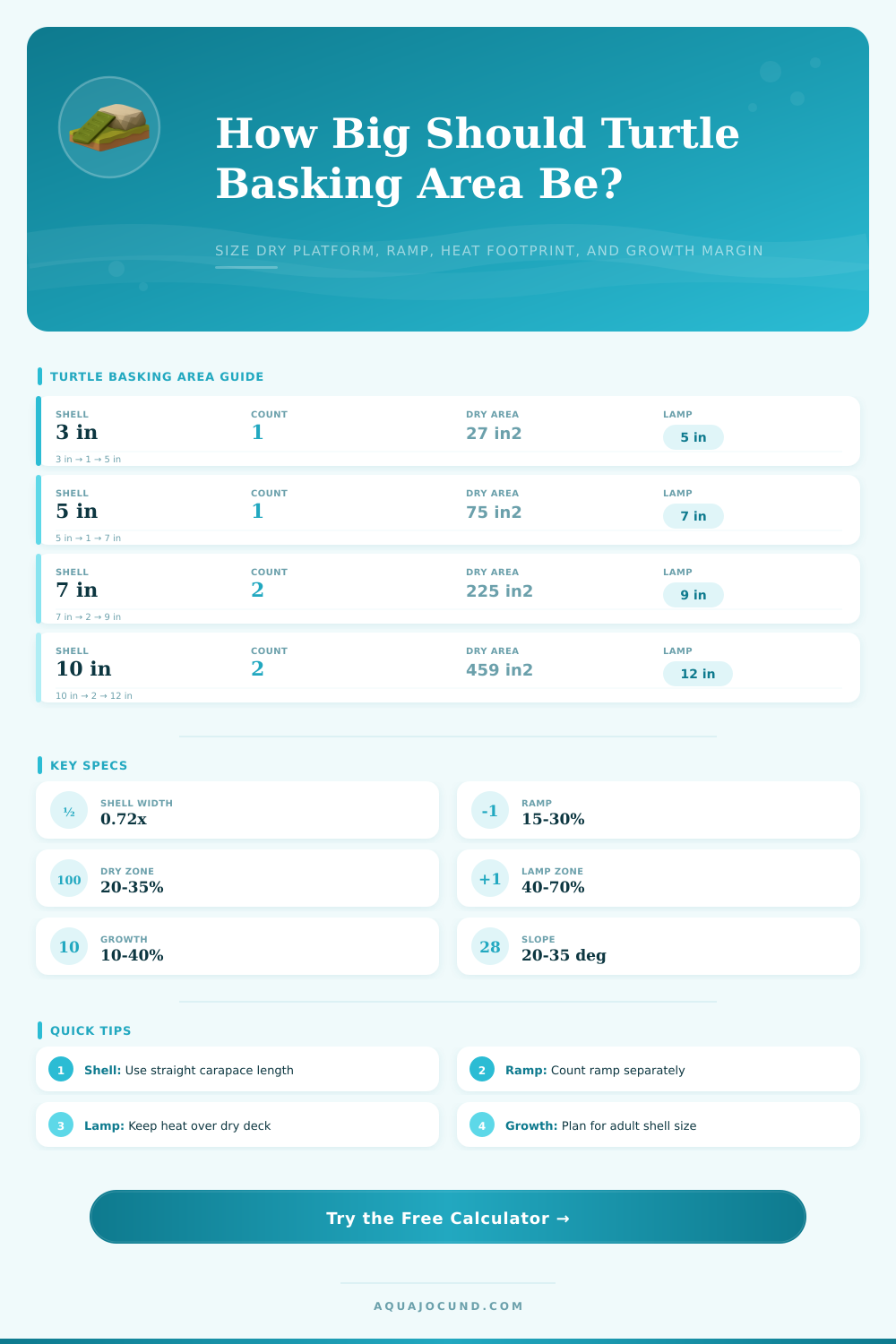
| Shell rectangle | Shell length x 0.72 shell length | Full dry body support | Basic turtle footprint |
| Count pressure | Base area x turtles x crowd factor | 1.15x to 1.6x | Shared basking room |
| Ramp area | Ramp length x ramp width x dry credit | 15% to 30% of deck | Entry surface contribution |
| Dry zone share | Usable dry area / water surface | 20% to 35% | Surface footprint balance |
| Heat footprint | Pi x radius squared | 40% to 70% of dry deck | Warm zone coverage |
Even if you buy all the heaters and filters available in the marketplace, you’ll still be doing it wrong if you overlook the dry land. Turtles bask on warm surfaces to maintain their body temperature and dry their shell to prevent rotting. Most new keeper take a shortcut here because they think a little rock or a floating dock will suffice. Before you know it, you notice your turtle’s shell has changed color or your turtle seem sluggish. That’s when you realize the mistake.
The formula above removes the guesswork and tells you precisely what minimum amount of dry surface your turtles require given their size and quantity. Biology meets basic geometry in the fundamental idea. One turtle requires an area approximately equal to its shell length times its shell width. Seventy-two percent of the straight line distance across the carapace is generally considered the width. From there, you have a minimal rectangle for each turtle. If you add multiple turtles, you must multiply this area again because of crowding. No turtle want another turtle on top of it, and everyone needs enough heat. To get more turtles in you either need more surface area or you need larger tanks. Automatically, the tool factors that in.
How to Choose the Right Basking Area for Your Turtle
It then divides the ramp from the main platform. Most guides consider everything including the ramp to be basking space. However, a wet ramp should not be counted as basking space but rather as an access point. That difference is important if you are trying to squeeze equipment into a cramped tank. Treat ramps separately and you’ll have a better sense of how much space can actualy be used.
Another variable often forgotten about until it’s too late is growth allowance. Turtles are juvenile animals. They grow up quickly. If you don’t allow for the adult shell size at purchase time, you’ll find yourself cramming a perfect fit platform into a cramped space within a matter of months. Enter expected adult length into the calculator and it will add an additional percentage buffer for future growth. That way you won’t have to upgrade the platform every couple of weeks which is very costly. Instead, you want something that fits now but will also work down the road.
The page has a reference table that lays all of this out clearly. It displays surface area scaling by both tank size and number of turtles. This allows you to benchmark your setup against standard sizes. The most important aspect of any output is probably how much area the heat lamp covers. If you have a giant dry platform but no heat reaching it, then what good is it? This output tells you what percentage of your deck is covered by your bulb.
If this is too small, you’ll have lots of un-used cool parts of your basking area. Turtles are temperature-regulating creatures. They will get used to where they feel comfortable (the warm spot) and won’t leave until they’re uncomfortable or overheated. So you want a gradient. You want a big lamp footprint that provides at least some warmth across the whole dry part of your tank so the turtle has options to move from hot -> cool depending on its needs.
Surprisingly, this also involves the shape of the tank. A long narrow tank has different surface constraints than a wide breeder tub or a round stock tank. The calculator accounts for those kinds of geometry differences. You’ll get a better idea if your preferred platform style really fits into the available water depth without cramping it. Heavier adults don’t like floating docks and they take up water volume. Slabs of cork bark look cool, but they are usually irregularly shaped so there is less usable flat area. Acrylic shelves that mount over the water use less inside space but need to be considered when planning lids. Each material has its trade-offs on looks, stability, and usable drying area.
Consider the pace in your tank. Don’t have your basking area be a minefield. Make it somewhere to go. Is it too small? No problem, they’ll bypass it. Too high? Who cares, they won’t get there. Wet? Well, that invites shell and bacteria problems. Not big enough? Then don’t expect them to use it often. Make the deck the proper size. Now you’ve got something that gets used regularly. It is something you can watch and appreciate every day.
That’s when you know you should of did the math right. When they extend out onto the dry deck after taking a swim, then you know that your basking area isn’t just about filling space. It’s about creating a healthy environment. Dry land does its job when you do yours and keeps your turtles warm, dry, and thriving year after year.