
They were beautiful in the store tank. They was perfect, vibrant swimmers with something to prove. Now you’re home. They’ve been adjusted properley and plopped into your main display. Fast forward three days. One of them is no longer the beautifull fish you bought. It’s in a corner hiding, gasping for breath. Sound familiar? This happen to aquarium hobbyists almost every day.
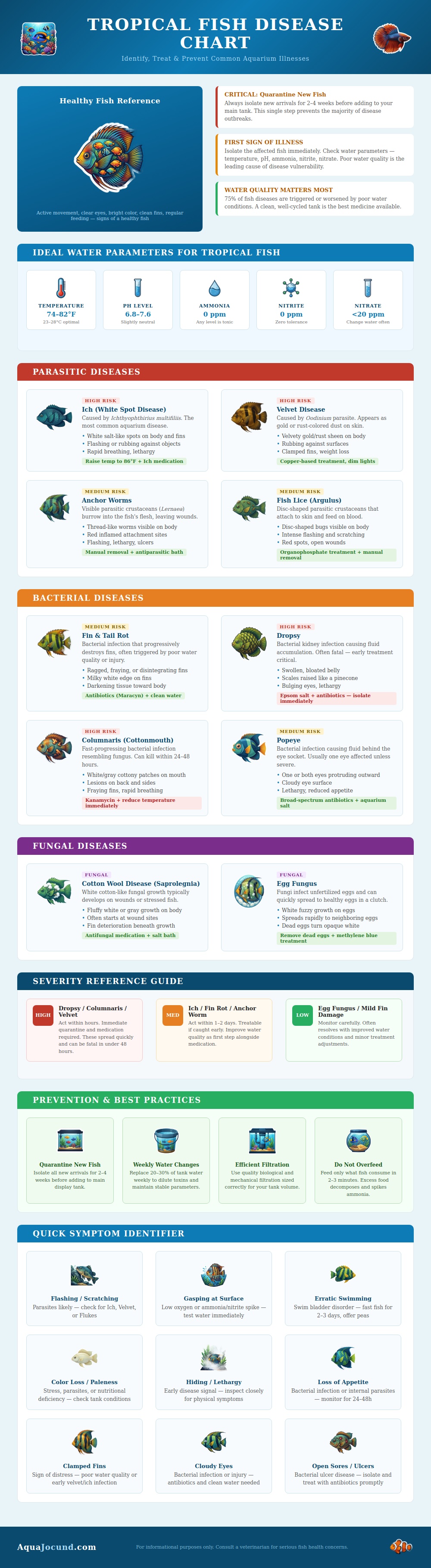
Why? While we spend a lot of time marveling at the beauty of the fish, we don’t spend enough time considering the invisible but very real chemistry that keeps them alive. The graphic above break down exactly what is going on and what to do about it before your new purchase becomes another statistic.
How to Keep Your Fish Healthy
The second fallacy is treating disease like an outside invader instead of a breakdown of your tank’s environment. In most cases, those nasty bugs didn’t arrive via some airborne superbug. Stress triggers most outbreaks, and stress almost invariably results from poor water quality. This chart illustrate that nearly 3/4 of all fish diseases result either directly or indirectly from poor water quality. That’s a shocking statistic, but it should of make sense when you consider what an aquarium is. It is a closed loop with no river to wash away your waste.
Each time they breathe, each time they shed scales, each time they eat a bite of food, they add chemical burden to your closed loop. If you fail to manage that burden, their immune systems breaks down. Why else would the first sign of illness be so often something other than a fungus or a spot? It’s behavior change. They may lose their appetite, become lethargic, or clamp their fins. Your fish will tell you that something is wrong before anything becomes visible.
The best thing you can do (and the thing most people skip) is quarantine. You are taking a gamble by putting new fish directly in your existing tank and risking everything you currently have. Quarantining new fish for 2-4 weeks gives you time to identify and treat any potential bacteria and parasites that may not be visible without exposing your current set-up. This step prevents outbreaks from occurring and is why the infographic repeats it over and over. Yes, quarantine sucks. But having to set up a little hospital tank for a few weeks are much less inconvenient than wiping out an entire tank of fish. Consider quarantine to be insurance. It is insurance that actualy pays out.
Distinguishing between parasitic diseases (e.g., Ich and Velvet) and bacterial/fungal diseases (e.g., Columnaris/Dropsy) is huge, as the remedies tend to be polar opposites. Raising water temps accelerates parasite’s life cycle, making it easier to treat. On the other hand, lowering the water temp slows down bacteria and may require antibiotics. Increasing oxygen demand while also accelerating bacterial growth will only serve to kill the fish quicker if they has a bacterial infection. This clear separation of the two types visually helps you avoid guessing blind.
If the fish is flashing and has white spots, chances are high that it’s parasitic. If its fin(s) look frayed or cottony, then it’s likely fungal/bacterial based off how it looks. Knowing this saves lives and time. It sounds boring but prevention is still cheaper than cure. Regular water changes (e.g., 20-30% weekly) reduce nitrate accumulation, a toxin that poisons fish gradually over time. Quality filtration help remove particulate matter before it breaks down and turns to ammonia. Don’t feed more than the amount your fish will consume within a couple of minutes. Anything left uneaten will rot in substrate.
The above actions are easy enough to do but because they’re so easy to forget about, we let our guard down until an issue occurs. Consistent care create a safety net of sorts for when something goes wrong; no medication can create this cushion. All in all, health for your tropical fish has far less to do with knowing how to dose drugs than it does having respect for the environment they live in. If you provide stable parameters in a clean tank then your fish is going to be robust against the pathogens that try to take hold and cause disease.
So when your fish have clear eyes, bright colors and they move around actively, realize that’s not simply because they’re attractive. That’s proof that your system is functioning properly. Pay attention to your fish, isolate newcomers, and maintain a clean tank. The fish will let you know something’s amiss well ahead of time, and it won’t be too late.
